According to the data from China Mobile Robot Industry Alliance (CMRA) and the statistics of New Strategy Mobile Robot Industry Research Institute (NSRI), the sales volume of unmanned forklifts in China was 32,000 in 2025, representing a year-on-year growth of 30.61%, maintaining a relatively rapid growth rate. Thanks to the increase in labor costs, the acceleration of factory automation transformation, the maturity of navigation technology and the cost reduction of core components, unmanned forklifts have become standard equipment in manufacturing, warehousing, new energy, pharmaceuticals, cold chain and other scenarios, and the market penetration rate continues to rise.
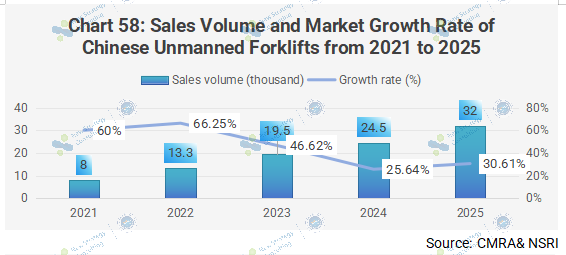
Chart 58 shows that 1. Sub-sectors show strong growth momentum. The unmanned forklift directly competes with the traditional industrial forklift market, with a vast potential for substitution. It is a necessary product for automated logistics scenarios. 2. Dual-driven by technology and scenarios. The improvement of technology maturity has enabled unmanned forklifts to be more suitable for complex warehouse and production line scenarios. At the same time, the demand for upgrading e-commerce logistics and manufacturing production lines is continuously driving the expansion of the market. 3. The competitive pattern is gradually becoming clearer. The slowdown in growth rate indicates an increase in industry barriers. Manufacturers with core navigation technologies, scene customization capabilities and service systems will gradually gain the upper hand, while the survival space for small and medium-sized enterprises will be compressed.
Here are major suppliers in the Chinese unmanned forklift market in 2025, including Hikrobot, EP Equipment, Heli EFORK, HCGZ Intelligence, TUSKROBOTS, SEER, LGIM, AiTEN, HRG, Multiway Robotics, SIASUN, Gen-song and AGV.
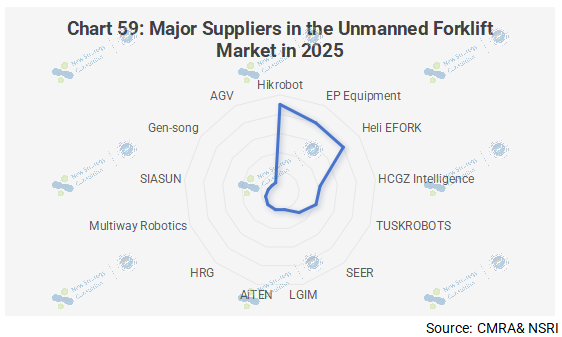
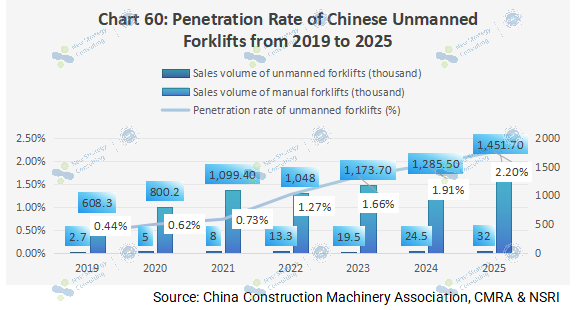
Chart 60 shows that from 2019 to 2025, the sales volume of unmanned forklifts in Chinese market increased from 2,700 to 32,000, growing by more than 11 times in 7 years. The penetration rate rose from 0.44% in 2019 to 2.20% in 2025, increasing by 5 times in 7 years. Moreover, the growth rate became steeper year by year, indicating that the process of unmanned substitution is accelerating. The sales volume of manual forklifts have increased by 138.6% over the past 7 years, indicating that the traditional forklift market is still expanding steadily. The basic handling demands in industries such as logistics and manufacturing remain strong. The growth of manual forklifts provides a vast alternative space for unmanned forklifts: even if the penetration rate increases by only 1 percentage point, the corresponding new sales of unmanned forklifts would exceed 14,000, and the market potential is enormous.
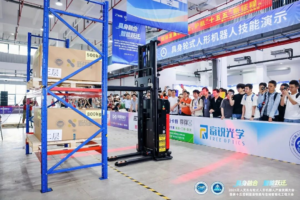
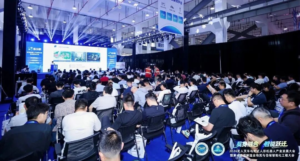
The Second Global Unmanned Forklift Application Scenario Competition & the Material Handling and Sorting Challenge for Embodied Wheeled Humanoid Robots 2026 will be held by CMRA in Nantong Jiangsu from May 21-22, 2026. Building upon the existing unmanned forklift category, this event will introduce a wheeled humanoid robot track for the first time, addressing the industry’s practical needs for embodied intelligence implementation scenarios and further bridging technological innovation with industrial applications.