During July 13 and 14, MINIEYE made two pivotal strategic moves in quick succession.
First, the company signed a formal strategic agreement with DiDi Cargo (a subsidiary of DiDi), announcing the full integration of its “Bamboo” series L4 “True Map-free” RoboVans into DiDi’s open dispatch network for “point-to-point” local freight. Immediately following this, it formed a tripartite collaboration with DiDi Cargo and the Foshan Chancheng City Infrastructure Development and Construction Co., Ltd.; beyond merely securing internet traffic and commercial orders, this move simultaneously locked in local urban road access rights and infrastructure support.
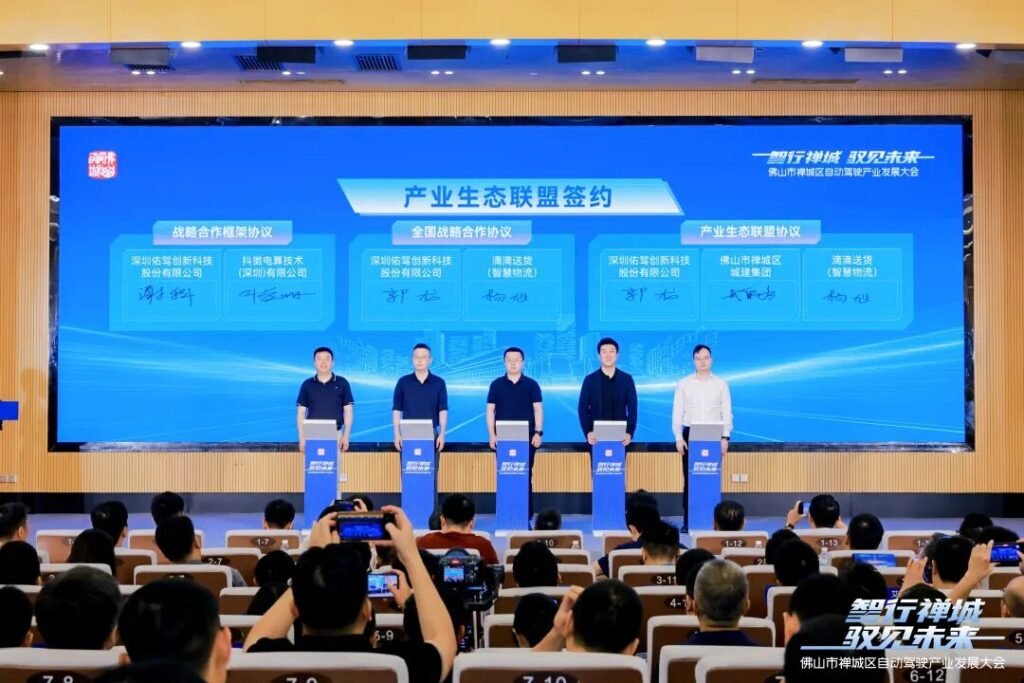
This was not merely a simple commercial contract; rather, it represented a substantive strategic alignment between a leading traffic platform and “map-free” autonomous transport capacity occurring as the autonomous vehicle industry moves beyond the technology validation phase and into the complex, open-road scenarios of urban logistics distribution.
DiDi Cargo’s ambition for 100 cities: The challenge of non-standardized, ad-hoc orders
To grasp the true significance of the partnership between MINIEYE and DiDi Cargo, one cannot simply focus on the agreement itself, but needs to first understand the collective trajectory of domestic local freight platforms regarding autonomous driving initiatives, as well as DiDi Cargo’s specific position within that landscape.
Over the past few years, the deployment of autonomous driving in logistics has followed a typical “easy-to-hard” progression. Early breakthroughs were concentrated in closed industrial parks, ports, or the “last mile” of express delivery. These scenarios, characterized by either restricted access and minimal environmental variables, or very low speeds and simple interactions, served as ideal incubators for technology validation.
Subsequently, e-commerce logistics systems like Cainiao and JD.com began introducing autonomous vehicles to fixed-route transport such as “warehouse-to-warehouse” or “warehouse-to-station” operations. While these scenarios involved public roads, they remained essentially “planned logistics”: routes were relatively fixed, delivery times were controllable, and high-precision maps required only a single survey to remain valid for extended periods. This represented a “semi-open” comfort zone.
However, the true heartland of local freight lies not in these highly standardized fixed routes, but in the immediate, random, and non-standardized ad-hoc orders scattered throughout the city. This is the core reason why, despite the industry’s years of clamoring for “driverless” operations, true city-wide, stochastic dispatching on open roads has never quite succeeded: autonomous vehicles used to be largely “confined” to preset routes. Once they strayed from high-definition maps, facing obstacles like street vendors in old districts, complex pedestrian flows during rush hours, or unpredictable, non-preset paths, they often struggled to move at all.
It is against this backdrop that DiDi Cargo’s entry appears particularly unconventional and strikingly bold.
As a freight platform born from a ride-hailing parent company, DiDi Cargo inherited not the “planned” DNA of e-commerce logistics, but rather an “any-point-to-any-point” logic of immediate response. Its core capacity pool consists of “on-demand, stochastic, and non-standardized” ad-hoc orders, characterized by small batches, high frequency, and city-wide open-road dispatching between arbitrary locations. This fundamental shift in order characteristics thrusts autonomous vehicles from the relatively simple task of “patrolling fixed routes” into the complex arena of “dynamic, city-wide navigation and interaction.” This demands an exponential leap in capabilities regarding dynamic path planning, real-time decision-making amidst complex traffic, and adaptability to unstructured environments.
An even deeper challenge lies in the hybrid human-machine dispatching mechanism. DiDi Cargo possesses a mature intelligent dispatch engine and a vast existing pool of human drivers, enabling “mixed dispatching” that combines manned and unmanned vehicles such as deploying autonomous vehicles to handle transport needs during the night or for orders with less urgent delivery windows, thereby smoothing out demand troughs. Such hybrid dispatching demands far more from autonomous vehicles than mere mobility, they must demonstrate exceptional “plug-and-play” capability, dynamic decision-making, and system compatibility. Otherwise, integration into the system would simply drag down the matching efficiency of the entire platform. Looking at existing industry attempts at automation, traditional high-definition (HD) mapping solutions prove largely ineffective for a model like DiDi Cargo. Deploying in a single city requires weeks of advance data collection and mapping at great cost; furthermore, the pace of minor urban changes such as temporary roadworks, shop relocations, and traffic restrictions far outstrips the map data collection and update cycles. This leaves vehicles prone to stalling when encountering unexpected road conditions, making it impossible to support the platform-level, high-concurrency, random dispatching required, or to sustain the ambition of rapid, nationwide scaling.
Therefore, while DiDi Cargo pilots in cities like Qingdao and Weifang have validated the cost-reduction potential of autonomous vehicles, scaling this model to hundreds of cities requires shedding the “mapping burden,”, which creates a critical demand for “map-free” solutions, lightweight systems, and the ability to rapidly deploy operational capacity.
Threading the needle: How does “True Map-free” technology precisely handle complex urban delivery?
In recent years, the industry has recognized the need to break free from reliance on HD maps and has actively explored technologies and implementation paths to achieve this. As of 2026, numerous companies have launched “map-free” products or technical architectures, turning the move away from maps into a major industry trend.
Amidst this landscape dominated by “map-free” narratives, why was MINIEYE the one to successfully tackle this challenge?
The answer lies not in a presentation deck, but in the specific operational pain points of DiDi’s local freight business. Working backward from these needs reveals the inevitable logic behind this partnership.
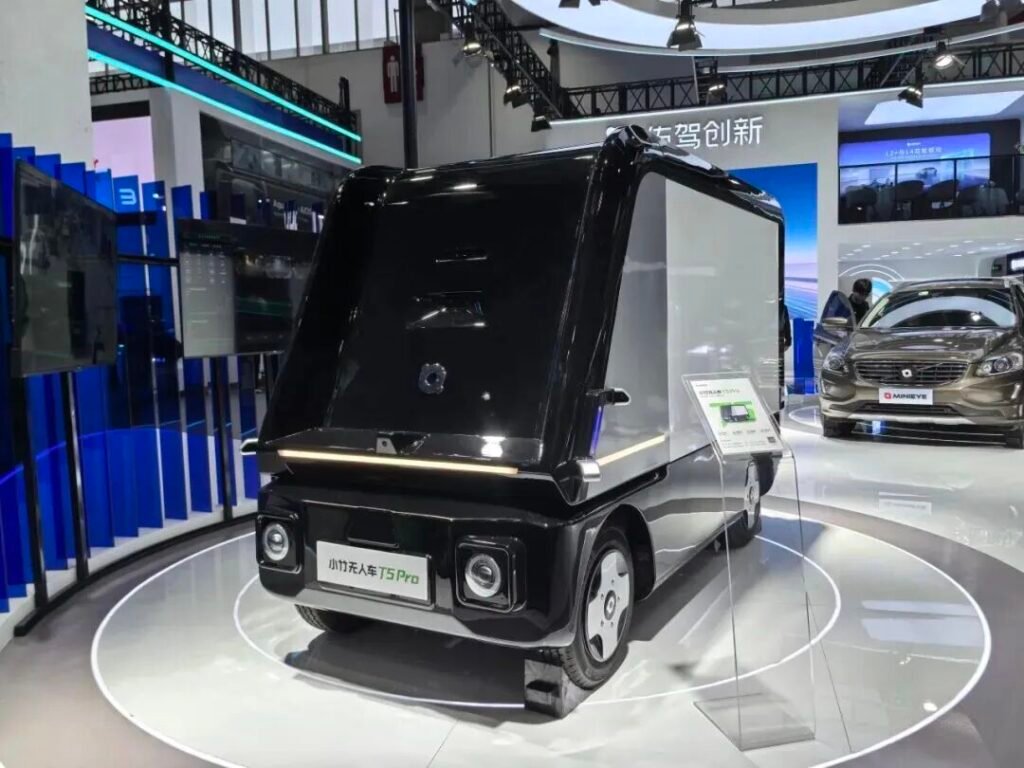
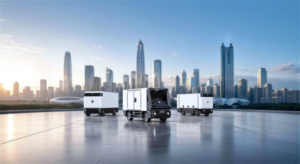
Under the agreement, MINIEYE serves as the technology and capacity provider, supplying compliant, mass-produced L4 RoboVans (the “Bamboo” series) and a complete autonomous driving software system. The company is responsible for ensuring vehicles meet national standards for intelligent connected vehicles and local regulatory requirements for demonstration operations. It also provides full-lifecycle technical support, including vehicle warranties, routine OTA updates, offline maintenance, and remote safety operator intervention, while continuously iterating autonomous driving algorithms to adapt to complex scenarios such as open urban roads, industrial parks, and shopping districts.
To address the bottleneck caused by HD maps, MINIEYE has introduced a “True Map-free” solution capable of breaking the impasse. The “Bamboo” series features a “True Map-free” solution that relies on multi-sensor fusion and end-to-end large models, enabling vehicles to construct local semantic maps in real-time and completely eliminating the need for pre-built high-definition maps. Furthermore, the deployment cycle has been slashed from weeks to hours, allowing the system to seamlessly adapt to DiDi’s open-road scenarios which span multiple cities and feature unstructured environments and frequent changes, thereby truly realizing the capability to “drive anywhere.” This “plug-and-play” capability for city-wide generalization is precisely what is needed to support DiDi’s ambitious vision for handling the city-wide, random, and scattered delivery orders that characterize its logistics operations.
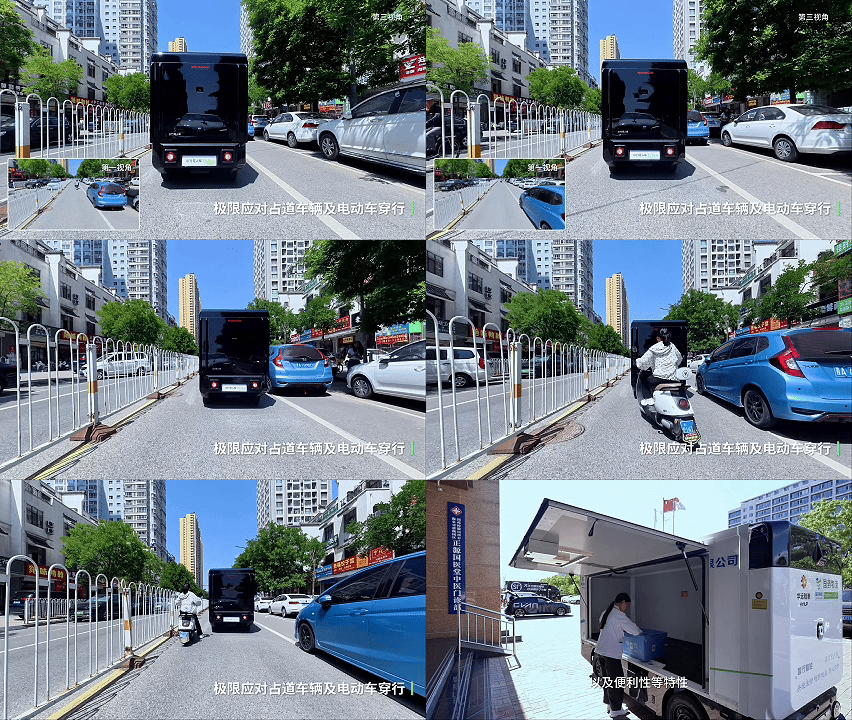
Secondly, the agreement outlines how DiDi Cargo will leverage traffic from its local freight platform and its mature intelligent dispatch system. By opening order entry points via its app and mini-programs, it establishes a closed-loop process for unmanned delivery, covering everything from one-click ordering and intelligent dispatch to fulfillment tracking, user notifications, and settlement. It will continuously channel stable last-mile delivery orders into the system, enhancing overall fulfillment efficiency through a hybrid human-machine dispatch model. This means the autonomous vehicles will not operate as isolated islands but will be integrated into DiDi’s established logistics network.
To address the challenges of coordinating hybrid human-machine dispatch and overcoming bottlenecks in order fulfillment efficiency, MINIEYE demonstrates the millisecond-level responsiveness and resilience of its full-stack system. Its AI engine, sharing the same architecture across L2 and L4 passenger vehicle applications, feeds large-scale mass-production data back into the handling of “long-tail” scenarios in urban delivery, creating a “technology-order-data” flywheel effect. This enables continuous algorithmic iteration, allowing the system to increasingly match the capabilities of human drivers in complex urban delivery environments. Such reliable system compatibility, ensuring smooth operations without bottlenecks, is the key to sustaining the efficiency of hybrid dispatch operations.
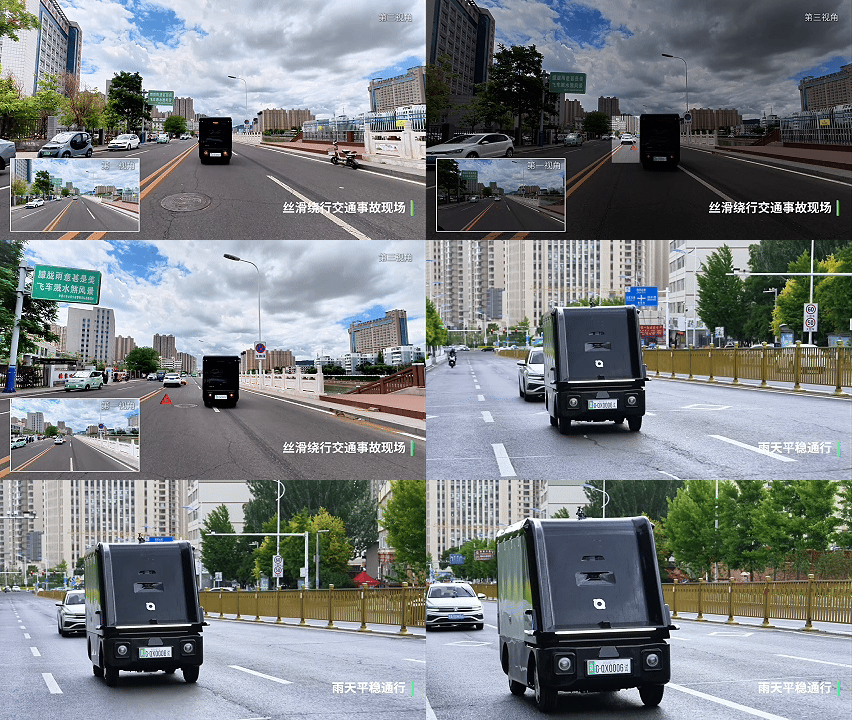
The agreement also clarifies the commercial vision for the partnership: the two parties will jointly deliver a one-stop solution, creating replicable benchmark models across multiple cities nationwide, which requires the partners to possess comprehensive, closed-loop capabilities spanning everything from technology development to manufacturing.
To address the platform’s need for large-scale vehicle deployment, MINIEYE leverages its automotive-grade R&D capabilities and mature passenger vehicle supply chains to ensure quality and consistency at the source of manufacturing. Furthermore, its map-free solution eliminates the massive costs associated with map licensing and updates. Combined with economies of scale that dilute BOM costs and standardized operations that reduce management overhead, MINIEYE effectively meets DiDi’s dual requirements for optimized full-lifecycle TCO and consistent mass delivery, transforming driverless vehicles into truly profitable, standardized production tools.
This proposition holds irresistible appeal for DiDi, a company seeking to replicate its business model rapidly and cost-effectively.
With the platform and technology in place, a “proving ground” was still needed to validate the commercial value, which is precisely the significance of this tripartite alliance. If the partnership between MINIEYE and DiDi represents a market-driven synergy of “technology plus traffic,” then the involvement of Chancheng District, Foshan provides the crucial “institutional piece” for this commercialization experiment. This “government-facilitated, enterprise-led” model not only resolves the awkward dilemma of having vehicles but no roads to run them on, but also elevates driverless vehicles from mere commercial pilots to integral components of urban smart logistics infrastructure.
Looking further, MINIEYE Innovation demonstrates a sophisticated capacity for “government-enterprise collaboration.” By deeply integrating automotive-grade transport capacity, platform traffic, and local infrastructure, the three parties have constructed a rapidly replicable “iron triangle” model. Once successfully proven in Foshan, this will mark a pivotal leap from technical validation to the export of standardized solutions.
The second half begins, where is the new critical juncture?
For a long time, the market has habitually focused on the “last-mile” delivery segment for driverless logistics, recognizing the vast market potential in this area.
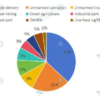
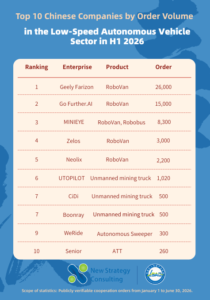
The data from Chinese Low-speed Autonomous Driving Industry Development Report 2026 indicates that nearly 55% of new RoboVans deployed in 2025 were allocated to express delivery scenarios, confirming that last-mile delivery remains the core application area. However, this proportion has declined significantly compared to previous years, as new transport capacity shifts on a large scale toward same-city instant delivery sectors such as wholesale and retail, food and beverage, and pharmaceuticals. Industry forecasts suggest that the growth potential of the local instant delivery sector will surpass that of traditional last-mile express delivery.
Moreover, local instant delivery serves as the ultimate proving ground for autonomous vehicles, characterized by extreme complexity, high unpredictability, and tightly coupled scheduling requirements. Continued growth in this sector marks a pivotal step toward the large-scale commercial deployment of the autonomous delivery industry.
Viewed in this light, MINIEYE’s strategic entry into this high-barrier “blue ocean” market represents far more than a simple business extension, but a strategic expansion of its own capabilities. Once the technical solution proves effective in such demanding scenarios, it demonstrates that the algorithms possess genuine city-level generalization capabilities, capable of seamlessly handling highly unpredictable, non-standard, ad-hoc orders while efficiently managing scheduled, fixed-route operations. This is akin to securing the most valuable hub in the logistics landscape; the resulting downward-compatible potential is sufficient to unlock a growth market far broader than that of standard last-mile delivery alone.
This move also provides the most compelling commercial validation for “map-free” solutions, which have hitherto remained at the stage of operational demonstrations and lacked verification in large-scale, highly complex commercial scenarios. As map-free technology continues to evolve and operational scales expand, autonomous vehicles will gradually become a fundamental component of local delivery fleets, accelerating the transition of the “layered capacity network” concept into reality.
In the long run, MINIEYE’s series of strategic moves undoubtedly establishes a new benchmark for industry competition. As the competitive focus shifts from isolated deployment capabilities to comprehensive, fleet-wide service capabilities, vendors possessing the trifecta of “full-stack technology, mass production capabilities, and map-free solutions” are likely to gain the upper hand in the next phase of the autonomous delivery race. MINIEYE’s strategic maneuvers are destined to become a decisive factor in reshaping the competitive landscape of this mid-game phase.
The 6th Low-Speed Autonomous Driving Scenario Ecosystem Co-construction and Expansion Conference 2026, hosted by the Low-Speed Automated Driving Industry Alliance (LSAD) and organized by Jinglv Environment, will take place in Hefei from July 23 to 24.
The conference aims to establish a platform for in-depth dialogue between the capital and industrial sectors. By dissecting the commercial logic of mining applications and seeking the “greatest common denominator” for multi-scenario deployment, the event seeks to provide key insights for the high-quality development of the low-speed autonomous driving industry in the post-IPO era.