According to incomplete statistics from the Humanoid Robot Scene Application Alliance (HRAA), more than 91 new humanoid robots were released globally in the first half of 2026, representing a year-on-year increase of approximately 23%.
New Product Launches Continue to Rise, with a Surge in June
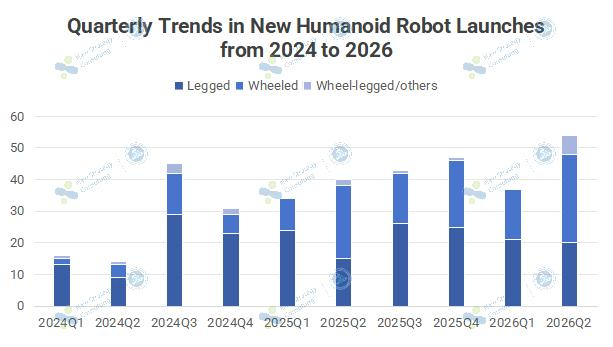
Quarterly trends show that the number of new models in the second quarter of 2026 increased by about 46% compared to the first quarter, accounting for nearly 60% of the total releases for the half-year; the pace of new product launches in the industry has clearly accelerated.
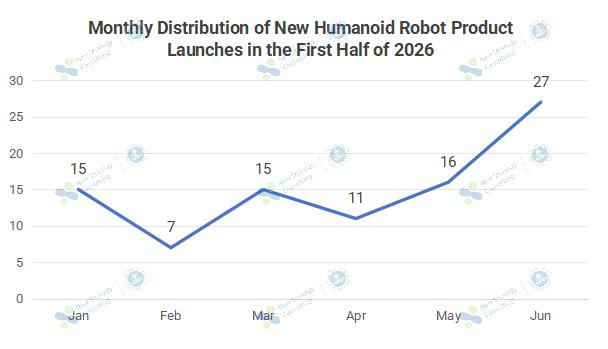
The monthly distribution followed a pattern of starting low and ending high. Fifteen models were released in January, dropping to seven in February before rebounding to fifteen in March. Entering the second quarter, numbers grew in April and May, culminating in a surge of 27 releases in June, accounting for nearly 30% of the half-year total and half of the second quarter’s new models.
For comparison, approximately 74 new humanoid robots were released globally in the first half of 2025; the figure for the same period in 2026 represents a 23% increase. Compared to the first half of 2024, the number has roughly tripled. Innovation in complete humanoid robot units remains in an expansion phase, though the rate of growth is gradually stabilizing.
China Accounts for Nearly 80%, Emerging as the Primary Source of New Models
In terms of geographic distribution, China released 71 new humanoid robots in the first half of 2026, accounting for approximately 78% of the global total. The United States released 12 models (about 13%), while other countries and regions combined released 8 models.
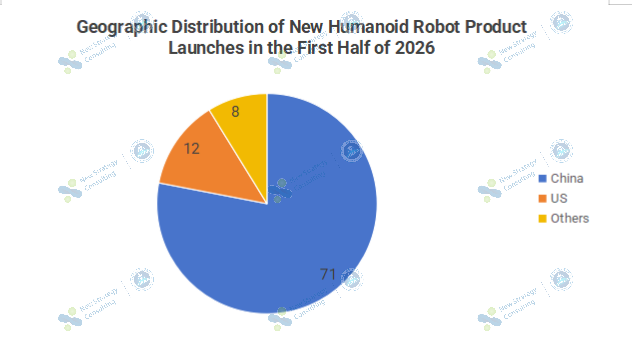
China has become the market with the highest density of new humanoid robot releases. A growing number of manufacturers, a relatively complete supply chain, and sustained demand across sectors such as research and education, data collection, and industrial manufacturing have collectively driven rapid product iteration.
However, a high volume of releases merely reflects industry activity. As the number of new models continues to rise, the focus of competition will gradually shift from release speed to actual delivery, operational stability, and capabilities regarding scenario-based validation.
Wheeled Models Overtake Bipedal Ones, and Product Pathways Increasingly Diverge
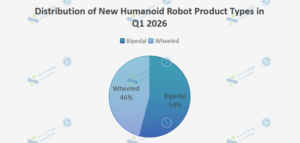
Regarding locomotion methods, the first half of the year saw the release of 41 bipedal robots (approx. 45%), 44 wheeled robots (approx. 48%), and 6 models featuring wheel-leg hybrids or other configurations (approx. 7%).
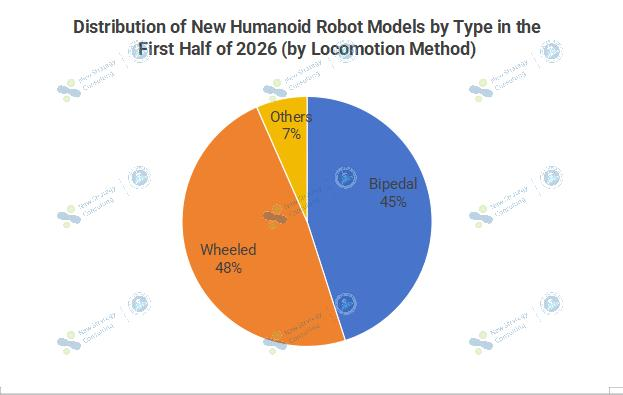
This marks the first time that the number of new wheeled robots has surpassed that of bipedal robots within a six-month period. Notably, 28 new wheeled models were released in the second quarter, significantly outnumbering bipedal products, while the number of wheeled-legged and other hybrid configurations also began to rise.
A review of quarterly trends over the past two years reveals that while bipedal robotics remains a key technological pathway, its absolute dominance is narrowing. Wheeled robots are garnering increased attention in flat-terrain environments, such as factories, warehouses, commercial service settings, and data collection sites, thanks to their mobility stability, long battery life, high load capacity, and relatively manageable deployment costs.
The rapid proliferation of wheeled products is closely linked to practical demands during the commercialization phase. In flat environments like factories, warehouses, showrooms, and shopping malls, wheeled chassis offer superior mobility efficiency and stability, while also making it easier to balance battery life, payload, and cost. For tasks such as loading and unloading, picking and transport, inspection, guiding, and mobile manipulation, the combination of dual arms and a wheeled chassis can already meet a significant portion of operational needs.
The bipedal approach still holds a higher ceiling for general-purpose capability. Navigating steps, narrow corridors, and complex terrain as well as interacting with facilities designed around human dimensions still requires mobility structures that mimic the human form. However, at the current stage, enterprises are increasingly prioritizing effective uptime and task completion rates, thereby creating more market space for wheeled robotic solutions.
Prices Continue to Drop, Leading to a Multi-tiered Product Market
As the number of new products grows, the pricing structure for humanoid robots is also rapidly stratifying.
The first category consists of compact products aimed at universities, developers, and the exhibition market. These robots typically achieve lower price points by reducing physical size, simplifying degrees of freedom, and scaling back hardware specifications, all to expand the developer and user base.
The second category comprises mid-range products designed for data collection, scientific research, and light-duty services, striking a balance between cost, openness, and operational capability.
The third category includes high-performance products intended for industrial manufacturing and complex tasks. These robots require higher payloads, greater precision, more powerful computing capabilities, and robust safety systems; consequently, their prices are expected to remain high in the near term.
Therefore, it is unlikely that a single pricing standard will emerge in the humanoid robot market. Future price competition will center largely on product positioning: low-cost products will drive market expansion, while high-end products must demonstrate their value through enhanced efficiency and sustained operational capabilities.
Application Scenarios Are Beginning to Define Product Form Factors
Trends from the first half of the year indicate that an increasing number of robots are being designed around specific tasks; the standardized “general-purpose humanoid” form factor is being diversified to suit different scenarios.
In industrial settings, enterprises prioritize dual-arm payload capacity, operational precision, vertical lift range, and continuous runtime. In warehousing and logistics, mobility efficiency, grasping range, and navigation capabilities take precedence. In research and education, open interfaces, secondary development capabilities, and data acquisition functions serve as core metrics.
Scenario-specific demands are also driving the emergence of wheeled and hybrid configurations. For tasks that do not require traversing steps or complex terrain, companies are moving away from a fixation on bipedal forms, opting instead for more stable and cost-effective mobility solutions.
This signifies a shift in humanoid robot development: moving from the “build the hardware first, then find a use case” approach to one where task requirements dictate size, configuration, and specifications.
Technological Competition Shifts from Locomotion to System-Level Capabilities
In the past, new humanoid robots primarily showcased locomotion capabilities such as walking, running, and jumping. As of 2026, the technological race has shifted toward the synergy between manipulation and system-level operations.
First, there is heightened focus on dual-arm collaboration, grasping success rates, operational precision, and task continuity. Robots must simultaneously handle mobility, perception, and manipulation; isolated locomotion metrics no longer suffice to represent the robot’s overall performance.
Second, the trend toward hardware modularity has intensified. Various dexterous hands, grippers, sensors, computing platforms, and lifting mechanisms can be combined based on the specific scenario, allowing a single robot platform to handle a wider range of tasks.
Third, embodied AI models and data closed-loop systems are increasingly becoming integral parts of the product. Competition among manufacturers has expanded beyond hardware design to encompass algorithms, data handling, control systems, and deployment capabilities. A robot’s ability to consistently execute real-world tasks will become the critical benchmark in the next phase of development.
The 91 new products launched in the first half of 2026 demonstrate that the humanoid robot market is expanding rapidly while undergoing distinct structural changes: China holds the largest share of supply, the number of wheeled models has surpassed that of bipedal ones, price points are diversifying, and product forms are increasingly tailored to specific scenarios. The race to launch new products continues, but the industry’s focus is shifting from “quantity of launches” to “actual functional capability.”