On November 29, the four-day 2025 Shenzhen International Artificial Intelligence Sanitation Robot Competition-cum-Application Innovation Competition successfully concluded at Shenzhen University of Information Technology.
As an important measure to implement the national “Artificial Intelligence+” action and support Shenzhen’s construction as a pioneering city in artificial intelligence, the competition was jointly organized by multiple departments. With “technology-driven, global collaboration” as its core concept, it served as a “battleground” for solution technologies, a “strong magnetic field” for the industrial ecosystem, a “treasure trove” for industry innovation, and a “fast track” for result transformation through diverse pathways of “promoting research and application through competition.” The competition attracted nearly 8,000 professional participants from over 200 urban management departments and more than 500 enterprises nationwide.

The “Battleground” Yields Fruitful Results, Strengthening the Foundation for Technological Iteration
The competition focused on the practical application of AI-powered sanitation technology, featuring two stages: closed rounds and open rounds. It adopted a three-dimensional competition system encompassing “specialized competition, scenario innovation, and application innovation,” specifically testing the core operational capabilities of participating sanitation robots, the robot solution capabilities of companies for non-standardized, highly complex scenarios, and their system integration and model innovation capabilities.
Over 40 real-world urban operation scenarios were specially constructed, attracting more than 40 sanitation robot companies and over 200 intelligent devices from across the country to compete. After 115 rounds of competition, 18 technology and application awards were selected. This “real scenario, real challenge” model greatly promoted the iterative upgrading of key technologies such as perception, decision-making, and control.
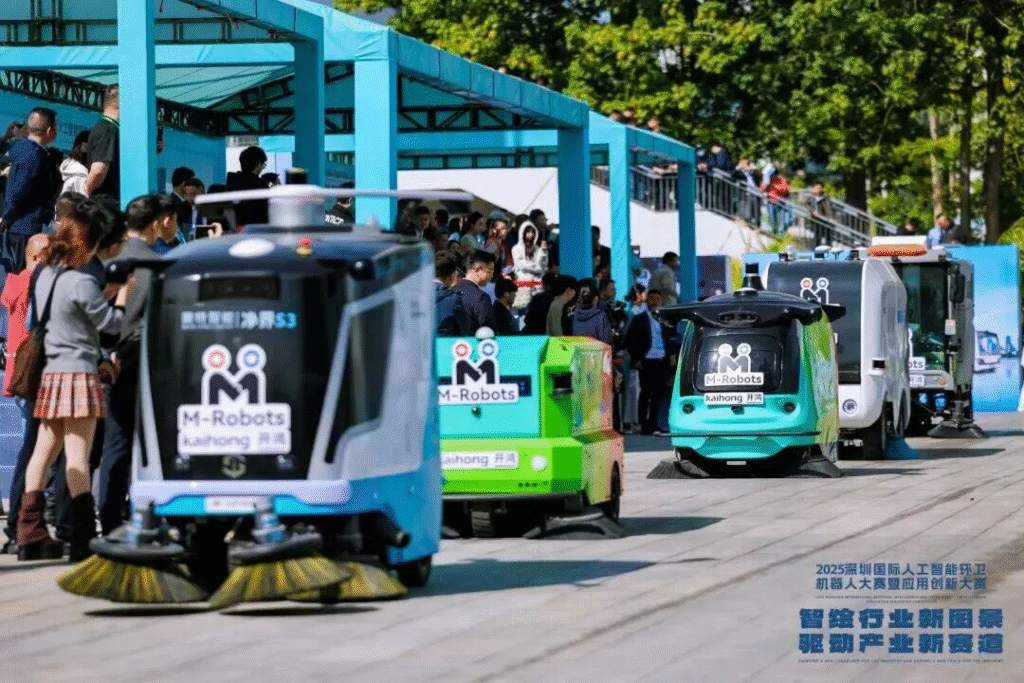
Furthermore, the competition showed a significant trend of category expansion, no longer limited to single sweeping robots, intelligent garbage sweepers, sanitation robot dogs, and other diverse equipment were showcased, forming a full-chain product matrix covering “sweeping-transfer-refined operations,” marking a step towards intelligent sanitation from single-point operations to full-area collaboration.
The “Strong Magnetic Field” Yields Results: Industry-Academia-Research-Application Synergy
Currently, Shenzhen has gathered nearly two-thirds of China’s leading sanitation robot companies, forming a complete industrial chain centered on Longgang District. Leveraging the industrial agglomeration effect of Shenzhen and Longgang District, this competition once again played a “strong magnetic field” role, attracting numerous sanitation robot companies such as INFORE ENVIRO, Cowa Robot, Saite Intelligence, New Energy, Alpheus, RoboMaster, and Jinglv Environment to participate, along with innovative teams from universities and research institutes, as well as relevant government departments and units.
Through diverse links such as closed competition, public performances, new product roadshows, and visits to demonstration sites, the competition not only provided a platform for global AI technical talents and R&D teams to showcase their strengths but also built bridges for talent exchange between universities and enterprises, and between government and enterprises, constructing a powerful industrial ecosystem encompassing technology, market, and capital. The competition further strengthened this ecological advantage, promoted the deep integration of various elements such as government, industry, academia, research, application, and capital, and laid a solid foundation for cultivating top talents for the industry’s continuous innovation and long-term development.
The “Treasure Trove” – Revitalizing the Industry: Multi-dimensional Innovation Injects Vitality
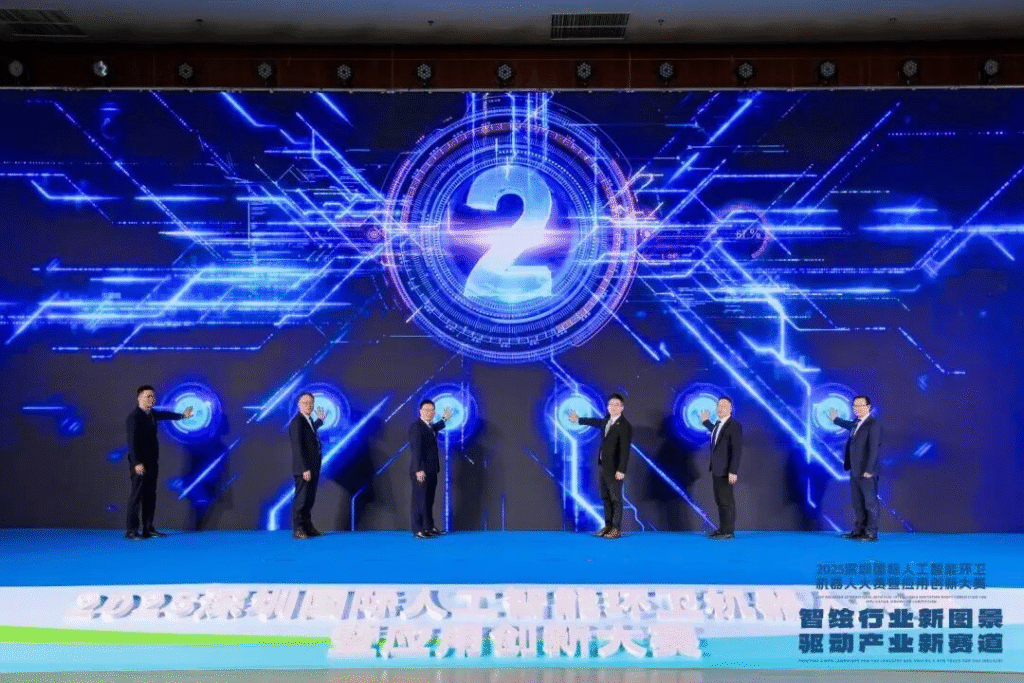
As the most authoritative, professional, and comprehensive AI sanitation robot competition platform in China, the competition fully leveraged its “treasure trove” function, becoming a window to showcase China’s latest intelligent sanitation technologies to the international community. At the opening ceremony, a stunning “Open Source HarmonyOS Formation” composed of various brands and models of AI sanitation robots made its debut. This formation, through a “Super Equipment Management Platform,” achieved seamless cross-brand and cross-device collaboration, signaling to the audience that the “future” of intelligent sanitation has arrived.
Furthermore, the first standardized operation mode for non-standard scenarios in China was established here, the first intelligent urban management system in China was launched, the AI and robot “three-in-one” platform was introduced, and the Low-Speed Automated Driving Industry Alliance (LSAD) simultaneously released its “Industry Application Status and Trend Insights.” Five companies, including Cowa Robot, Saite Intelligence, Alpheus, RoboMaster nd Jinglv Environment, launched six new sanitation robot products.
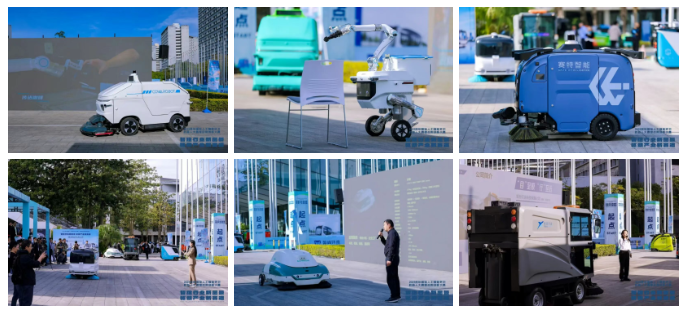
The competition comprehensively showcased China’s advanced intelligent sanitation technologies and solutions, as well as the keen industry insights and profound scenario understanding of Chinese enterprises.
The “fast track” has been further accelerated, with 300 million yuan in orders driving the competition
Adhering to a “practice-oriented” approach, the competition features multi-dimensional scenario-based challenges, allowing participating technologies to undergo on-site verification by government and enterprises, achieving precise matching between technology supply and market demand.
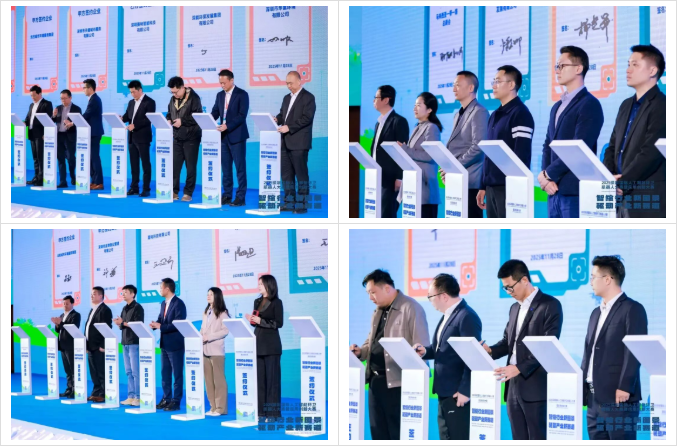
Simultaneously, leveraging the resource matching platform built by the competition, participating companies not only have priority access to government procurement needs information but also connect with diverse stakeholders such as “the Belt and Road” resources and investment and financing institutions. During the event, over 40 companies signed contracts on-site, facilitating orders for over 1,600 sanitation robots, totaling 300 million yuan.
Furthermore, through a comprehensive media matrix including central media, local media at all levels, and industry media, the innovative achievements of “AI + sanitation,” such as the open-source HarmonyOS sanitation robot collaborative operation and AI large-scale model recognition, have entered the public eye, effectively promoting the application of sanitation robots and ensuring that technological achievements truly serve refined urban governance, injecting lasting momentum into green and low-carbon urban development.
New Strategy Insights:
Overall, this competition was not only a concentrated contest of technology and strength, but also a successful practice in Shenzhen of using the competition as a link to connect the entire chain of “technology research and development—scenario verification—large-scale application—value creation.” It powerfully promoted the leapfrog development of the AI-powered sanitation industry in three dimensions: technology, talent, and application, contributing replicable “Shenzhen experience” and “Longgang model” to smart city governance nationwide.
Looking to the future, the potential market size of intelligent sanitation services in China is already close to 300 billion yuan. According to the New Strategy Low-Speed Automated Driving Industry Research Institute, by 2025, the sales of intelligent sweepers in municipal roads, parks, and scenic areas alone will reach 5,000 units. Intelligent sanitation is gradually evolving from a single tool into an indispensable dynamic data node in smart cities, and its large-scale development is a grand experiment integrating technology, business, and urban governance.
As one of the co-organizers of this competition, LSAD has always been a core driver of the intelligent sanitation ecosystem. Guided by the principles of “technological cooperation, unity and collaboration, and win-win symbiosis,” the alliance integrates resources from over 300 member units across the industry chain, establishing an efficient communication platform for government, enterprises, academia, research, and investment. Its events, such as the Intelligent Sanitation Technology Application Promotion Conference, have become important bridges for industry collaboration and result transformation.
Regarding standards development, LSAD has spearheaded the formulation of several group standards, including the Safety Specifications for Low-Speed Unmanned Sweeping Vehicles, continuously improving industry access and operational standards, and providing crucial guidance for the compliant implementation of technological innovations in the Shenzhen competition. Furthermore, industry research reports and blue books released by LSAD provide data support for industry trend analysis and technological research directions.
Li Jinke, Secretary-General of LSAD, stated, “We expect that, under the guidance of Shenzhen as a pioneering city, the industry can continue to overcome challenges such as customized needs, operation and maintenance networks, and cost control, driving the industry towards a deeper level of intelligent and networked development. LSAD will also continue to leverage its advantages in resource aggregation and ecosystem building to empower more cities to replicate the ‘Shenzhen experience’ and accelerate the implementation of new high-quality productivity.”
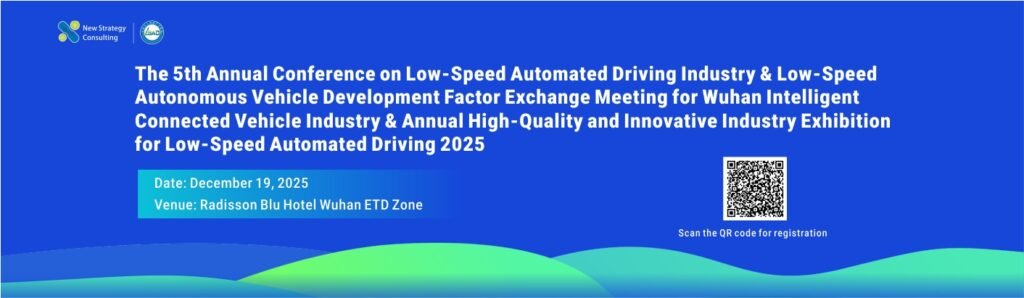
On December 19, 2025, the Low-Speed Automated Driving Industry Alliance (LASD) and Wuhan Junshan New City Technology Investment Group Co., Ltd. will jointly host the 5th Annual Conference on Low-Speed Automated Driving Industry in the National Intelligent Connected Vehicle (Wuhan) Test Demonstration Zone, bringing together representative companies and elite leaders from the entire industry chain. The Low-Speed Autonomous Vehicle Development Factor Exchange Meeting for Wuhan Intelligent Connected Vehicle Industry & Annual High-Quality and Innovative Industry Exhibition for Low-Speed Automated Driving will also be held concurrently. Stay tuned!