According to publicly available information and incomplete statistics from the New Strategy Low-Speed Automated Driving Industry Research Institute, 19 new autonomous vehicles were launched in the domestic and international markets during the first quarter of 2026, covering core application scenarios such as unmanned sanitation, unmanned delivery, and smart agriculture.
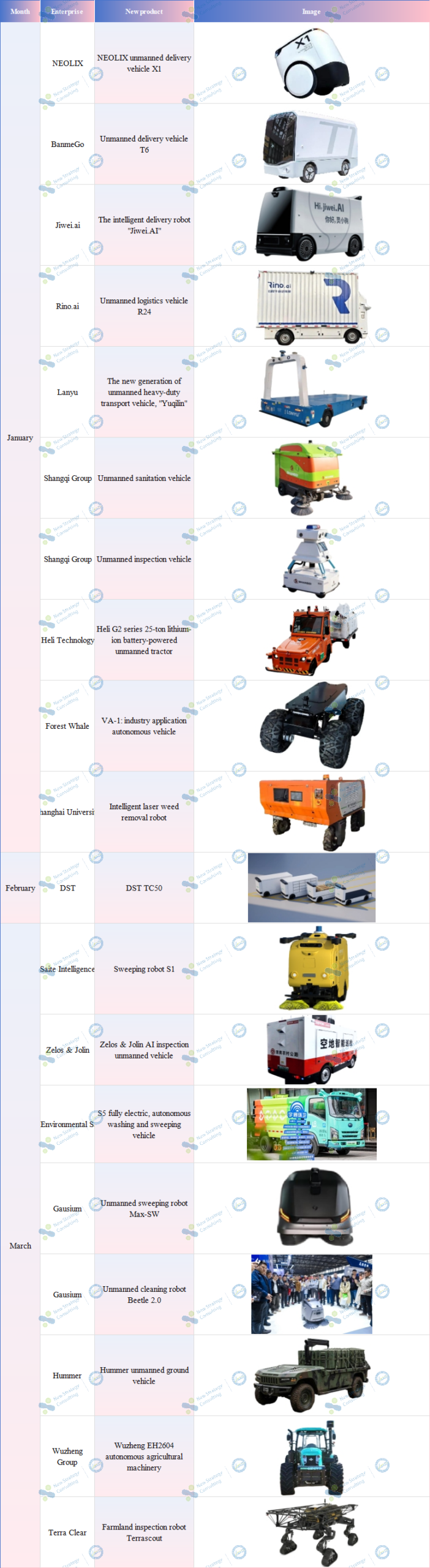
Overview of New Low-Speed Autonomous Vehicles in Q1 2026
In terms of market distribution, unmanned delivery and unmanned sanitation services remain the dominant sectors. Companies such as NEOLIX, Zelos, and Saite Intelligence have all launched new products, forming the “dual engines” driving industry growth. Smart agriculture follows closely, with three new products released, indicating an accelerated pace of agricultural intelligence. Additionally, enterprises continue to deepen their expertise in applications like unmanned inspection, industrial park logistics, and unmanned ports, while also launching products tailored to specialized needs such as firefighting and emergency response.
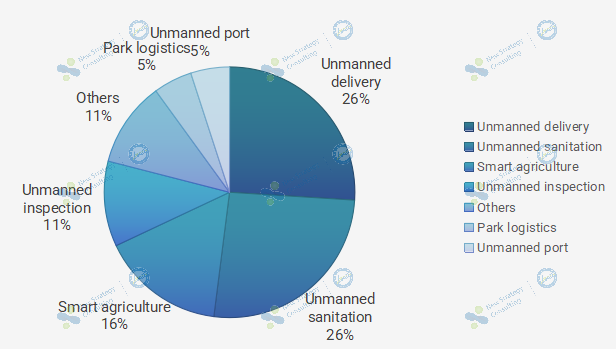
Scenario Distribution of New Low-speed Autonomous Vehicles in Q1 2026
An analysis of product categories reveals that unmanned delivery vehicles and unmanned sweeping vehicles account for the largest share, reflecting the clear market demand trends observed in the first quarter.
Among these, the unmanned delivery sector is highly competitive, with products featuring comprehensive transportation coverage and meticulous scenario-specific optimization.
For example, the X1 unmanned delivery vehicle launched by NEOLIX focuses on small parcel delivery at the last mile, emphasizing flexibility; while the R24 introduced by Rino.ai, hailed as “the industry’s first 24-cubic-meter high-capacity unmanned logistics vehicle,” directly competes with traditional 4.2-meter trucks, targeting core urban delivery scenarios such as warehouse-to-store services and short-distance branch routes. This demonstrates that technological innovation in the industry is driving the formation of a comprehensive transportation capacity ecosystem.
Furthermore, the new unmanned delivery vehicles have seen comprehensive improvements in reliability, intelligence, and cost-effectiveness. For instance, the BanmeGo T6 features a 550 TOPS computing platform, emphasizing 360-degree comprehensive perception and OTA update capabilities; the Jiwei.AI highlights its high payload capacity and 240-kilometer range; while the DST TC50 focuses on vehicle-grade safety and low maintenance costs from a commercial vehicle lifecycle management perspective.
The new unmanned sanitation product demonstrates strong capabilities in replacing manual labor and enhancing management efficiency.
On one hand, the new product demonstrates enhanced adaptability to various scenarios. The Saite Intelligence “Sweeping robot S1” features a 1.1-meter ultra-narrow passage capability and an automatic waste packaging function, effectively addressing cleaning challenges in complex areas such as backstreets and urban villages.
On the other hand, emphasis is placed on “fully automated” operations and quantifiable value. Most new products explicitly highlight metrics such as “annual labor cost savings per vehicle,” “vehicle utilization and execution rates,” and “efficiency improvements.” Such clear value propositions are becoming pivotal in driving large-scale implementation.
In addition to the several newly launched products, the first quarter also saw minor technological innovations based on existing offerings. For instance, Sweep Zero addressed pain points such as high costs, slow deployment, and limited application scenarios by introducing an upgraded 1.5-ton unmanned sweeping vehicle equipped with the innovative OCC 4D+ lightweight mapping algorithm, significantly reducing costs while expanding its application from industrial parks to public parks, auxiliary roads, and bicycle lanes.
Conclusion:
Analysis of first-quarter low-speed autonomous vehicle launches reveals three key trends:
- Deepened scenario-specific development: Companies are moving beyond generic platforms to deliver highly specialized products optimized for specific use cases, reflecting increasing product specialization.
- Value proposition shift from “technical demonstration” to “economic benefits”: Most new products explicitly highlight percentage reductions in labor costs and operational efficiency improvements, or emphasize automotive-grade reliability to lower lifecycle costs—a sign of the industry transitioning from technical validation to commercialization and large-scale adoption.
- “Data intelligence” as a core competitive advantage:New products predominantly emphasize high-performance computing platforms, dedicated AI models, and real-time data processing capabilities, indicating a shift in competitive focus from hardware alone to an integrated “hardware + data + algorithms” ecosystem.
Overall, the new products in Q1 2026 demonstrate steady progress in practical applications for low-speed autonomous driving, advancing along the path of “addressing real-world challenges and creating economic value.” Looking ahead, the emergence of leading products across various application scenarios will accelerate the industry’s entry into a phase of market consolidation and ecosystem development.