Sanitation leads at 31%, Guangdong tops the list, and year-to-date awards now exceed RMB 21.8 billion.
China’s low-speed autonomous driving sector had a record-breaking third quarter in 2026. According to the New Strategy Low-Speed Autonomous Driving Industry Research Institute, nearly 200 new contracts were awarded in Q3, with a total value of more than RMB 8 billion. More than 1,000 autonomous vehicles are expected to be deployed from these projects.
Both the number of projects and the total contract value were the highest of any quarter this year.
For the first three quarters combined, China awarded over 550 contracts worth more than RMB 21.8 billion. Q4 is usually the busiest season for government and corporate procurement, so full-year numbers are likely to go even higher.
Note: Starting this quarter, the Institute tightened its counting rules. On the commercial side, only purchases, leases, operations, and retrofitting of low-speed autonomous vehicles are included. On the research side, desktop ROS kits and non-vehicle projects are excluded.
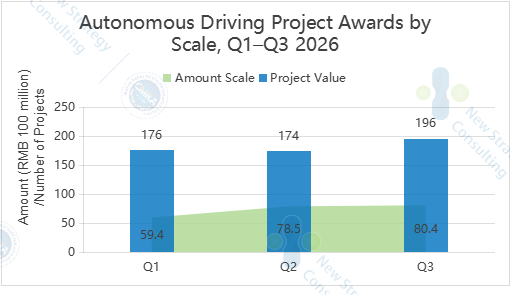
Autonomous Driving Project Awards by Scale, Q1–Q3 2026
Where the Projects Are: Guangdong Leads
Q3 projects were spread across 29 provinces and regions. Four regions had 10 or more projects: Guangdong, Jiangsu, Zhejiang, and Guangxi. Guangdong had the most, with 40 projects, and also saw the biggest increase.
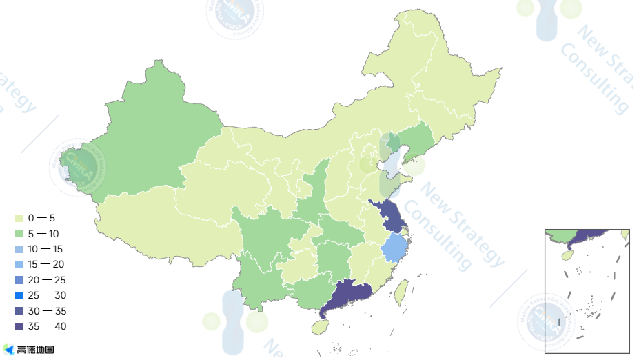
Regional Distribution of Autonomous Driving Project Awards, Q1–Q3 2026
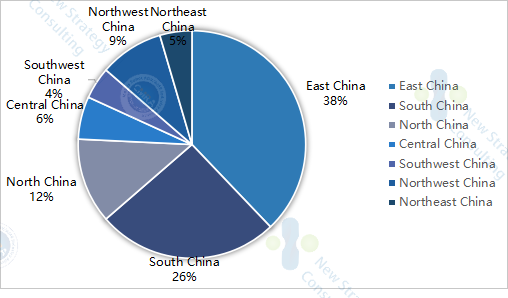
Autonomous Driving Project Awards by Region, Q1–Q3 2026
On a monthly basis:
July: 65+ projects, nearly RMB 2.5 billion
August: 61 projects, RMB 3.5 billion — the highest-value month
September: 69 projects, about RMB 2.05 billion — the most projects, but smaller average size
Small Projects Dominate, But Big Projects Bring the Money
Most contracts were small. Projects worth RMB 1 million to 10 million made up 72% of all deals. These were mainly for sanitation, education, and inspection. They are easier for smaller suppliers to win.
But the big money came from a few large contracts. Projects worth RMB 100 million or more were only 20% of the total number, but they accounted for over 95% of the total value. August is a good example: just 61 projects brought in RMB 3.5 billion, because several large orders were signed that month.
Nearly 20 projects were worth RMB 1 billion or more. Most of these were in unmanned sanitation, across East, Northeast, and South China. These projects often include vehicle purchase, operations, and management platforms together.
Sanitation Is the “Golden Track”
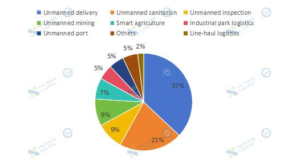
Unmanned sanitation was the largest application area, taking 31% of all Q3 projects. This matches earlier findings that billion-RMB deals are concentrated in sanitation. The sector has three advantages: strong policy support, fixed routes, and high commercial maturity.
Security patrol came second with 19%. Demand for unmanned patrols is growing quickly. Projects have already been deployed in Shanghai’s Zhangjiang Town and Guangzhou’s Guangbai Logistics Park.
Education and logistics made up the third tier. Unmanned shuttles, agriculture, mining, and ports together accounted for 13%. These areas are still small but grew fast in Q3.
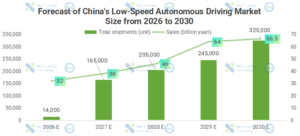
Industry forecasts predict China’s low-speed autonomous vehicle sales will reach 95,000 units in 2026, with a market size of over RMB 41 billion.
New Policies Are Helping the Market Grow
Q3’s strong performance is partly due to new policies. On July 1, 2026, China’s first national industry standard for autonomous delivery vehicles (GA/T 2388-2026) took effect. It sets rules for speed, operating hours, and allowed areas. Other groups also released safety standards for remote driving and road operations.
These rules raise the bar for quality and help larger, more compliant companies win more contracts.
What’s Next: Q4 and Global Expansion
With Q4 being the traditional peak season, 2026 is on track to set new records.
Globally, the low-speed autonomous vehicle market reached USD 3.89 billion in 2025 and is expected to hit USD 4.68 billion in 2026. China is a major driver of this growth. In the first half of 2026 alone, China awarded about RMB 13.9 billion in low-speed autonomous driving contracts. Unmanned sanitation startups also raised over RMB 700 million.
Chinese companies are also going global. Neolix got Singapore’s first unmanned freight license and Malaysia’s first L4 public road test permit. It also formed a joint venture with UAE’s Emirates Post to deploy 2,000 vehicles this year. Minieye will deliver L4 unmanned logistics vehicles to the Middle East, Australia, and Southeast Asia.
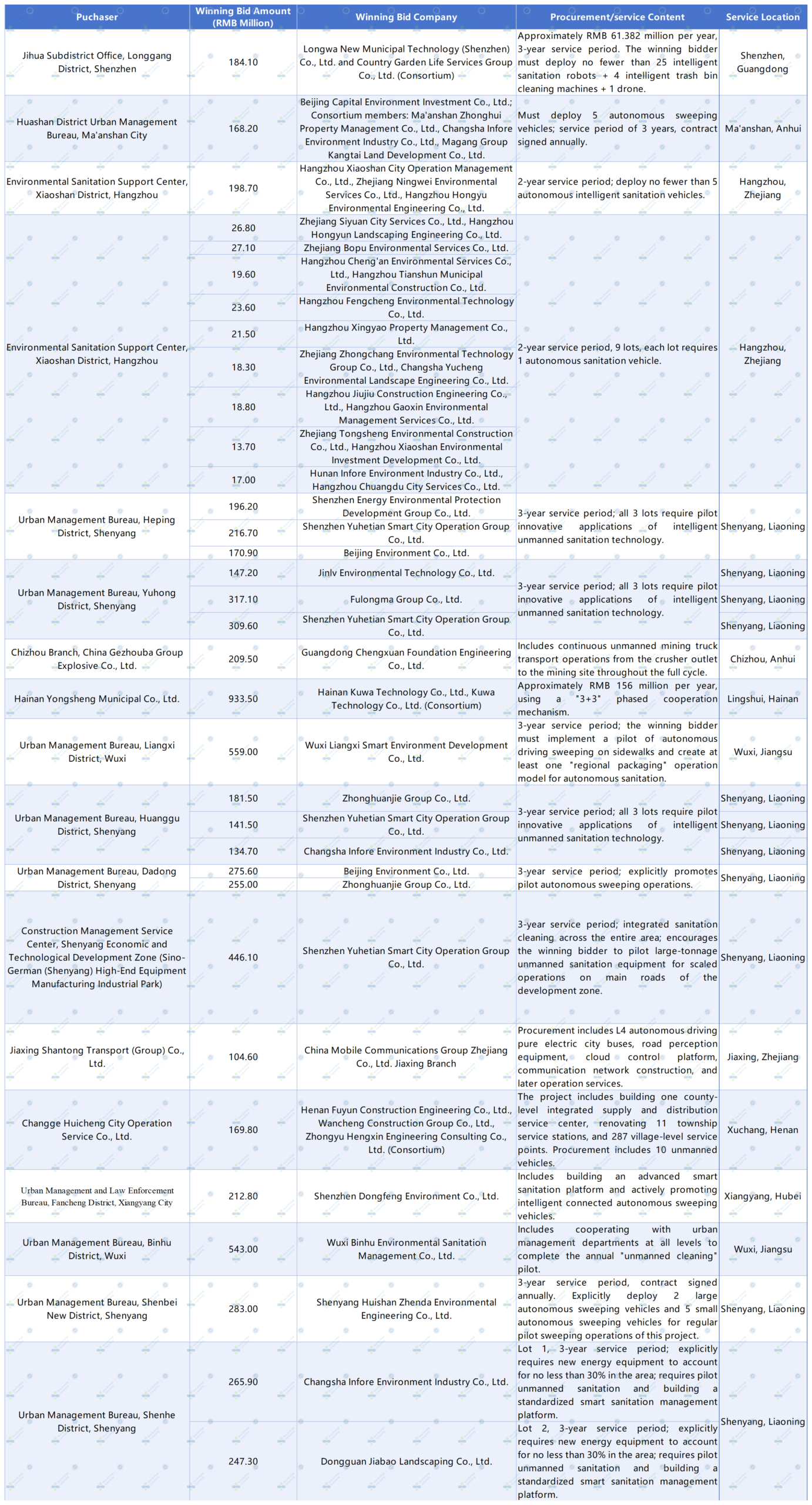
Selected Major Autonomous Driving Project Awards in Q3 2026.