
Chinese makers of low-speed self-driving vehicles launched 18 new models in the third quarter of 2026. The models cover delivery, sanitation, inspection, ports, and agriculture. The surge signals a shift from technology validation to scenario-specific commercialization—with leading players now eyeing overseas markets.
October 13, 2026 — Data from the CMRA Low-Speed Autonomous Driving Industry Research Institute shows a rise. China’s low-speed autonomous vehicle sector introduced 18 new models in Q3 2026. The models cover core application scenarios, including autonomous delivery, sanitation, inspection, port logistics, and smart agriculture.
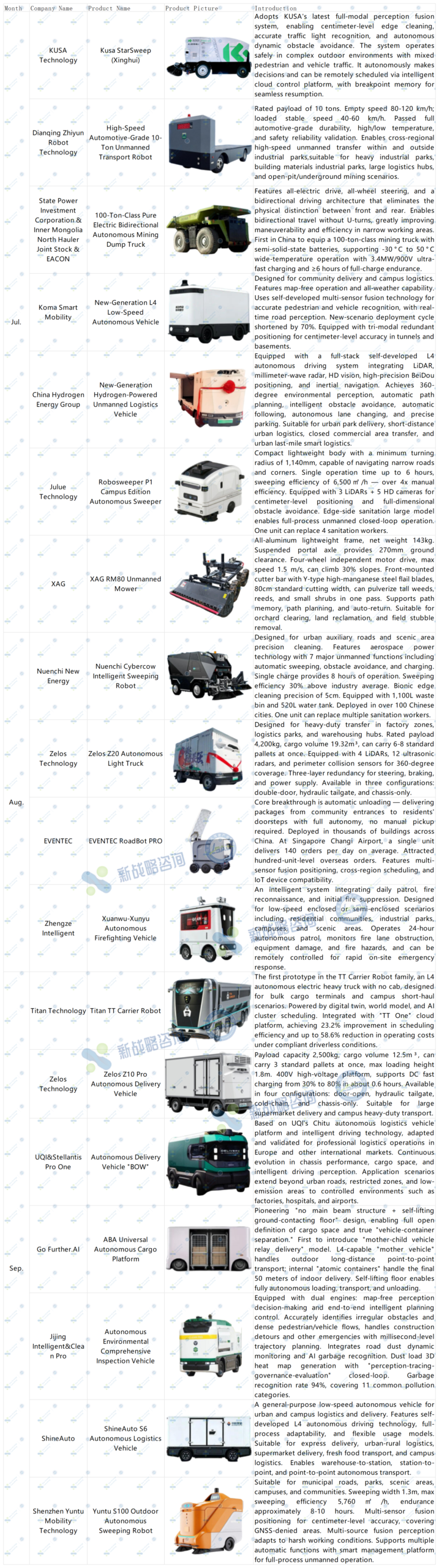
Q3 2026 Low-Speed Autonomous Vehicle Launches
From a launch rhythm view, Q3 showed a pattern of concentrated releases early and late in the quarter. Releases then slowed down in the middle.July opened the quarter with a surge of new products. Companies focused on heavy-duty mining trucks, campus transfers, hydrogen logistics, and embodied AI sanitation.
In mid-quarter, the pace slowed as manufacturers shifted focus to field scenario testing, algorithm iteration, and operational solution refinement. The end of the quarter brought another wave of new products. Urban delivery logistics and sanitation cleaning shifted. There was also more focus on commercialization and systematic delivery.
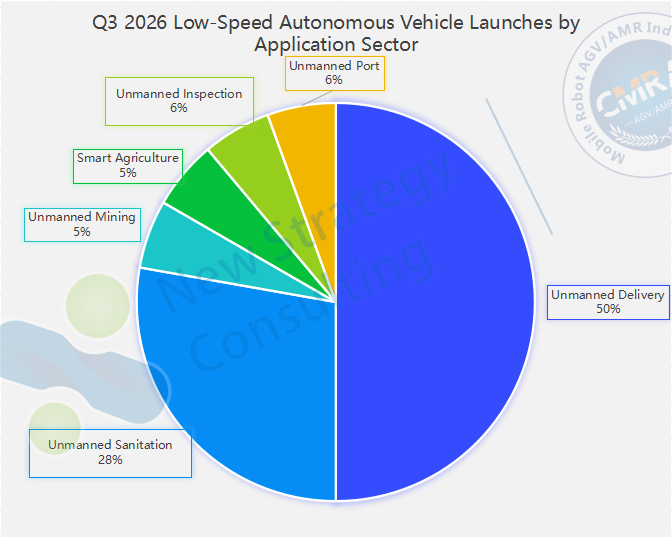
Q3 2026 Low-Speed Autonomous Vehicle Launches by Application Sector
Delivery Robots: Higher Payload, Modular Platforms, Map-Free Navigation
Autonomous delivery remained the largest category for this quarter , with new models from companies including Zelos, Dianqing Zhiyun, Go Further. AI, ShineAuto, EVENTEC, and Koma Smart Mobility.
Key trends in this segment:
- Higher payload capacity: Zelos’ Z10 Pro targets supermarket and campus logistics with a 2,500 kg payload, while the Z20 light truck moves into heavy-duty transfer between parks and warehousing hubs.
- Modular platforms: Go Further. AI’s ABA universal cargo platform features a detachable container and “mother-child” relay mode, enabling outdoor-to-indoor autonomous delivery for the last 50 meters.
- Map-free navigation: Koma Smart Mobility’s new L4 low-speed vehicle emphasizes map-free, all-weather operation and rapid deployment in new scenarios.
- End-to-end architecture: ShineAuto’s S6 is designed for express delivery, urban-rural logistics, retail, and fresh food transport, with mass production underway.
Sanitation Robots: From Cleaning to Integrated Inspection and Data Governance
The sanitation segment saw five new models from Kusa Technology, Nuenchi New Energy, Shenzhen Yuntu Mobility Technology, Jijing Intelligent, and Julue Technology. Applications range from municipal cleaning and park maintenance to back-alley sweeping, road dust inspection, and fire warning.
Representative examples:
Kusa Technology’s Xinghui embodied AI cleaning robot uses multi-modal perception for centimeter-level edge cleaning, traffic light recognition, and cloud-based scheduling.
Nuenchi’s Cybercow is a 3-ton class cabless cleaning robot with BeiDou centimeter-level positioning and a waste recognition model. It can operate for 8 hours per charge and has been deployed in over 100 Chinese cities.
Jijing Intelligent and Clean Pro’s unmanned environmental inspection vehicle combines map-free perception with end-to-end planning, achieving 94% waste recognition across 11 pollution categories and generating 3D road dust heatmaps.
The trend is clear: sanitation robots are evolving from single-function cleaning into integrated “cleaning + inspection + data governance” platforms.
Heavy-Duty and Specialized Scenarios: Mining, Ports, Agriculture
Beyond delivery and sanitation, Q3 saw a surge in heavy-duty autonomous vehicles for mines and industrial parks. It also saw growth in specialized uses like landscaping and fire emergency response. This confirms that autonomous driving is accelerating in complex industrial environments.
Overseas Expansion: The Next Frontier
A notable shift in Q3 was the increasing overseas ambitions of leading Chinese low-speed AV companies. While specific deployment details remain limited, several top players have begun laying groundwork in international markets. CMRA is actively tracking these overseas deployments and will provide further updates as more information becomes available.
Outlook
The Q3 2026 data confirms that China’s low-speed autonomous vehicle industry is shifting.
It is moving from “technology validation” to “scenario deepening.” Companies no longer chase generic demo products. Instead, they design specialized vehicles for key pain points. These include heavy-duty transfer, urban delivery, municipal sanitation, and special operations. Product specialization, platformization, and system integration are rising sharply.
As map-free solutions, embodied AI, automotive-grade redundancy, and large AI models scale, total lifecycle cost matters more. Operational delivery capability is also a key competitive focus. The commercialization of low-speed autonomous vehicles is entering a new phase of value verification.