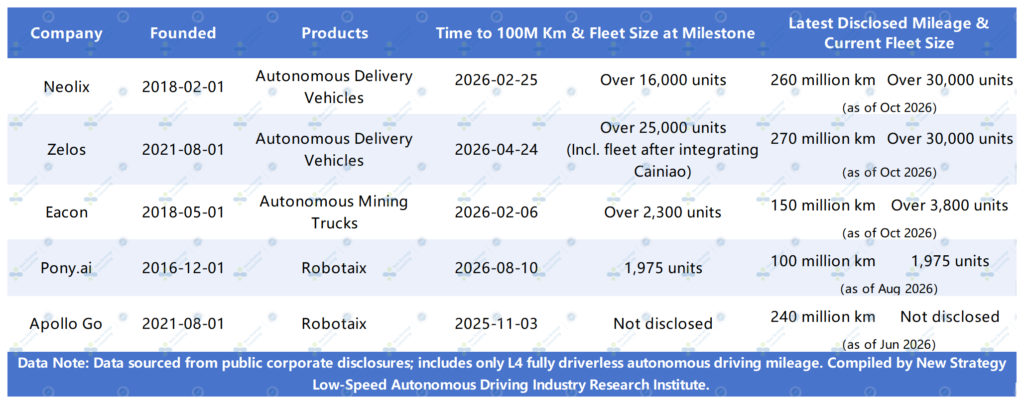
As of October 2026, six Chinese L4 autonomous driving companies have officially surpassed 100 million cumulative driving kilometers. According to data from the New Strategy Low-Speed Autonomous Driving Industry Research Institute, these companies span three key sectors: autonomous delivery, mining transport, and Robotaxi.
While they share the same milestone, the underlying data structures and operational models driving this mileage are vastly different.
1. Scale-Driven Model: Autonomous Delivery
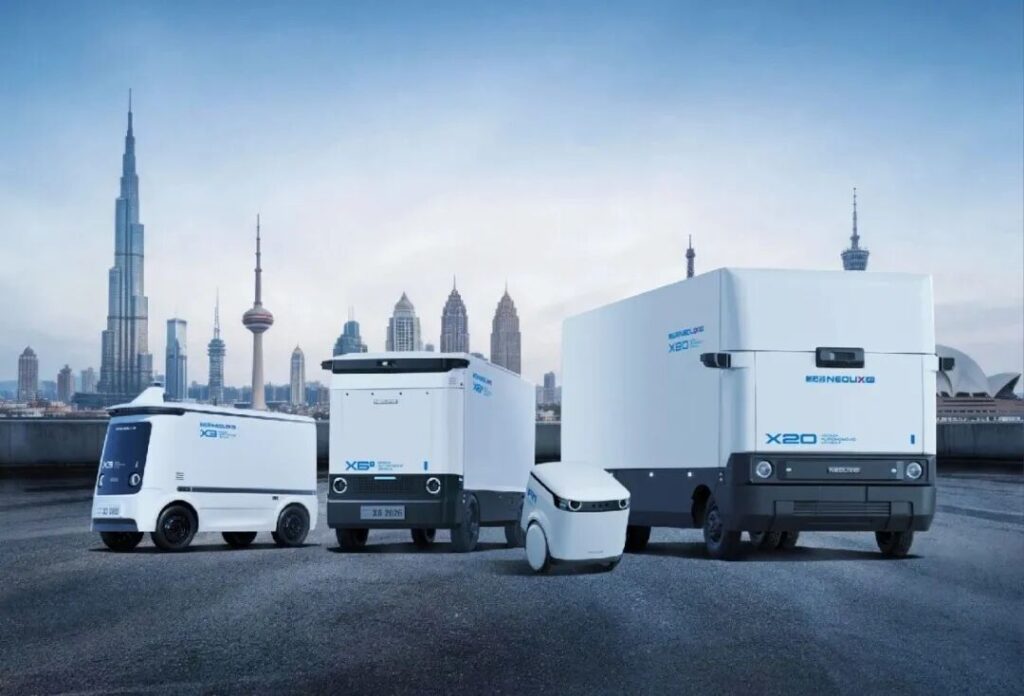
Represented by Neolix and Zelos, mileage here is driven by massive fleet deployments. For instance, Neolix reached 100 million kilometers in February 2026 with roughly 16,000 vehicles globally. Zelos, after integrating with Cainiao’s delivery business, operates a dual-brand fleet of over 25,000 units.
The Logic:Single vehicles run only a few dozen kilometers daily, primarily on high-frequency, short-distance routes (e.g., last-mile delivery, cold chain). The core value lies in gathering long-tail data across hundreds of cities, accelerating algorithm generalization while diluting manufacturing and operational costs through economies of scale.
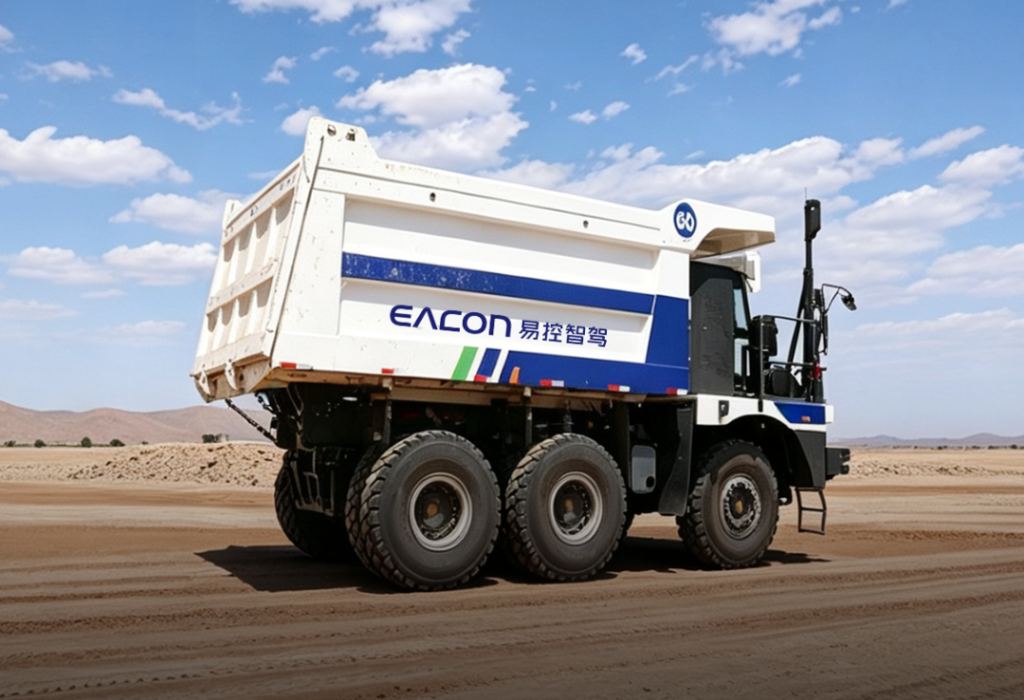
Taking Eacon as the benchmark, this model relies on a moderate fleet size with extremely high utilization rates. Eacon hit the 100-million-kilometer mark in February 2026 with about 2,500 mining trucks in operation.
The Logic:Operating in closed, fixed routes, these heavy-duty trucks run 24/7. Mileage accumulation is directly tied to production value (clients pay by transported volume). Growth is driven not by exponential fleet expansion, but by increasing density within single mines, enhancing system stability, and adapting to diverse geological conditions.
3. High-Density Single-Vehicle Model: Robotaxi
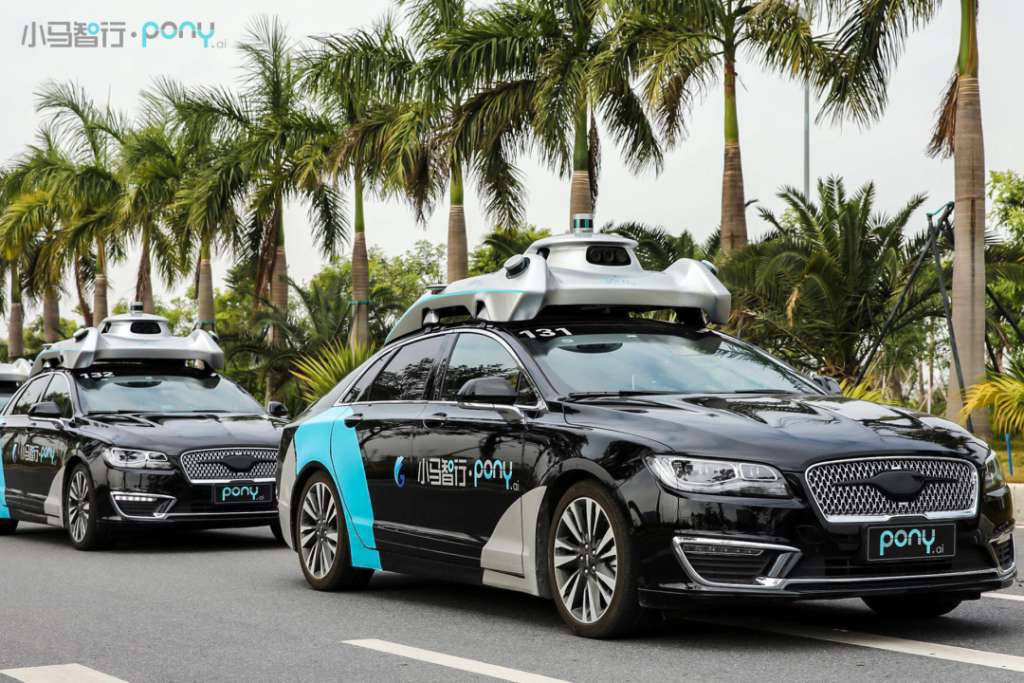
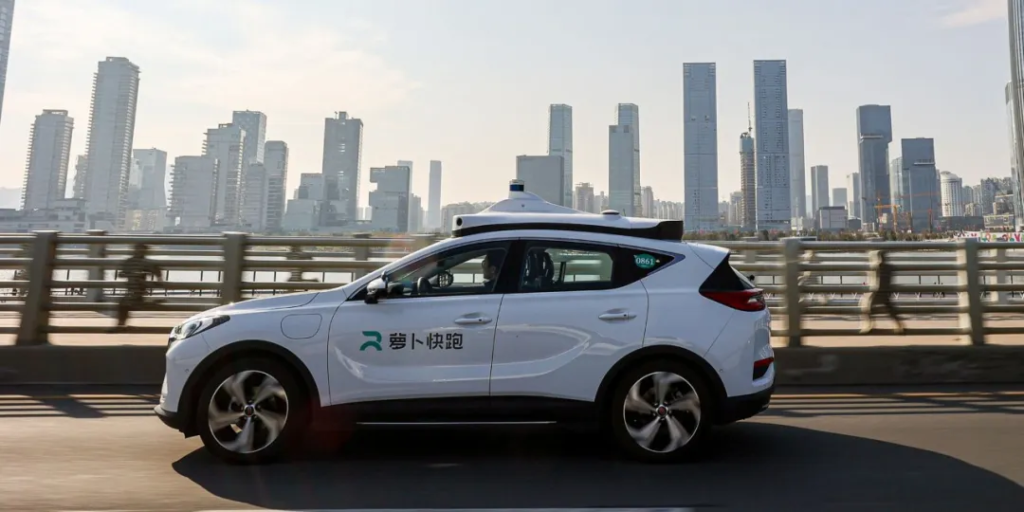
Represented by Baidu Apollo Goand Pony.ai, this sector relies on intense single-vehicle utilization. Pony.ai reached 100 million kilometers in August 2026 with a fleet of just over 1,700 vehicles.
The Logic:Unlike delivery fleets, Robotaxis require high order density and complex urban interaction. The core metric is single-vehicle operational efficiency—how many hours per day a car can run and how many orders it can fulfill. As fully driverless operations increase and hardware costs drop, the efficiency of individual vehicles becomes the primary engine for mileage growth.
Post-100M Growth: Quality over Quantity
Since crossing the 100-million mark, the growth rate has accelerated. Neolix added another 160 million kilometers in just 8 months, while Zelos reached 270 million kilometers in 6 months. This acceleration is fueled by three key industry shifts:
Mapless Technology:The shift from HD mapping to mapless solutions (e.g., Zelos achieving 95% mapless penetration for new routes) has cut city deployment time from a month to a single day, transforming autonomous driving from bespoke projects into standardized, scalable products.
RaaS (Robotics-as-a-Service):Revenue models are shifting from selling hardware to selling transport capacity. Pay-per-order models and flexible leasing (yearly/monthly/hourly) allow fleets to be reused across daytime express delivery and nighttime restocking, maximizing daily utilization.
Global Expansion:Mining autonomous driving companies are actively exporting to high-value overseas markets, while Robotaxis and delivery vehicles are also beginning to replicate successful domestic models internationally.
Conclusion
The race to 100 million kilometers is no longer just about adding more vehicles; it is a shift from quantitative accumulation to qualitative leaps in operational efficiency and commercial viability. As the industry matures, there is a pressing need for a centralized platform and coordinated industry consensus to anchor these new benchmarks.
From massive funding rounds to national-level testing and 300-unit orders, Chinese robotics is accelerating commercialization. Capital Surge: AgiBot targets a RMB 50 billion valuation; Astribot raises... Continue reading
Sanitation leads at 31%, Guangdong tops the list, and year-to-date awards now exceed RMB 21.8 billion. China’s low-speed autonomous driving sector had a record-breaking third... Continue reading
Chinese makers of low-speed self-driving vehicles launched 18 new models in the third quarter of 2026. The models cover delivery, sanitation, inspection, ports, and agriculture.... Continue reading
BYD’s Humanoid Robot Design Patent Leaked for the First Time NVIDIA Reportedly to Invest Another $1 Billion in Figure AI Rino.ai Closes $100 Million Series... Continue reading
On September 7, 2026, a notice titled “Public Notice of Employee Claims (Fifth Batch)”—bearing the reference number “(2026) DeepBlue Bankruptcy Administration No. 8-5″—quietly appeared on... Continue reading