While the global humanoid robot industry is still struggling to refine their products for factory deployment, its most expensive component—the dexterous hand—has already concluded a fierce price war in the Chinese market.
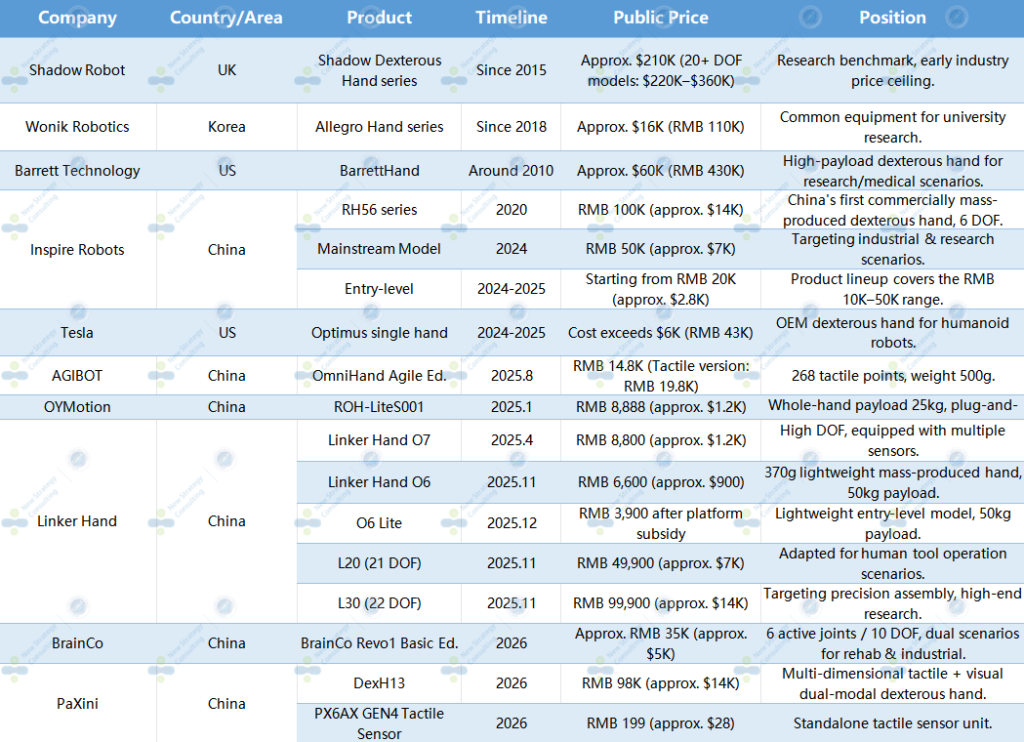
Five years ago, high-DOF dexterous hands like the UK’s Shadow Hand cost over $200,000. Today, entry-level commercial models mass-produced by Chinese manufacturers have crashed to just $550 (3,900 RMB), with mainstream versions firmly under $10,000.
This is not just a marketing gimmick; it is a fundamental restructuring of the underlying logic of China’s domestic robotics supply chain. Here is how this revolution unfolded.
1. The Price Crash: Who Did What?
Several key domestic players drove this disruption:
Inspire Robots: China’s earliest commercialization pioneer. Initial unit prices exceeded $140,000, dropping to $14,000 in 2020. Today, their flagship models are around $2,800(officially claiming a low of $1,400). This is driven by their self-developed micro servo cylinders and the scaling of their Suzhou factory.
Linker Hand : Master of product tiering. Its high-end models ($7,000–$14,000) are a fraction of the Shadow Hand’s price, while its entry-level model dropped to $550 (O6 Lite). Remarkably, its 370g O6 model handles a 50kg payload.
AgiBot & OYMotion: Entering from the OEM and industrial consumer ends. AgiBot anchored its OmniHand at $2,000 under the logic that “a hand cannot cost more than the body.” OYMotion’s ROH-LiteS001 targets industrial scenarios at $1,200.
PaXini : Breaking the bottom line of components. Their 4th-gen multi-dimensional tactile sensor dropped to just $28, proving the real price war is at the foundational component level.
2. The Five Driving Forces Behind the Price War
Why did prices collapse so fast in the Chinese market? It boils down to five points:
Vertical Integration (Localization):Micro servos, reducers, and tactile sensors are localized, eliminating import premiums.
Product Tiering:Stripping redundant DOFs for basic tasks to cut costs, while reserving flagship specs for research.
OEM Pressure: Domestic humanoid makers forced upstream suppliers to optimize structures for cheaper BOMs.
Manufacturing Upgrades:Moving from manual assembly to automated production lines to improve yield rates.
Capital & Hyper-competition:A flood of new players and capital triggered aggressive pricing to grab domestic market share.
3. The Reality Check: Price vs. Performance
Despite the hype, the Chinese market is splitting into two tracks:
Low-DOF (Under $1,500): Suitable for basic picking, but lacks durability for long-term, complex operations. Industry insiders note that some ultra-low pricing sacrifices profitability.
High-DOF (Flagship): Constrained by complex calibration and precision sensors, prices remain high (e.g., PaXini’s $14,000 flagship), serving high-end medical and precision manufacturing.
The Next Frontier
As the price barrier collapses in the Chinese market, price is no longer the ultimate selling point.
The core benchmark for procurement in the next phase will shift to lifespan, environmental adaptability, and full lifecycle costs. The ultimate test is no longer “who can build the cheapest hand,” but “who can build a hand that survives the real world.”
Key Takeaways: Unitree Leads the Volume:Leading OEMs like Unitree, UBTECH, and Leju secured high-frequency bids in September. The “Pulse” Effect: China awarded 78 humanoid robot... Continue reading
Why composite mobile robots (56.1%) and China’s hardware supply chain are reshaping global industrial automation in 2026. The global mobile robotics industry reached a major... Continue reading
According to public filings, PaXini submitted its IPO counseling registration application to the Beijing Securities Regulatory Bureau on September 20, 2026. Guotai Haitong Securities has... Continue reading
Genisom AI, a Chinese startup that makes quadruped and humanoid robots, has closed a Series B round worth several hundred million yuan. The round was led by... Continue reading
Tesla has launched a new round of production audits of Chinese suppliers as it accelerates preparations for the mass production of its Optimus humanoid robot.... Continue reading