Market Volume Surges: China disclosed 419 AGV/AMR procurement projects in the first three quarters of 2026, totaling approx. RMB 2.64 billion (approx. $370 million).
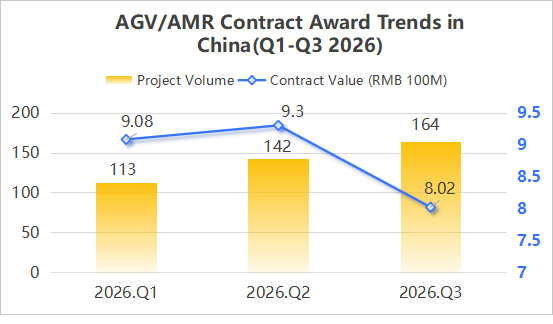
Q3 “Volume Up, Value Down”: Q3 hit a record high of 164 projects (up 45% from Q1), but total contract value fell 13.8% QoQ to RMB 802 million.
The “Missing” Mega-Deals: Unlike Q1 and Q2 which featured single projects worth over RMB 400 million, Q3’s largest deals were smaller, highlighting the market’s shift toward smaller, distributed deployments.
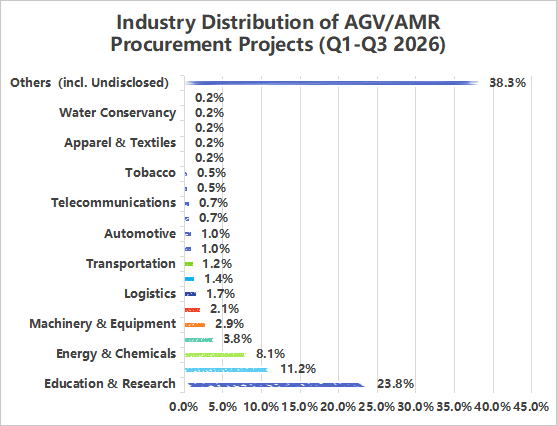
Top Sectors: Education & Research (23.8%) leads in project volume, followed by Manufacturing (11.2%) and Energy & Chemicals (8.1%).
In the first three quarters of 2026, China’s AGV/AMR market demonstrated strong resilience and continuous expansion. According to data from the CMRA and the New Strategy Mobile Robot Research Institute, the market’s growth is being driven by a dual trajectory: sporadic mega-deals dictating the total financial value, and a rising wave of small-to-medium projects expanding application scenarios.
1. Data Overview: Continuous Volume Growth
The project volume grew steadily each quarter: 113 in Q1, 142 in Q2, and a peak of 164 in Q3. However, total disclosed value dropped in Q3 to RMB 802 million, down from RMB 908 million in Q1 and RMB 930 million in Q2.
This “volume up, value down” trend is not a sign of market contraction. Rather, it reflects the absence of massive RMB 400-million-level projects in Q3 (like the RMB 415 million smart warehouse project in Q1 or the RMB 403 million Lexus factory project in Q2). Q3’s two largest deals were RMB 203 million and RMB 116 million, respectively.
2. Deal Size Breakdown: The Rise of SMEs
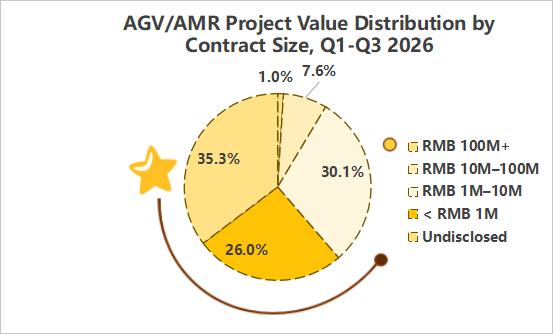
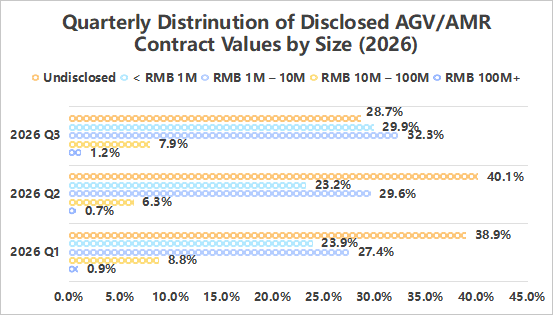
The structural shift toward smaller projects is evident. In Q1-Q3, projects valued at RMB 1 million or below accounted for 56.1% of all projects. By Q3 alone, this ratio had climbed to 62.2%.
Conversely, mega-deals (RMB 100 million+) and large deals (RMB 10 million+) made up only 8.6% of total project volume. While rare, these mega-deals still dictate the overall financial ceiling of the quarter, whereas the growing volume of SME projects provides a wider foundation for AGV/AMR adoption across diverse industries.
3. Industry Landscape: Beyond Traditional Manufacturing
While manufacturing remains a core driver, procurement data shows a highly diversified application landscape:
Education & Research (23.8%):Leading in project volume. Universities and vocational schools are shifting from buying single robots to building comprehensive “training platforms” and “integration bases.”
Manufacturing (11.2%):Moving from single-point trials to multi-process deployments, particularly in semiconductors and 3C electronics.
Energy & Chemicals (8.1%):Driven by the need for safe, stable, and highly adapted logistics automation in complex industrial environments.
Conclusion
China’s AGV/AMR market is transitioning from a “technology validation” phase to a “scenario-specific commercialization” phase. The future competitive edge for industry players will rely not just on winning flagship mega-deals, but on their ability to replicate mature solutions across a broader range of clients, processes, and industries.
Key Takeaways: Unitree Leads the Volume:Leading OEMs like Unitree, UBTECH, and Leju secured high-frequency bids in September. The “Pulse” Effect: China awarded 78 humanoid robot... Continue reading
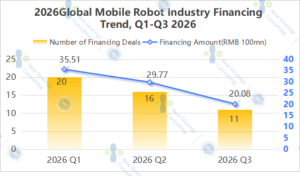
Key Highlights: Total Funding & Deals:According to incomplete public market statistics compiled by the CMR Industry Alliance and the New Strategy Mobile Robot Research Institute,... Continue reading
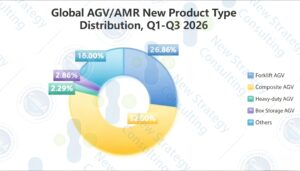
Why composite mobile robots (56.1%) and China’s hardware supply chain are reshaping global industrial automation in 2026. The global mobile robotics industry reached a major... Continue reading
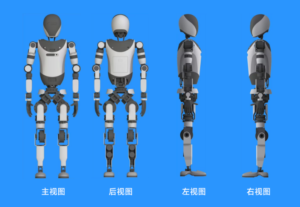
BYD’s Humanoid Robot Design Patent Leaked for the First Time NVIDIA Reportedly to Invest Another $1 Billion in Figure AI Rino.ai Closes $100 Million Series... Continue reading
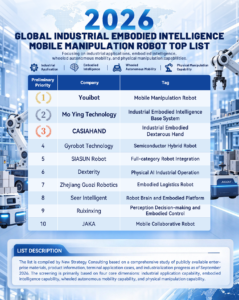
Embodied intelligence is emerging as one of the most important technological directions in the global robotics industry. The combination of “mobility + manipulation” naturally aligns... Continue reading