In 2026, wheeled humanoid robots are moving from exhibition stands to factory floors. According to incomplete statistics from the CMRA and the New Strategy Mobile Robot Industry Research Institute, 178 new AGV/AMR products were launched worldwide in the first three quarters of 2026. Composite products led with 91 models, about 52%, and more than 80% of composite products were wheeled humanoids. That is roughly one new wheeled humanoid every three days. But new products are only the start.
The real questions are: which factories are they entering, and how many can move from a demo to continuous work?
20+ companies enter factories, and tasks move from handling to assembly
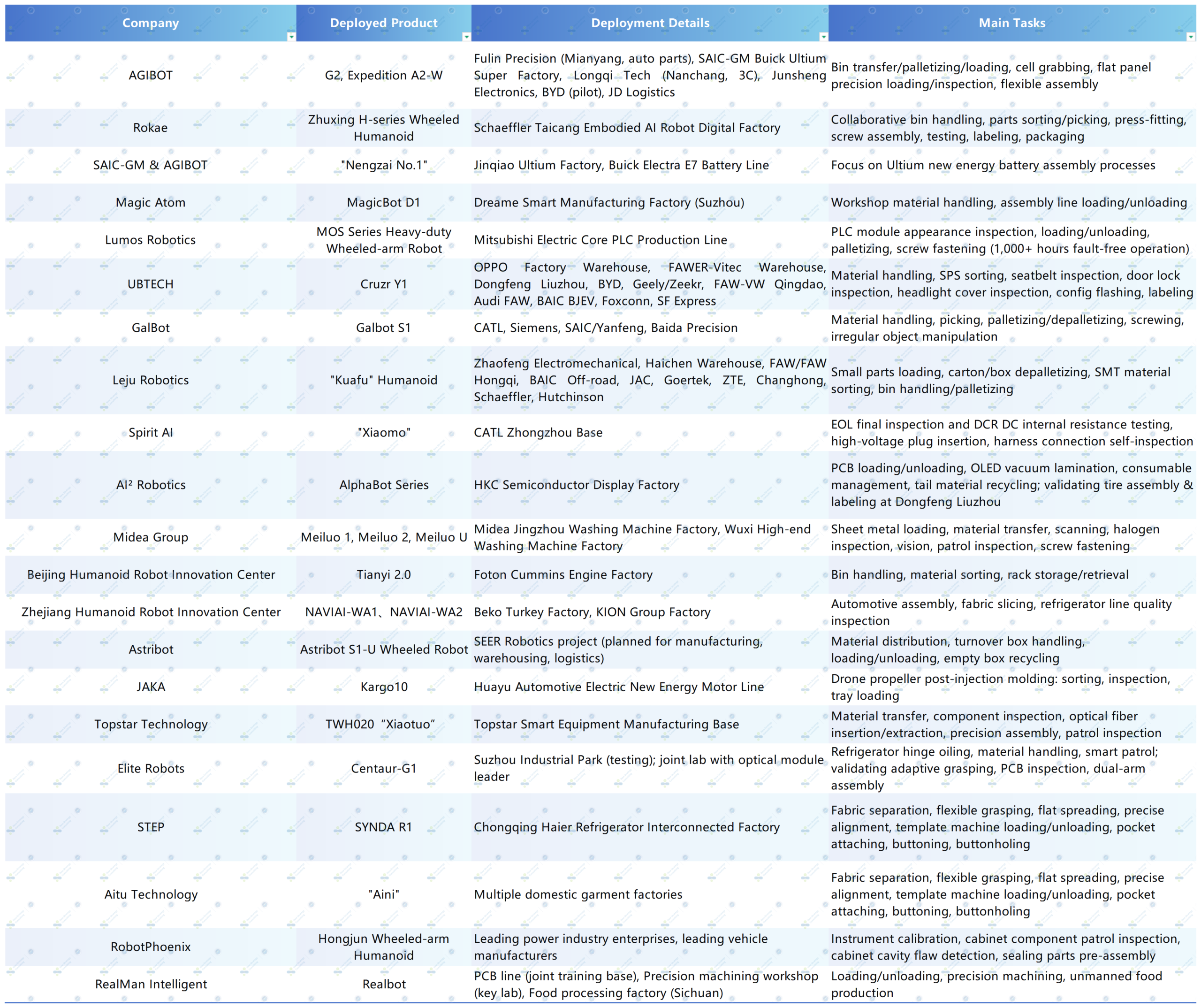
More than 20 companies have sent wheeled humanoid robots into factories for deployment, testing, validation, and scenario cooperation.
Applications cover automotive, electronics, and logistics, including CATL, BYD, SAIC-GM, Audi FAW, OPPO, Foxconn, Midea, Dreame, and JD Logistics. Early tasks were mainly parts handling, bin sorting, and loading/unloading—essentially an extension of logistics.
In 2026, quality inspection, press-fitting, and screw assembly are entering the task list. Exploration is moving from “how materials flow” to “how parts are assembled.”
In Guangdong, China. More than 2,000 humanoid robots entered manufacturers in 2026 and are stably deployed; the full-year number may exceed 3,000.
But a longer list does not mean all projects have reached scale. Factory testing, scenario validation, regular deployment, and batch purchase are four different stages with different standards. The industry is moving from the ice-breaking stage—“will any factory try?”—to real-world testing—“can robots stay on the line?” To judge real progress, look at specific tasks and real operating data.
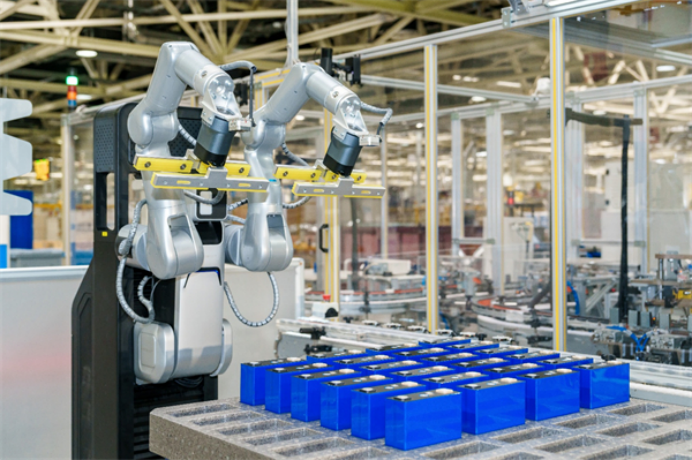
Cases are more telling. Eight AGIBOT G2 robots worked for six consecutive days in the quality-inspection section of Longcheer Technology’s Nanchang(China) factory. By the second day of the live stream, cumulative work time exceeded 22 hours, with 23,384 tasks completed and a 99.97% success rate. Cycle time reached 80–90% of human workers. ROKAE Zhuxing H series was deployed at Schaeffler Taicang(China), covering bin handling, parts sorting, press-fitting, and screw assembly. Leju Kuafu achieved regular deployment at Zhaofeng Mechanical and Electronic for picking, transfer, and loading. LUMOS MOS series completed validation on a Mitsubishi Electric PLC line with over 1,000 hours of continuous fault-free operation. Tuosida Xiaotuo and Aitu Technology Aini entered injection-molding post-sorting inspection and flexible garment production.
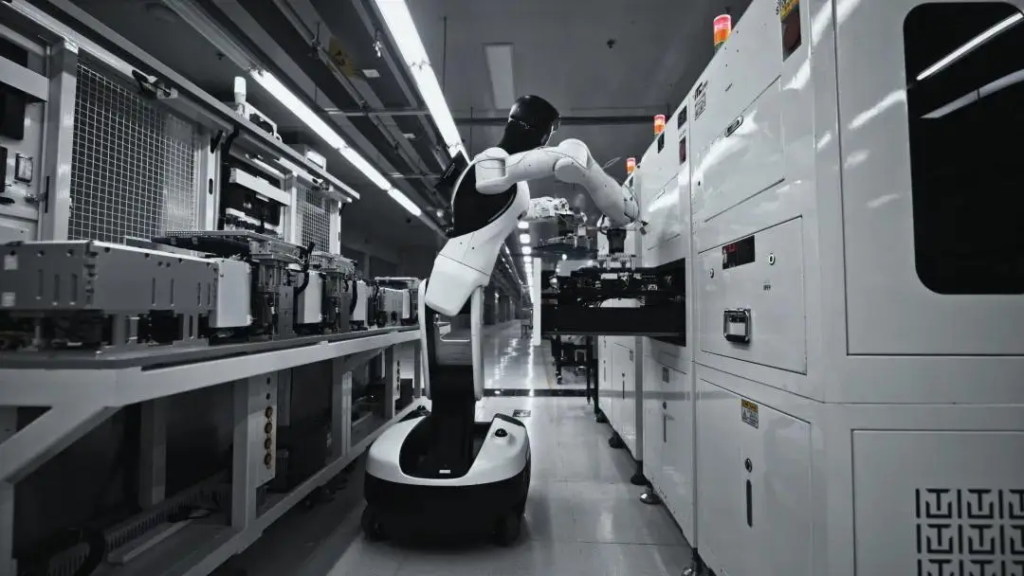
The common point: wheeled robots are entering tasks that used to require humans and are hard to fully solve with fixed automation. But handling, sorting, loading/unloading, and precision assembly have different thresholds.
The first group relies more on mobility, recognition, and grasping; the latter demands positioning accuracy, force control, and process consistency. Maturity depends not on how long the task list is, but on whether each task can be completed stably and economically.
Customers become Competitors, Competition upgrades
Some manufacturing giants are no longer only buyers and testers; they are also developing robots.
Midea sent its Meiluo series to its Jingzhou washing machine factory. SAIC-GM and AGIBOT customized Nengzai No.1 for the Ultium battery line. A self-developed closed loop owns the scenario, data, process knowledge, and iteration channel, so robots can be adjusted quickly around internal lines. But a robot developed for one line cannot necessarily be copied directly to other factories, because material specs, processes, equipment interfaces, and safety rules differ.
Third-party robot firms must prove cross-customer and cross-line replication, plus deployment efficiency, O&M cost, and long-term stability. Self-developed loops compete on scenario depth and iteration speed; third-party productization competes on replication and delivery efficiency. The dividing line is not who enters the factory first, but who can turn one success into repeatable delivery. Competition now extends to scenarios, data, engineering delivery, and organizational efficiency.
Easy to enter, hard to stay: factories only recognize a report card
Factories care about effective tasks per day, how often manual intervention is needed, recovery time after a failure, and whether production takt time is affected. Customers do not want a demo of “what the robot can do”; they want a report card showing “can it deliver stably.” Some projects have reported high success rates and continuous operation, but metrics, task difficulty, and test environments differ, so success rates cannot be compared directly. There is still a gap between short tests and long production: thousands of operations in a standardized environment are different from continuous work in a factory with staff movement, material offset, and equipment changes. Whether a robot can recover autonomously or needs remote takeover directly affects efficiency.
Cost is not just the robot’s price. Deployment and debugging, site modification, O&M staff, spare parts, software updates, and downtime losses all count. If every new station needs new development, or if robots frequently need human intervention, commercial value is discounted. Deployment numbers and long-term plans matter, but real operating data better determines commercialization. Entering a factory is easy; staying at work is hard. In the end, factories will pay only for a report card that survives line tests.
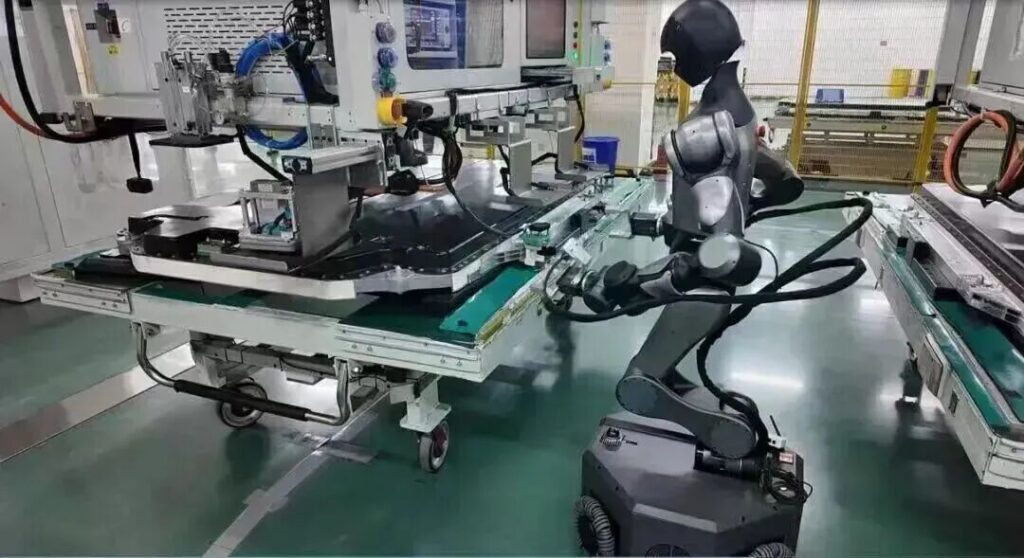
Why industrial scenarios favor wheeled humanoid robots?
In flat, structured factory areas, a wheeled base offers high mobility efficiency, stable operation, and relatively low energy use. Compared with mobile robots, wheeled humanoids can also use arms, dexterous end effectors, and multimodal perception to grasp, load/unload, sort, inspect, and partly assemble, connecting mobility and manipulation.
Factories do not necessarily need robots to walk like humans; they need robots to adapt to existing lines, use existing space, and do more tasks with minimal site modification. For manufacturing scenarios with flat floors, relatively fixed stations, and frequent material flow, a wheeled base is more practical, while upper-body operation opens space for multi-process work.
The industry focus is shifting from “can they enter the factory?” to “can they work continuously?”, and from single-task validation to a broader test of efficiency, reliability, deployment cost, and scalable replication.
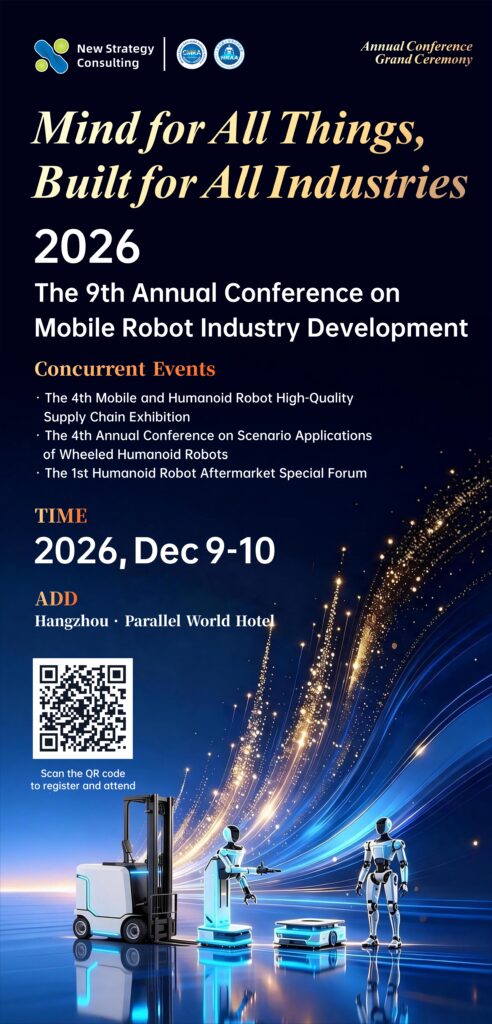
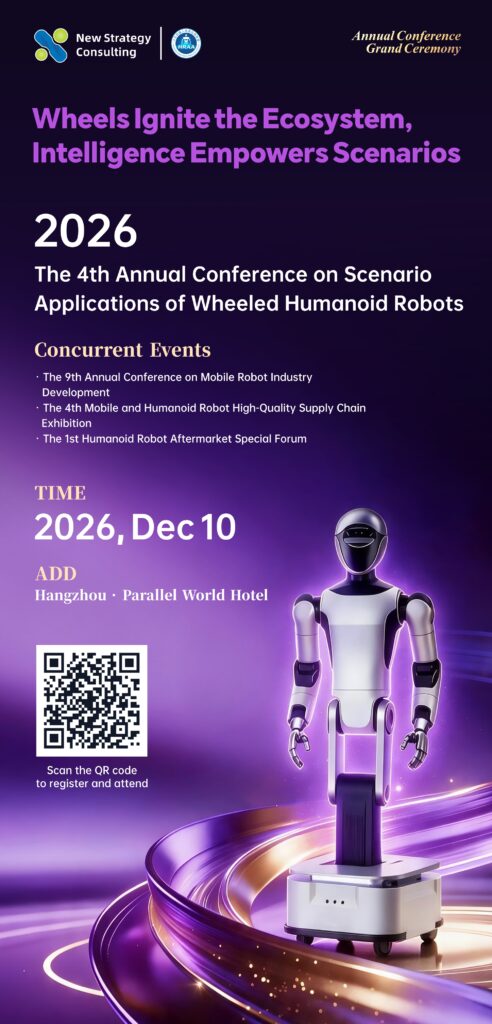
2026 The 9th Annual Conference on Mobile Robot Industry Development and the 4th Annual Conference on Scenario Applicationsof Wheeled Humanoid Robot will be held on December 9–10 at the Parallel World Hotel in Hangzhou.
The conference will focus on industrial embodied intelligence deployment, motion control, chassis technology, manufacturing applications, and data collection and annotation, promoting the industry’s shift from product exploration to deep scenario deployment.