New procurement players are entering, with single deployments reaching 10 units.
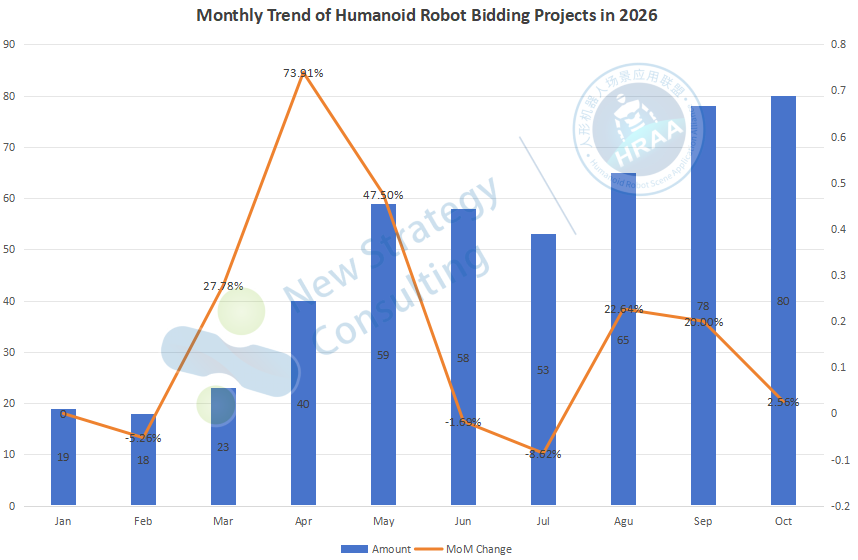
According to incomplete statistics from the Humanoid Robot Scenario Application Alliance, in October 2026, the number of publicly disclosed embodied AI and humanoid robot-related awarded projects in China exceeded 80, with total disclosed contract value of approximately RMB 153 million.
Compared with September, the number of awarded projects in October was 80, basically flat. However, the awarded amount fell from RMB 284 million to RMB 153 million, a month-on-month decline of about 46%. No RMB 100 million-level project appeared this month. The largest single project was the Longyou County Four-Province Border Artificial Intelligence Industrial Park Infrastructure Project, with disclosed service value of RMB 23.6 million. The project covers procurement of humanoid robots, motion capture equipment, storage equipment, and hardware equipment.
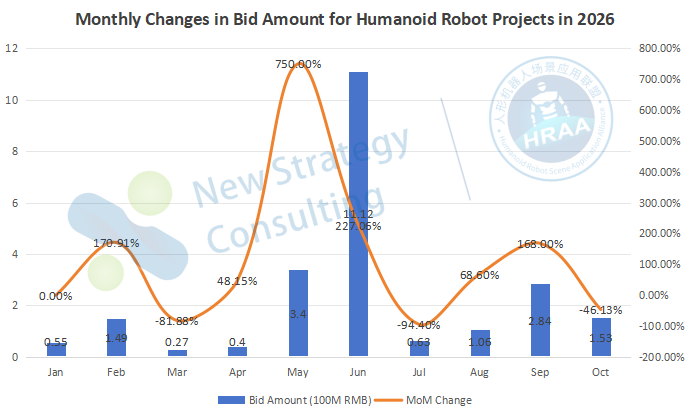
Based on a rough calculation using disclosed amounts, the average value per project in October was about RMB 2.1 million; the source text compares this with about RMB 3.9 million in September. In terms of project scale, October had two projects above RMB 10 million and about 27 projects at the RMB 1 million+ level. Their cumulative disclosed value exceeded RMB 80 million, accounting for more than 52% of the total. The procurement structure remained dominated by college training laboratories, data collection platforms, and medium-to-large pilots. No large batch procurement orders from government or enterprise buyers were implemented.
In terms of buyer groups, research institutions and colleges remain the main purchasers of humanoid robots. A notable development this month is that preschool teacher education colleges began to appear among tendering entities, with relatively substantial project investments. A representative case is Hubei Preschool Teachers College, which procured 10 humanoid robots for teaching and training. This was the awarded project with the highest number of robot units in a single project this month, with a total value of more than RMB 4.63 million.
Overall, the October bid data signals three trends:
1. Demand structure is moving “downstream”
Buyers are shifting from large government and enterprise orders back to colleges and pilot platforms. This is not a contraction in demand, but a transition from the “demonstration project” stage to the “fragmented validation” stage.
2. Scenario boundaries are “spilling over”
The entry of preschool teacher education, elderly care, transportation, and other specialized colleges means the application narrative for humanoid robots is expanding from “replacing industrial workers” to “general-purpose interaction platforms.” Scenario switching is fast and granular, but depth in any single scenario remains limited, and replicable standardized solutions have not yet been formed.
3. Commercial momentum is “building strength”
The main reason for the 46% month-on-month decline in value is that September included an extreme single project exceeding RMB 150 million. Excluding that project, actual order density did not weaken. The real value of the current 80-plus projects lies in accumulating multi-scenario interaction data for embodied models, rather than short-term revenue contribution. In short, humanoid robots are moving from “showing muscle” to “finding work.” Whoever first achieves a closed ROI loop in a niche segment will secure the ticket to the next stage.
2026 The 9th Annual Conference on Mobile Robot Industry Development and the 4th Annual Conference on Scenario Applicationsof Wheeled Humanoid Robot will be held on December 9–10 at the Parallel World Hotel in Hangzhou.
The conference will focus on industrial embodied intelligence deployment, motion control, chassis technology, manufacturing applications, and data collection and annotation, promoting the industry’s shift from product exploration to deep scenario deployment.