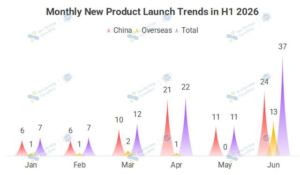
According to incomplete statistics from China Mobile Robot Industry Alliance (CMRA) and New Strategy Mobile Robot Industry Research Institute (NSRI), a total of 25 AGV/AMR products were launched globally in the first quarter of 2026, covering various categories such as unmanned forklifts, ACRs, composite robots, and wheeled humanoid robots. Among them, Chinese companies launched 22 new products, and foreign companies launched 3.
While the overall number is not as high as the peak period of concentrated new product launches, in terms of structure and technological content, the new products in Q1 are more like a concentrated expression of a “clear direction” rather than a simple expansion in quantity.
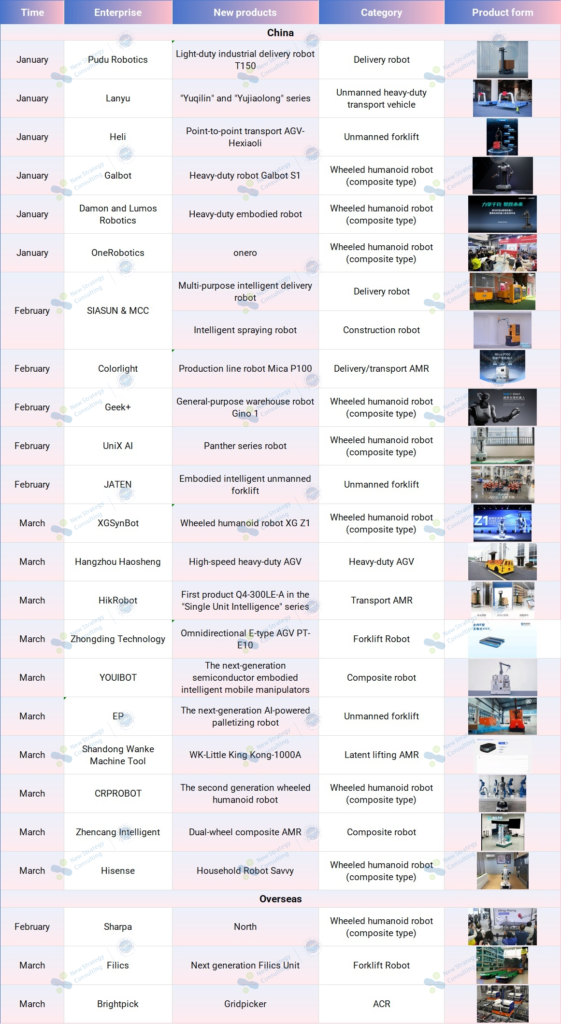
Chart: Overview of Global AGV/AMR New Products in Q1 2026
(Incomplete statistics compiled by NSRI based on publicly available data; if there is any omission, please make a correction!)
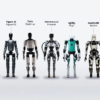
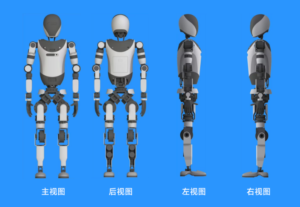
In terms of product form, composite products dominated the new products launched in the first quarter. There were 11 composite products this quarter, totaling approximately 44%. This proportion not only continues the rapid growth trend of composite robots since 2025, but also further strengthens the integrated development path of “mobility + operation”. Of particular note is the concentrated emergence of wheeled humanoid robots this quarter, gradually forming a clear consensus on their form. The “half-humanoid” structure, based on a wheeled chassis and incorporating upper-body maneuvering capabilities, is becoming one of the most feasible technological solutions at present.
In terms of specific products, Geek+’s general-purpose robot Gino 1 is designed and trained entirely for general multi-tasking capabilities in warehousing scenarios, capable of performing various tasks such as handling and inspection. XGSynBot’s XG Z1 wheeled humanoid robot integrates an ultra-lightweight force-controlled robotic arm, omnidirectional forming, and a multi-path vision system, aiming to achieve general-purpose embodied intelligence across workstations and scenarios. From the core product logic, wheeled humanoid robots have broken through the limitations of single functions, flexibly switching between tasks such as picking, handling, and inspection, which is a concentrated manifestation of companies’ continuous exploration of embodied intelligence paths.
It is worth noting that companies in the industry generally start with scenario-specific applications and then gradually extend to general-purpose capabilities. This path reflects the industry’s realistic choice to balance cutting-edge technological exploration with commercialization. Steadily expanding capability boundaries within controllable scenarios also means that true maturity of general-purpose capabilities still requires time and continuous data accumulation.
Furthermore, while unmanned forklifts accounted for approximately 20% this quarter—a small number—their technological sophistication has significantly improved; embodied intelligence technology is gradually penetrating this traditional category. Relying on multimodal perception, semantic mapping, and VLA models, the new generation of embodied intelligent unmanned forklifts is beginning to understand more complex operating environments and autonomously plan paths and actions, even continuously optimizing its performance in actual operation through reinforcement learning. Unmanned forklifts are evolving from passive handling tools into intelligent agents with a closed loop of perception, understanding, decision-making, and execution.
In contrast, other categories such as heavy-duty forklifts and ACRs performed relatively steadily this quarter. Heavy-duty products accounted for approximately 8%. Although the number is limited, it’s noteworthy that five wheeled humanoid robots in the composite product category also possess heavy-duty attributes. To avoid double counting, they were not included in the heavy-duty category statistics. However, this structural overlap itself illustrates that “heavy-duty” is no longer an independent track, but is increasingly deeply integrated with embodied intelligence and composite forms.
On the other hand, while subcategories such as ACRs have not seen significant growth, they maintain stable market demand due to their mature applications in specific scenarios.
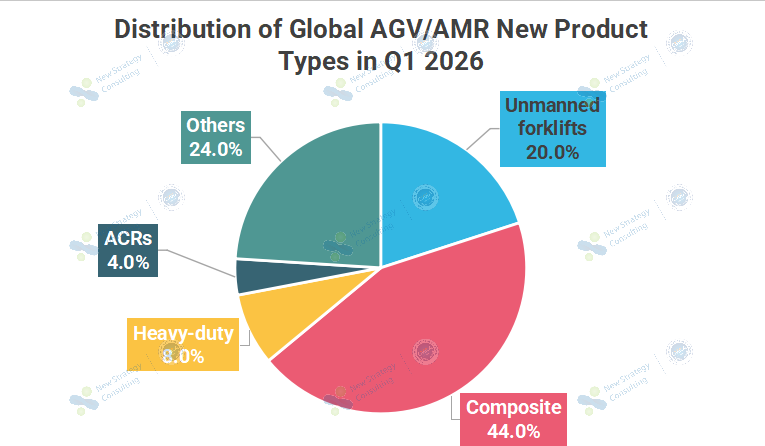
Chart: Distribution of Global AGV/AMR New Product Types in Q1 2026
Overall, the AGV/AMR new product landscape in Q1 2026 presents a picture of comprehensive penetration of embodied intelligence. The concentrated emergence of wheeled humanoid robots and the intelligent leap of unmanned forklifts both point in the same direction. The mobile robot industry is moving away from the old narrative that uses “handling efficiency” as a single coordinate, and instead is re-measuring its value boundaries within the complete intelligent closed loop of “perception-decision-execution.”
The Second Global Unmanned Forklift Application Scenario Competition & the Material Handling and Sorting Challenge for Embodied Wheeled Humanoid Robots 2026 will be held by CMRA in Nantong Jiangsu from May 21-22, 2026. Building upon the existing unmanned forklift category, this event will introduce a wheeled humanoid robot track for the first time, addressing the industry’s practical needs for embodied intelligence implementation scenarios and further bridging technological innovation with industrial applications.