
As more and more companies centered on “brain capabilities” and dexterity begin launching complete robot products, a clear trend is emerging: many teams are opting for wheeled designs for their robots.
This choice is closely related to these companies’ technological priorities. Compared to teams focusing on overall motion control, many companies focusing on “brain” technology are more concerned with the robot’s operational capabilities and task understanding—that is, whether the robot can recognize objects, plan actions, and perform specific tasks such as grasping, carrying, and organizing using its arms and hands, rather than simply walking.
Bipedal walking has always been one of the most complex problems in the field of robotics. Stable walking involves numerous engineering challenges, including gait planning, dynamic balance, and full-body coordinated control, requiring long-term investment to achieve a reliable level. Overcoming complex walking control problems simultaneously during the overall robot development phase significantly increases R&D resources and time costs. For companies whose core strengths lie in “brain” and operational capabilities, this is often not the optimal choice.
In contrast, wheeled chassis can significantly reduce the complexity of the mobility system. Wheeled mobility is technologically more mature and easier to stabilize, allowing companies to focus more R&D resources on perception, decision-making, and operational capabilities. These capabilities are precisely the most important technological accumulations for many embodied intelligence companies.
At the same time, wheeled structures are more conducive to validating operational capabilities. In many real-world tasks, robots primarily need to perform operations such as grasping, carrying, sorting, and organizing, rather than navigating complex terrain. Wheeled chassis provide a more stable platform, allowing robots to maintain a stable posture while performing tasks, thereby improving operational accuracy and efficiency.
Furthermore, the most readily deployable robot application scenarios, such as warehousing and logistics, factory production, and commercial service environments, typically have relatively standardized ground conditions. In these scenarios, mobility efficiency and stability are often more important than complex obstacle-crossing capabilities. Wheeled solutions not only meet these needs but also help robots enter real-world scenarios for validation more quickly.
Therefore, as companies focusing on the “brain” and operational capabilities of robots begin designing complete products, wheeled structures are gradually becoming a more suitable choice for the current stage of industry development.
The deployment path of humanoid robots is changing.
The increase in wheeled humanoid robots reflects, to some extent, a shift in the deployment path of humanoid robots. Compared to the past, when products focused more on showcasing technological capabilities, companies are now designing robots with a clearer focus on specific application scenarios.
Currently, the scenarios considered to have the greatest potential for deployment are mostly concentrated in structured indoor environments, such as warehousing and logistics centers, factory workshops, and commercial retail spaces. These environments typically have clear pathways, relatively flat floors, and fixed work processes, making them ideal for continuous robot operations.
In these scenarios, the core value of robots often lies in their ability to perform tasks. For example, in warehousing and logistics, robots need to perform tasks such as goods handling, package sorting, and shelf placement; in factory environments, robots may participate in material distribution, simple assembly, or loading and unloading processes; in commercial spaces, they may undertake tasks such as restocking and organizing shelves.
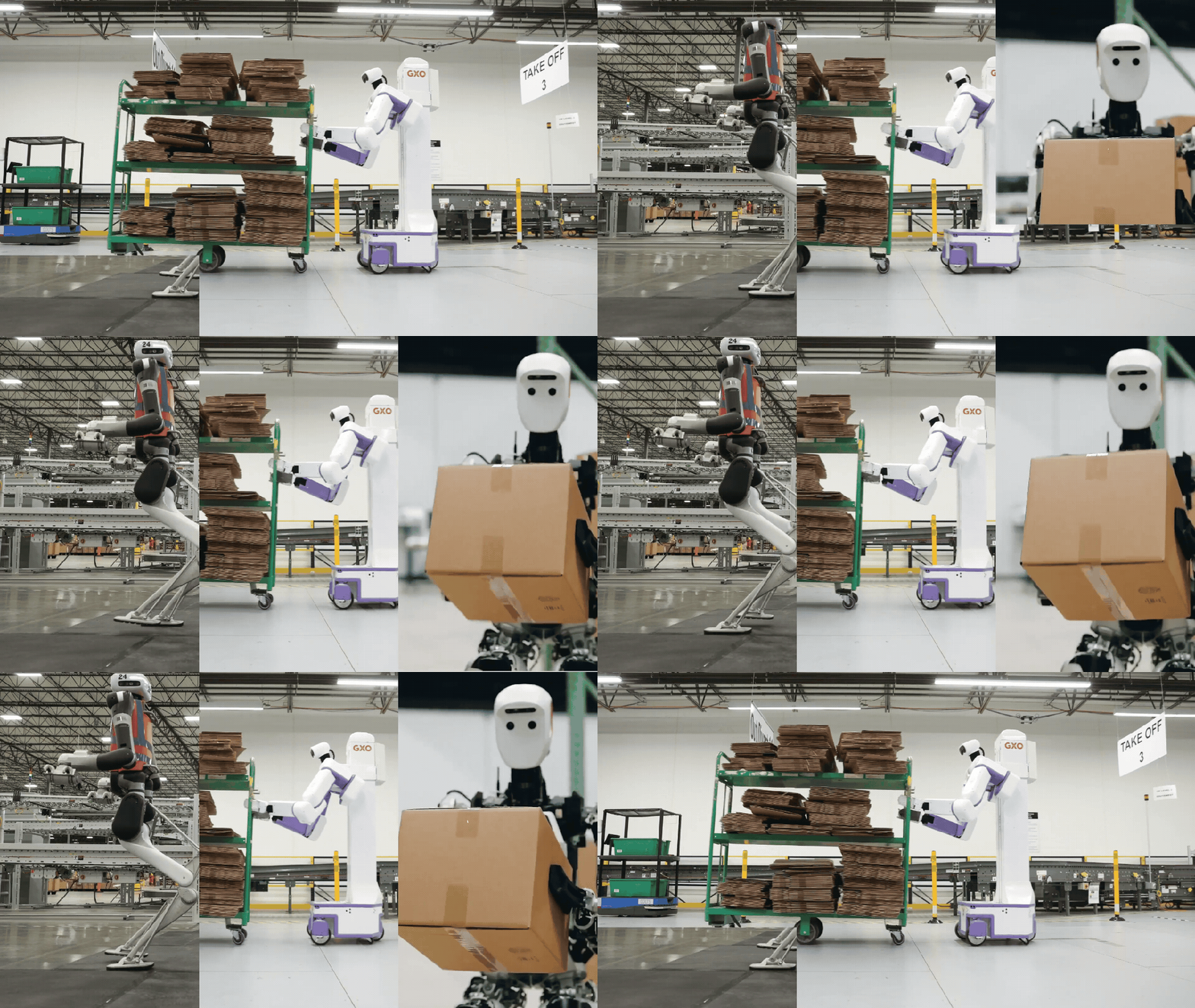
A common characteristic of these tasks is that movement and manipulation often occur simultaneously. Robots need to move between different locations while using their arms and hands to perform actions such as grasping, carrying, or organizing. Therefore, a robot form that can move stably and possess maneuvering capabilities is often more adaptable to these scenarios.
From this perspective, wheeled humanoid robots represent a relatively balanced combination of capabilities. Wheeled mobility enables highly efficient movement in indoor environments, while the humanoid upper body retains the maneuvering capabilities of two arms, allowing the robot to perform various task types.
As more and more companies begin developing robot products around specific scenarios, the application logic of humanoid robots is gradually changing. Unlike the early focus on showcasing technological capabilities, companies are now more concerned with the robot’s task completion efficiency and operational stability in real-world environments.
In this process, some robot forms that are closer to actual operational needs are gradually moving to the forefront of the industry.
New robot forms also require new application stages.
From capital betting on the “brain,” to more and more companies launching complete machines, and then to the increasing prevalence of wheeled humanoid robots, this change reflects that the embodied intelligence industry is moving from technological exploration to scenario implementation.
When robots truly enter real-world environments such as warehousing, logistics, and manufacturing, the industry’s focus is shifting from “can it be made?” to “can it work stably in the scenario?” In this process, the combination of mobility and operational capabilities demonstrated by wheeled humanoid robots provides a new path for the deployment of robots.