Hexagon Robotics and Schaeffler have announced an expanded strategic partnership to accelerate deployment of Hexagon’s AEON humanoid robots within Schaeffler’s global manufacturing network. Following a successful joint pilot in 2025, the companies plan to deploy at least 1,000 units by 2032.
Industrial Context
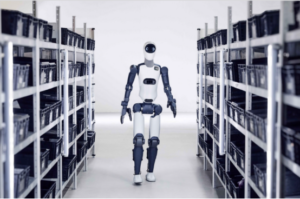
Manufacturers worldwide are under increasing pressure to enhance operational flexibility, efficiency, and sustainability. Traditional fixed automation struggles to adapt to complex, variable production environments, prompting interest in humanoid robotics as a flexible solution. Humanoid robots like AEON can navigate human-centric workspaces and perform tasks requiring fine motor skills, bridging a gap that conventional robotic systems cannot.
Technological Differentiation
AEON combines advanced sensor fusion, spatial intelligence, and physical AI with a wheel-based mobility platform and high-precision manipulators. In pilot deployments, AEON demonstrated multi-station part handling and automated inspection tasks in real production lines, suggesting the robot’s capabilities extend beyond controlled lab environments.
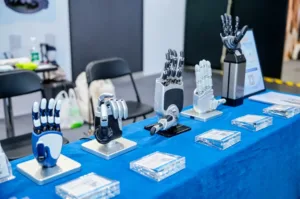
Schaeffler’s contribution of high-precision actuators further enhances AEON’s dexterity and reliability. According to Schaeffler COO Dr. Jochen Schröder, “Our actuator platform underpins next-generation humanoid robotics. Integrating Hexagon’s systems into our factories provides practical validation for these technologies while enhancing operational performance.”
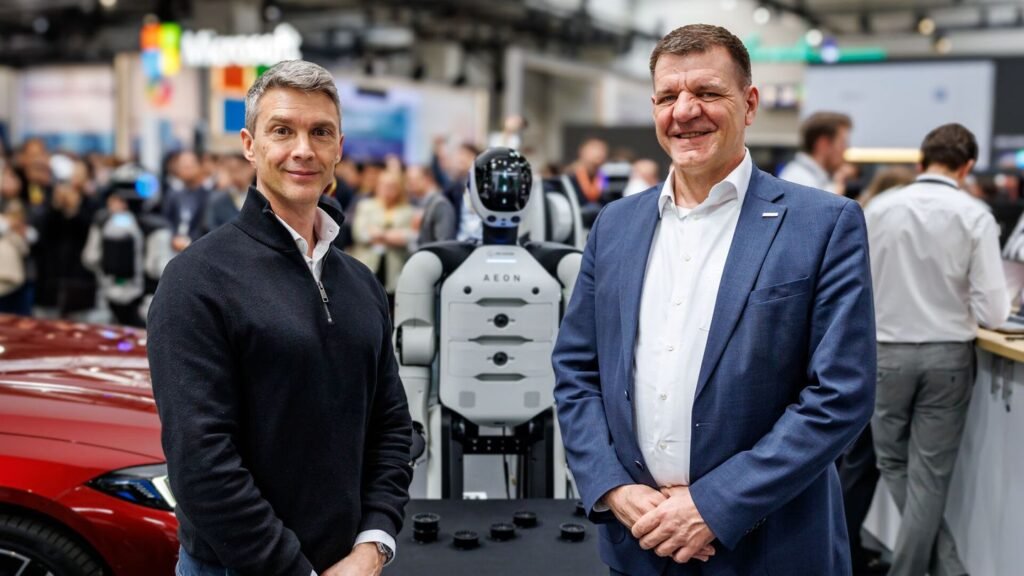
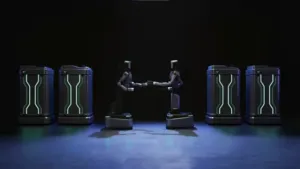
(from left to right) Arnaud Robert, President of Hexagon Robotics, and Dr. Jochen Schröder, Chief Operating Officer at Schaeffler AG, ratified the technology partnership at Hannover Messe. (Image: Schaeffler)
Strategic Implications
This partnership reflects a broader trend toward adaptive, data-driven automation. Key implications include:
Scalable Deployment: Generating operational data from multiple factory sites accelerates AEON’s development for diverse industrial applications.
Flexible Production: Humanoid robots can handle variable tasks across workstations without extensive reconfiguration, supporting agile manufacturing strategies.
Data-Driven Insights: Continuous feedback from real-world operations enables optimization of both robot performance and factory workflows.
Market Perspective
Humanoid robots remain a niche in industrial automation, but early deployments in high-value sectors like automotive and electronics signal growing feasibility. Successful integration of AEON could influence adoption of human-like robots in tasks requiring dexterity, inspection, and multi-station assembly.
Hexagon Robotics’ approach—embedding AI-driven humanoids in active production lines—illustrates the potential for robotics to extend beyond traditional automation, combining mobility, perception, and manipulation in a single platform. For Schaeffler, the collaboration supports its vision of a highly automated, intelligence-driven factory network.
Conclusion
The Hexagon-Schaeffler partnership demonstrates a methodical approach to integrating humanoid robots into industrial operations. While challenges remain—including cost, safety, and system interoperability—the collaboration provides a benchmark for deploying adaptive, data-centric robotic solutions at scale.

To further explore the application potential of this form factor in real-world scenarios, the First Material Handling and Sorting Challenge for Embodied Wheeled Humanoid Robots 2026 will be held on May 21-22, 2026. The First Embodied Wheeled Humanoid Robot Scenario Application Ecosystem Summit 2026 will also be held concurrently, and The Bluebook on the Development of the Wheeled Humanoid Robot Industry will be released.