On September 7, 2026, a notice titled “Public Notice of Employee Claims (Fifth Batch)”—bearing the reference number “(2026) DeepBlue Bankruptcy Administration No. 8-5″—quietly appeared on the bankruptcy administrator’s information channel.
There was no press conference, no letter of apology—only cold, stark figures in red: one additional employee creditor, with outstanding wages and severance pay totaling 346,800 yuan and unpaid housing provident fund contributions amounting to 70,600 yuan. This was in addition to the claims confirmed in the first four batches since the Shanghai Pudong New Area Court accepted the bankruptcy liquidation case on May 7—involving 102 employees and total claims of approximately 23.059 million yuan, the vast majority of which consisted of overdue wages and severance pay.
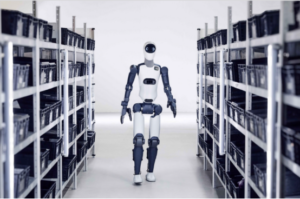
This robotics company—once basking in the halo of the “DeepBlue Technology” AI unicorn group and selling products to over a dozen countries—has ultimately entered judicial liquidation proceedings. At the corporate level, DeepBlue faced bankruptcy liquidation petitions from creditors while publicly announcing the discontinuation of long-loss-making business units—such as traditional autonomous driving and conventional robotics—to pivot resources toward large models and intelligent agents.
DeepBlue Robotics is not the first to face such a predicament.
From Tech Frenzy to a Slow, Painful Demise in Seven Years
Zooming out to the period between 2019 and 2026, the autonomous driving industry chain has been undergoing a seven-year-long, agonizing shakeout—a process akin to being sliced by a dull blade. From autonomous trucking, robotaxis, and LiDAR manufacturers to ADAS solution providers and unmanned delivery vehicles, one star enterprise and “unicorn” valued in the billions after another has faded from the spotlight into obscurity.
According to public data and incomplete statistics from New Strategy Low-Speed Automated Driving Industry Research Institute, more than 40 companies, business units, or projects within the autonomous driving supply chain have exited the market for various reasons since 2019.
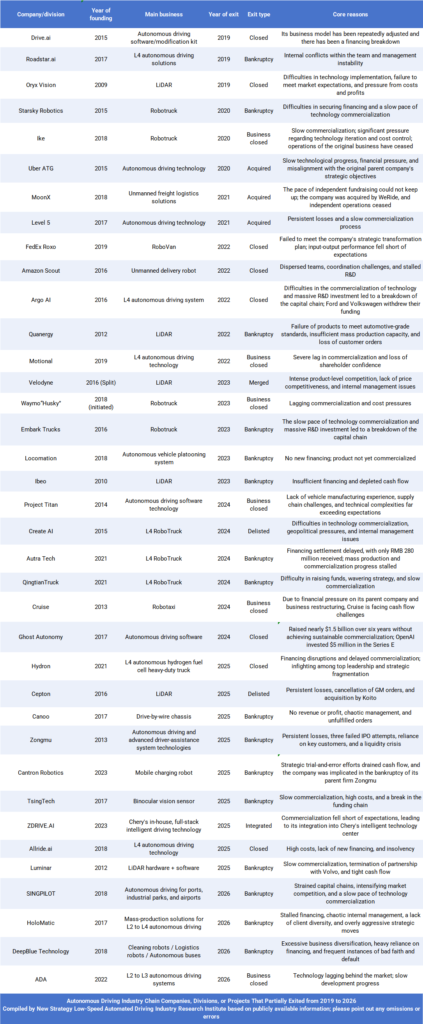
The first to fall were the early players—companies rapidly “ripened” by venture capital but which never managed to solve the fundamental problem of commercial viability. In 2019, RoadStar—which had once set an industry record for Series A funding—entered liquidation following infighting among its founding team; that same year, Drive.ai, a company backed by Andrew Ng, permanently shut down operations. In 2020, Starsky Robotics—the world’s first company to remove safety drivers from trucks—went bankrupt after its capital chain snapped; it was unable to secure the next round of funding.
During this phase, the industry could perhaps still console itself: “Just wait a little longer, and the technology will mature.”
But waiting comes at a cost.
Between 2021 and 2022, investor sentiment began to shift. Argo AI dissolved, and Apple shut down its autonomous driving division; capital was no longer willing to endlessly bankroll visions that remained distant and long-term.
Then, from 2023 to 2025, the industry faced a massive shakeout: HoloMatic halted core operations; Zongmu entered judicial restructuring; Allride.ai was ordered into bankruptcy liquidation after a labor arbitration case revealed it was insolvent; and ZDRIVE.AI was dissolved and absorbed by Chery…
By 2026, exits were no longer just “sudden deaths” of startups but had escalated into strategic loss-cutting at the corporate group level: DeepBlue Robotics’ Shanghai and Changzhou units entered bankruptcy liquidation, and the parent company, DeepBlue Technology, faced bankruptcy liquidation filings while simultaneously axing loss-making traditional autonomous driving and robotics businesses to concentrate resources on large models and intelligent agents.
Capital’s patience ran out before the technology could mature.
Three Modes of Exit, One Fatal Cause
By dissecting the core factors that forced 41 companies out of the market, we found that—whether through bankruptcy liquidation, business shutdowns, or acquisitions—the underlying issues centered on the following areas.
First, a failure to generate internal cash flow: these companies prioritized R&D over revenue collection, relying on external financing to survive. Once capital tightened and cash reserves could not cover the operational cycle, their capital chains inevitably snapped.
Second, slow progress in technology commercialization: a massive engineering gap separated successful lab trials from scaled delivery, and the pace of technological iteration failed to keep up with market demands.
Third, a mismatch between strategic resources and market reality: these companies either spread themselves too thin across too many fronts or bet heavily on a single direction at the wrong time, expending limited resources on targets that offered no short-term return.
Finally, there were errors in organizational management and strategy: during a period of tight cash flow, companies failed to timely consolidate and focus; indecision among leadership and exacerbated internal friction drained already limited cash reserves.
Overall, the forced exits of these enterprises can be attributed to a common pattern: commercial execution lagged behind the technological narrative, strategic ambition outpaced organizational management capabilities, and the ability to generate organic revenue fell short of valuations driven by fundraising.
Technology itself is not the root cause; the mistake lay in confusing “future realization” with “immediate monetization.”
The shoreline is revealed only when the tide recedes.
When viewed within a seven-year cycle, the exit of over 40 companies is not a signal of industry decline; rather, it represents the purging of bubbles inflated by rapid capital injection and the weeding out of players who could answer technical questions but failed to make the economic numbers work.
Therefore, instead of viewing this wave of exits merely as a cooling of the sector, it is better defined as a “deleveraging-style maturation”—where the exit of certain companies paved the way for a correction in industry consensus.
DeepBlue Technology will not be the last company to face this same predicament.
In the future, commercial narratives will supersede technological narratives as the industry’s driving force. Only those capable of transforming technology into deliverable products and grounding their visions in verifiable, closed-loop business models will earn the right to shape the next decade.