China’s mobile robotics industry showed a clear shift in the first half of 2026: growth remained strong, but investors and companies are increasingly focusing on profitability, order quality, overseas expansion and sustainable growth.
Based on the latest financial results, three groups are showing different growth patterns: AGV/AMR manufacturers, traditional forklift makers, and logistics system integrators.
AGV/AMR Manufacturers: Growth and Global Expansion Accelerate
Leading mobile robot companies continued to grow rapidly in H1 2026.
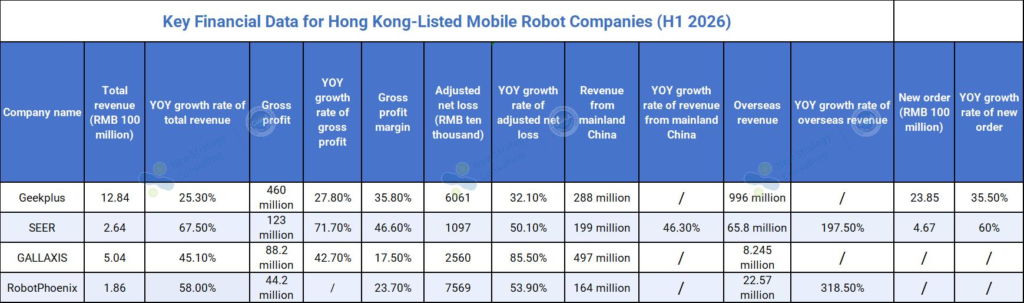
Geekplus, SEER, GALAXIS and RobotPhoenix all reported revenue growth of more than 25%. SEER’s revenue increased 67.5%, while RobotPhoenix grew 58%.
International markets were an increasingly important growth driver. SEER’s overseas revenue rose 197.5%, while RobotPhoenix’s jumped 318.5%. Geekplus generated RMB 996 million in overseas revenue.
At the same time, companies are expanding beyond traditional warehouse automation into manufacturing and other complex industrial applications. Embodied AI is also moving closer to practical deployment, with companies exploring the integration of mobile robots, industrial control and AI-based decision-making.
Geekplus
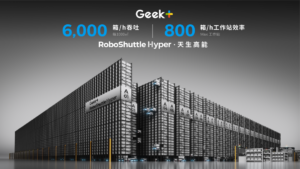
Geekplus reported RMB 1.284 billion in H1 revenue, up 25.3%, while new orders increased 35.5% to RMB 2.385 billion. Gross margin reached 35.8%, and adjusted net loss narrowed 32.1%.
The company is expanding its growth model from warehouse AMRs into manufacturing, subscription-based services and embodied intelligence.
SEER
SEER’s revenue reached RMB 264 million, up 67.5%, with gross margin improving to 46.6%.
Overseas revenue increased 197.5% to RMB 65.8 million, while overseas new orders rose more than 550%. Total new orders exceeded RMB 467 million, providing strong visibility for future growth.
GALAXIS
GALAXIS generated RMB 504 million in revenue, up 45.1%. Its robot and system sales increased 43.8%.
As of June 30, the company had approximately RMB 2.2 billion in orders awaiting delivery, including RMB 710 million from overseas projects. Its business now covers 31 countries and regions.
RobotPhoenix
RobotPhoenix reported revenue of RMB 186 million, up 58%. Robot hardware accounted for 41.9% of revenue, compared with 28.5% a year earlier.
Overseas revenue increased 318.5% to RMB 22.6 million. The company is also investing heavily in embodied AI and industrial robotics, although profitability remains under pressure.
Forklift Manufacturers: Intelligent Logistics Becomes a New Growth Layer
Traditional forklift manufacturers continued to benefit from scale, electrification and overseas expansion, but intelligent logistics is becoming an increasingly important growth driver.
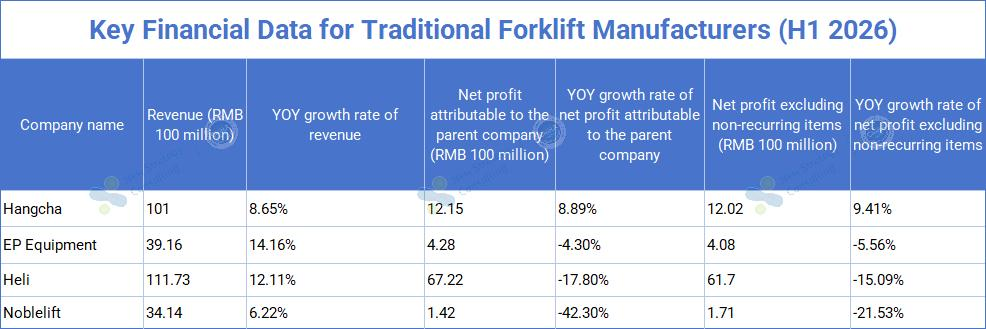
Hangcha generated RMB 10.1 billion in H1 revenue, up 8.65%, while its AGV/AMR business grew 30.81% to RMB 796 million. New AGV/AMR orders reached RMB 892 million.
EP Equipment reported RMB 3.916 billion in H1 revenue, up 14.16% year over year, while net profit fell 4.3%. Gross margin improved 1.5 percentage points to 30.9%.
Heli generated RMB 11.17 billion in revenue, up 12.11%, with overseas revenue rising 25% to RMB 5.02 billion.
Noblelift‘s revenue increased 6.22% to RMB 3.415 billion, while overseas revenue accounted for approximately 66% of total revenue.
The trend suggests that established forklift manufacturers are increasingly combining their traditional industrial vehicle businesses with robotics, intelligent logistics and AI-driven automation.
System Integrators: Greater Volatility, New Growth Strategies
System integrators faced greater pressure from project cycles and profitability.
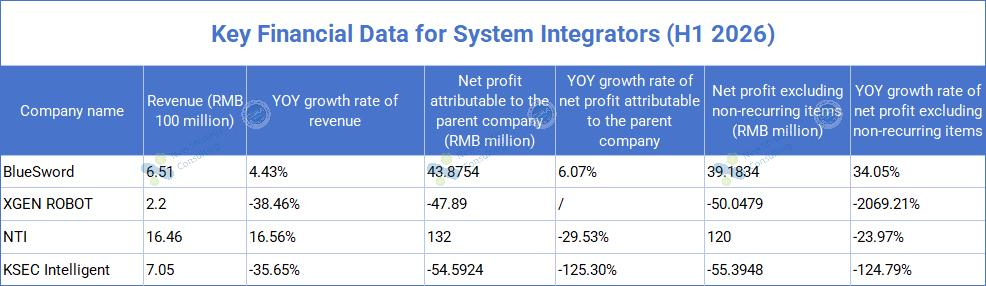
BlueSword was a notable exception. Revenue increased 4.43% to RMB 651 million, while net profit rose 6.07%. Overseas revenue more than doubled, reaching RMB 124 million.
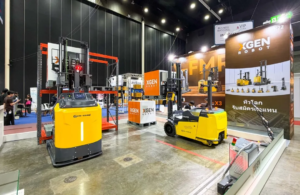
XGEN ROBOT, by contrast, saw revenue fall 38.46% to RMB 220 million as it entered a period of business restructuring and product expansion.
NTI maintained revenue growth of 16.56% to RMB 1.646 billion, but net profit declined 29.53%.
KSEC Intelligent reported a 35.65% decline in revenue to RMB 705 million, reflecting the impact of project cycles.
To reduce reliance on project-based revenue, system integrators are increasingly exploring standardized products, software, overseas markets and embodied robotics.
The Industry Is Moving From “Growth” to “Growth Quality”
The first-half results point to a broader change in China’s mobile robotics market.
For AGV/AMR manufacturers, international expansion, software, services and embodied AI are becoming new growth drivers.
For forklift manufacturers, intelligent logistics and electrification are adding new growth layers to established businesses.
For system integrators, the key challenge is to reduce dependence on project cycles and develop more scalable business models.
The industry’s next stage will therefore be less about who can grow fastest and more about who can turn growth into sustainable profitability and long-term competitiveness.
Revenue growth still matters. But increasingly, orders, margins, overseas execution and recurring revenue will determine which companies can sustain that growth.