According to statistics from the Low-Speed Automated Driving Industry Alliance (LSAD) and the New Strategy Low-Speed Auutomated Driving Industry Research Institute, by 2025, China saw approximately 850 units of autonomous transportation vehicles deployed at various ports, representing a year-on-year growth of 70.0%; the sales volume is estimated at approximately RMB 1.62 billion, up 36.2% year-on-year.
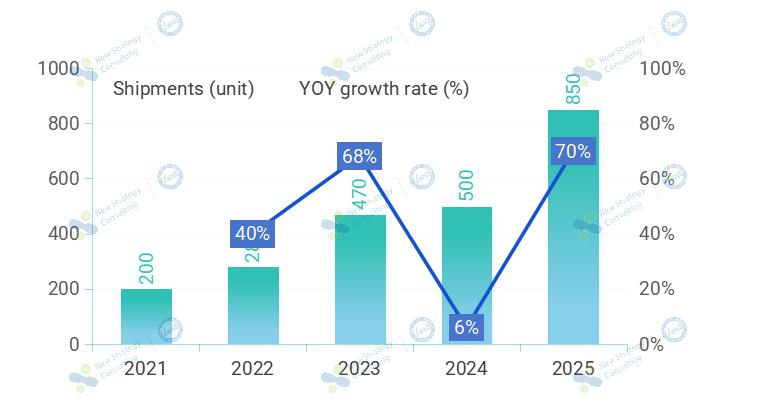
Fig.: Shipments and Growth Rate of Autonomous Vehicles at Chinese Ports from 2021 to 2025
In the first half of 2026, the industry continued its growth trajectory; as of the end of June, the newly added shipments of autonomous transport vehicles at various Chinese ports had exceeded 400 units, with the cumulative shipments over the years amounting to approximately 2,700 units (excluding vehicles not in operation). Of these, approximately 85% were delivered to Chinese ports for use.
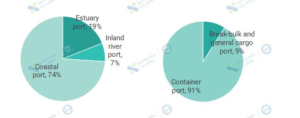
From an application perspective, the vast majority of autonomous vehicles delivered at Chinese ports over the years have been deployed at seaports (including coastal and estuary ports), with container ports serving as the primary application scenario.
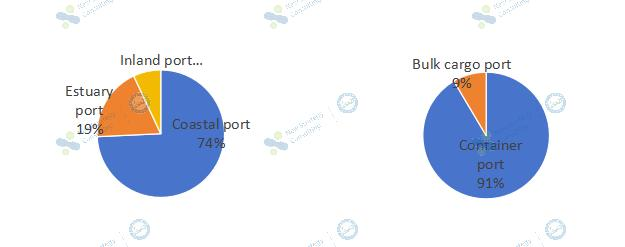
Fig.: Distribution of application scenarios for Autonomous Transport Vehicles at Chinese Ports
In terms of deployment scale, according to statistics from the LSAD and the New Strategy Low-Speed Automated Driving Industry Research Institute, nearly 40 port areas across China have implemented the mass deployment of autonomous transport vehicles (10 or more units), with 15 of these port areas featuring large-scale deployments (50 or more units).
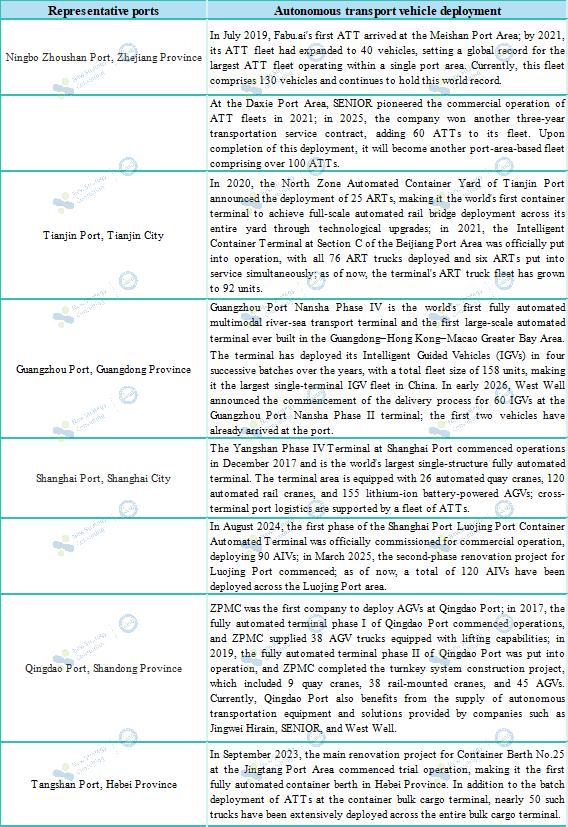
Fig.: Deployment Projects of Hundreds of Autonomous Transport Vehicles in Selected Chinese Ports
Among the deployed vehicle types, intelligent flatbed transport vehicles account for the largest delivery volume, representing over 60% of the total, with more than 1,400 units currently in operation across China, making them the primary model for current autonomous port transportation scenarios. ATTs follow, accounting for over 30% of the total.
It should be noted that the term “ATT” is often used in a broad sense within the industry; however, to facilitate consistent communication, the industry commonly refers to all driverless container transport vehicles operating in port environments as “ATTs.”
The term “ATT” as used in this article specifically refers to autonomous vehicles featuring a standard configuration of “trailer + semi-trailer container unit” and equipped with an independent traction power unit; this category includes both traditionally modified tractor trucks with a cab and wire-controlled traction system, as well as dedicated tractor trailers without a cab developed specifically for port-based operational scenarios.
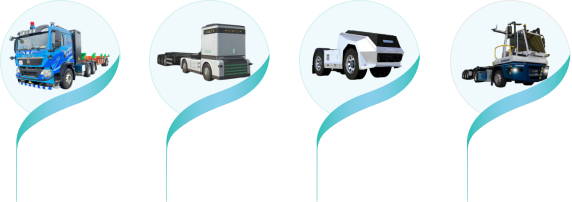
Fig.: Representative Models of ATTs for Selected Ports
In contrast, autonomous transfer equipment at ports that employs an integrated vehicle chassis combined with a container handling platform and does not feature an independent tractor unit, is uniformly classified as intelligent flatbed transport vehicles. From a technical perspective, this category of equipment is primarily divided into two main types: traditional magnetic-pin-guided AGVs and multi-sensor fusion-based autonomous navigation flatbed transfer vehicles; among these, the multi-sensor fusion approach has become the prevailing method.
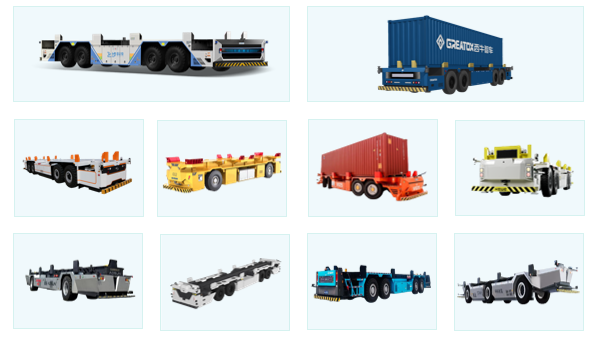
Fig.: Representative Models of Intelligent Flatbed Transport Vehicles for Selected Ports