On April 19, in the 2026 Beijing E-town Half Marathon and Humanoid Robot Half Marathon, the “Lightning” robot from the Qitian Dasheng team won the championship with a net time of 50 minutes and 26 seconds, even surpassing the world record for men’s half marathons. After the race, Honor released a poster stating that all six teams that finished in the top six used Honor robots.

Looking back at the timeline, from establishing a new industry incubation department in 2025 to officially entering the humanoid robot race, to “Lightning” winning the half marathon in 2026, Honor only took a little over a year. Behind this speed lies both the result of technological advancement and the formation of a complete supply chain capability.
- A Marathon, a Complete Supply Chain
From navigation and perception to structural components, execution systems, and heat dissipation solutions, behind this race, an industrial chain centered around the “Lightning” robot has clearly emerged.
CHCNAV
CHCNAV stated that it provided the “Lightning” robot with a full range of StellaX+PointX positioning solutions. This solution integrates high-precision chips, robust algorithms, and global differential services, providing solid perception support for outdoor humanoid robots with centimeter-level real-time positioning and excellent anti-interference capabilities, making “dynamic navigation” no longer a challenge.

AAC Technologies
AAC Technologies stated that the company mainly undertakes the development and delivery of precision structural components for the core motion units of robot heads and legs, completing customized MIM/CNC component design verification and mass production preparation in an extremely short cycle, ensuring that key structures meet standards in strength, precision, and reliability.
LY iTECH
LY iTECH also stated that the company is the supplier of 159 core structural components and surface treatments for the Honor championship robot “Lightning,” and its Dongguan Hengli factory has already delivered products in batches. Currently, it possesses core technologies for the execution layer of humanoid robots, such as servo motors, reducers, drivers, and motion controllers, and has provided humanoid robot customers with core hardware such as head assemblies, dexterous hand assemblies, limb assemblies, high-power charging, and heat dissipation solutions.
LENS
Lens was also deeply involved, providing 132 core metal structural components for the Honor robot, covering key motion units such as the head, arms, hips, and legs. LENS and Honor are in a deep collaborative phase of “joint development and simultaneous verification,” jointly overcoming industry challenges such as the high-degree-of-freedom joint structure of humanoid robots, providing a mature engineering path for embodied intelligence to move from the laboratory to consumer applications.
ORBBEC
ORBBEC previously stated that it provided the Gemini 330 series binocular 3D camera for Honor’s first humanoid robot, “Yuanqizai,” equipped with its self-developed depth engine chip MX6800, and combined with an active-passive fusion imaging system, enabling the robot to stably output high-quality depth data indoors and outdoors, as well as in complex lighting environments, thereby improving the reliability of overall environmental perception and action execution.
Hesai
Hesai stated that Honor’s first humanoid robot is equipped with the Hesai JT series LiDAR. According to reports, the Hesai JT series LiDAR provides the robot with 360° zero-blind-spot 3D perception, while also featuring a lightweight design and high reliability.
- The Mobile Phone Supply Chain is Taking Over Humanoid Robots
The rapid shift in supply chain composition reveals a clear change: more and more companies that previously served consumer electronics are entering the humanoid robot industry chain en masse.
Companies like AAC Technologies, LY iTECH, and LENS have long been deeply involved in the core supply chains of mobile phone and other consumer electronics manufacturers, accumulating mature capabilities in precision structural components, complete machine manufacturing, and process control. Now, these capabilities are being directly transferred to humanoid robots.
The Humanoid Robot Industry Development Research Report 2026 points out that the OEM/ODM system is becoming a key foundation for robots to move from prototypes to large-scale production, and is gradually differentiating into three paths during its development: OEM/ODM of complete machine, OEM/ODM of core modules, and joint development and manufacturing (JDM).
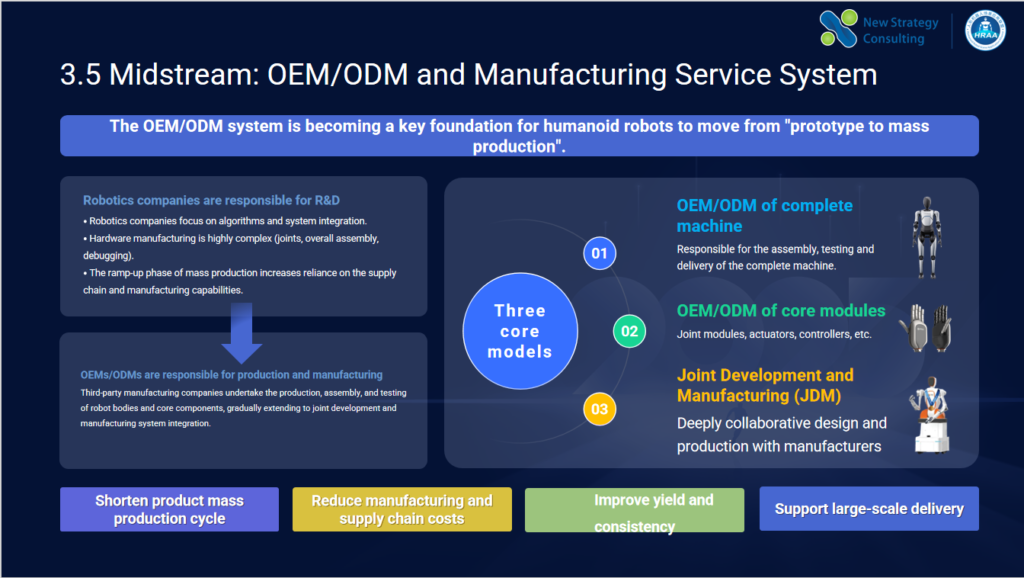
This means that the humanoid robot industry is replicating an industrial division of labor path highly similar to that of consumer electronics.
With manufacturers like Honor, Vivo, and Xiaomi continuing to increase their investment, the consumer electronics industry chain is beginning to absorb the “spillover effect” of humanoid robots. Electronic Manufacturing Services (EMS) companies such as Foxconn, Luxshare ICT, LENS, LY iTECH, and Jabil have already developed the systemic capabilities for large-scale manufacturing of complex products, supply chain integration, and cost control.
More importantly, these companies are extending their roles from “component suppliers” to “system-level manufacturing capability providers.” From structural components and precision manufacturing to core modules and even complete machine assembly, they are gradually embedding themselves into key aspects of robot production. Once the product form stabilizes, this system can quickly bring humanoid robots into a large-scale production track similar to that of mobile phones, accelerating the industry’s transition from the verification stage to true mass production.
- Beyond the “lower body,” the real competition lies in the “upper body”
The reason why this competition is so popular is not hard to understand. It is intuitive and easily disseminated. Viewers can immediately see who runs more steadily, who runs further, and who can finish the race. In a sense, marathons are bringing the “lower body capabilities” of humanoid robots into the spotlight.
However, besides the “lower body,” the “upper body” of humanoid robots is the foundation that truly determines their practical application. Therefore, while the industry is focused on how humanoid robots can complete a half marathon, another type of competition, more focused on real-world tasks, also deserves attention.
From May 21 to 22, 2026, the First Embodied Wheeled Humanoid Robot Scenario Application Development Forum will be organized by China Mobile Robot Industry Alliance (CMRA) and Humanoid Robot Scene Application Alliance (HRAA) and exclusively sponsored by Elite Robots.

Concurrently, the Material Handling and Sorting Challenge for Embodied Wheeled Humanoid Robots 2026 will also be held, focusing on two main scenarios: handling and sorting. Stay tuned!