The industrial mobile robot market is shifting from hardware-led growth to value-driven competition. At the 2026 Embodied Picking and Loading Robot Industry Forum held in Shanghai on November 4, the Industry Mobile Robot Intelligent Development Trend Research Report was officially released. The report was jointly hosted by the Mobile Robot Industry Alliance and the Humanoid Robot Scenario Application Alliance, and organized by New Strategy Mobile Robot Media.
With the theme “Embodied Intelligence Empowers Intelligent Loading and Unloading,” the forum brought together industry chain companies, technology experts and market participants to discuss embodied AI in logistics picking, loading and unloading, warehousing and commercial deployment.
Based on CMRA statistics, the report analyzes the global and China AGV/AMR market, technology evolution, competitive landscape and future opportunities.
Cover page of the CMRA and New Strategy Consulting report covering global market analysis, technology, and industry trends.
Three Core Judgments for the Industrial Mobile Robot Market
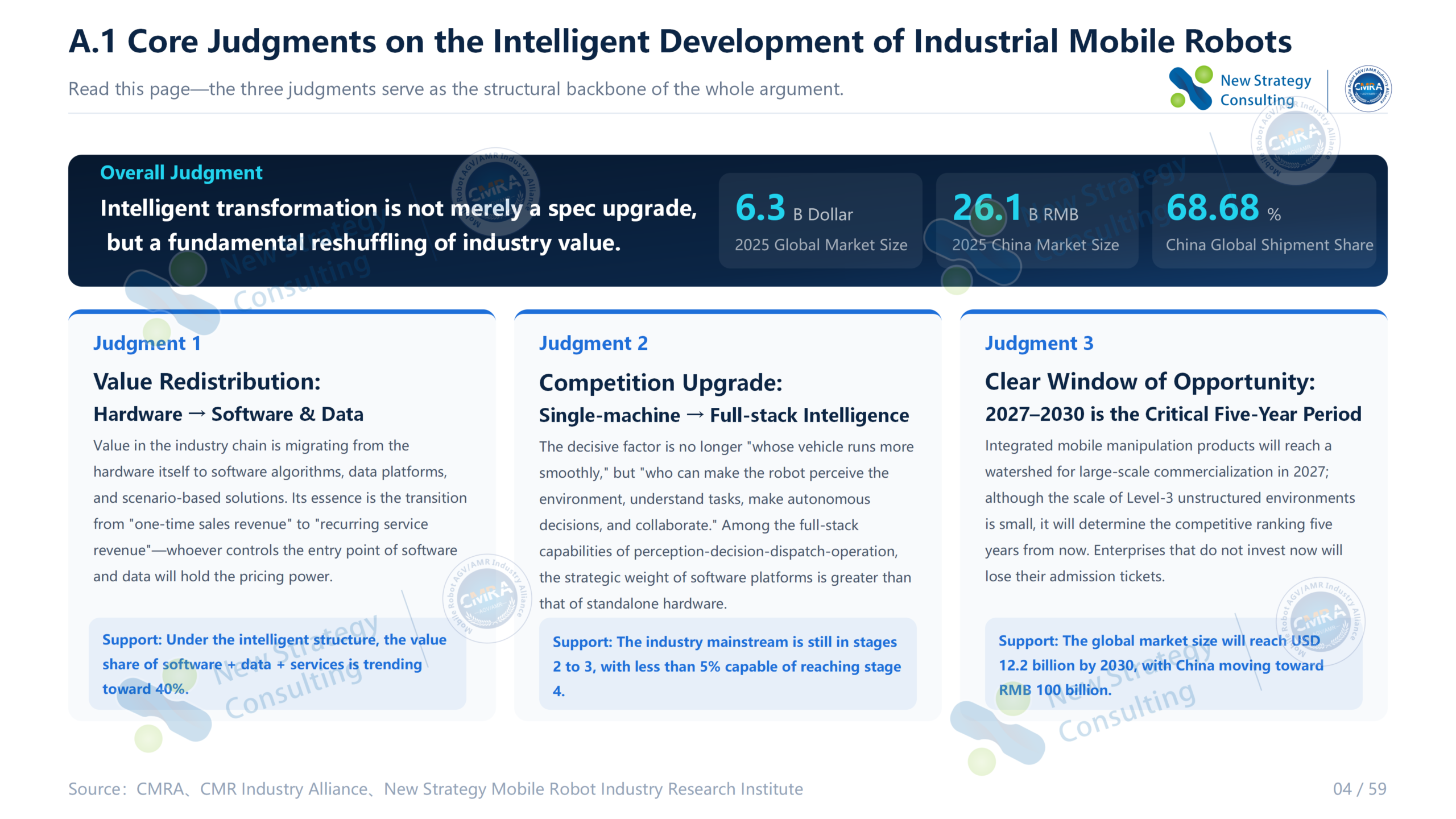
1. Value redistribution
Industry value is migrating from hardware bodies to software algorithms, data platforms and scenario-based solutions. The business model is moving from one-time equipment sales to recurring service revenue. Companies that control software and data entry points will control value distribution.
2. Competition upgrade
The deciding factor is no longer simply “whose vehicle runs more stably.” It is “whose robot understands scenarios, interprets tasks, makes autonomous decisions and collaborates with other systems.”
3. A clear window: 2027–2030
The report identifies 2027–2030 as a critical five-year window. Integrated mobile manipulation products are expected to reach a scale-commercialization inflection point in 2027. By 2030, the global market is projected to reach US$12.2 billion.
Key Industrial Mobile Robot Market Data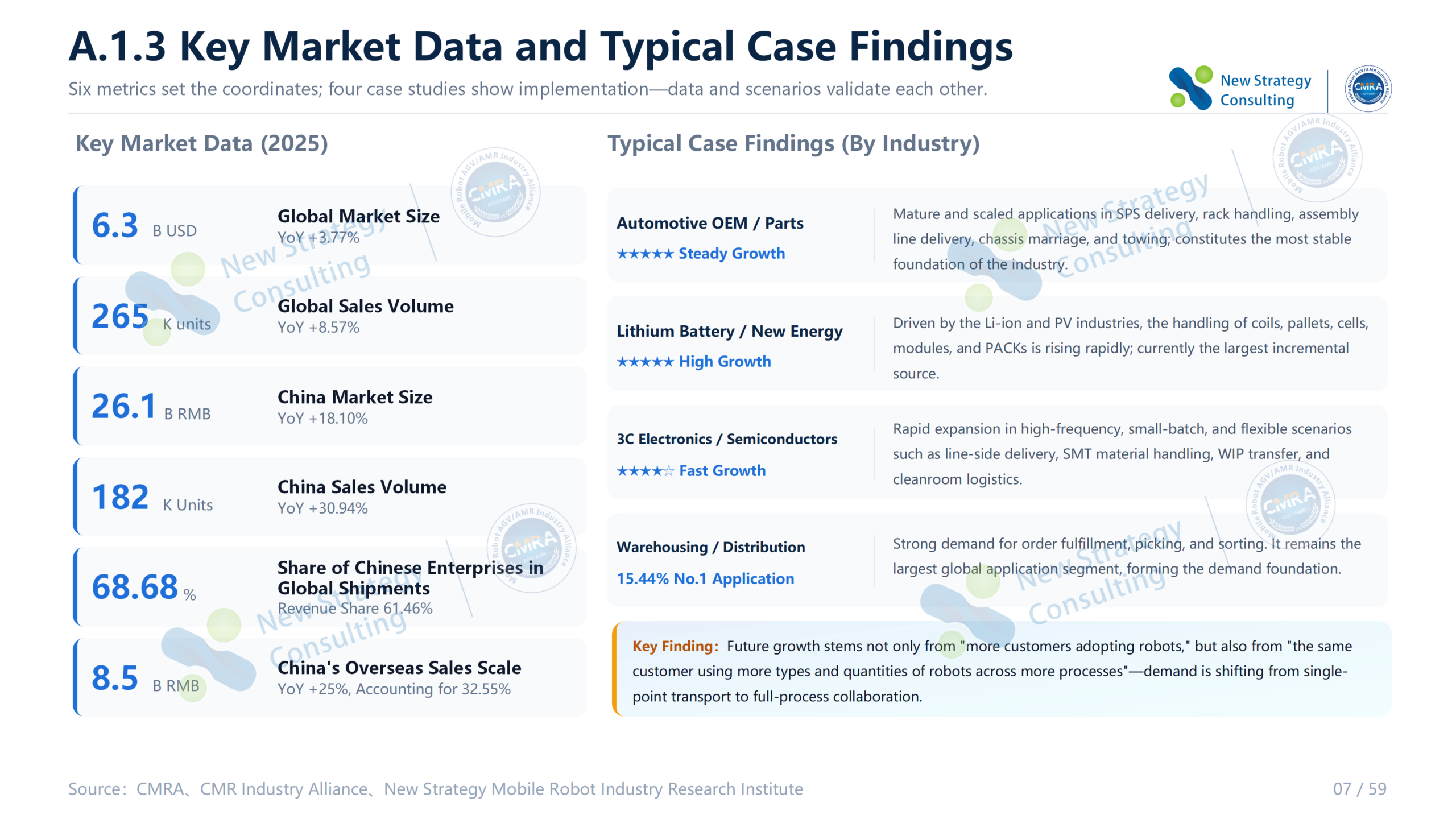
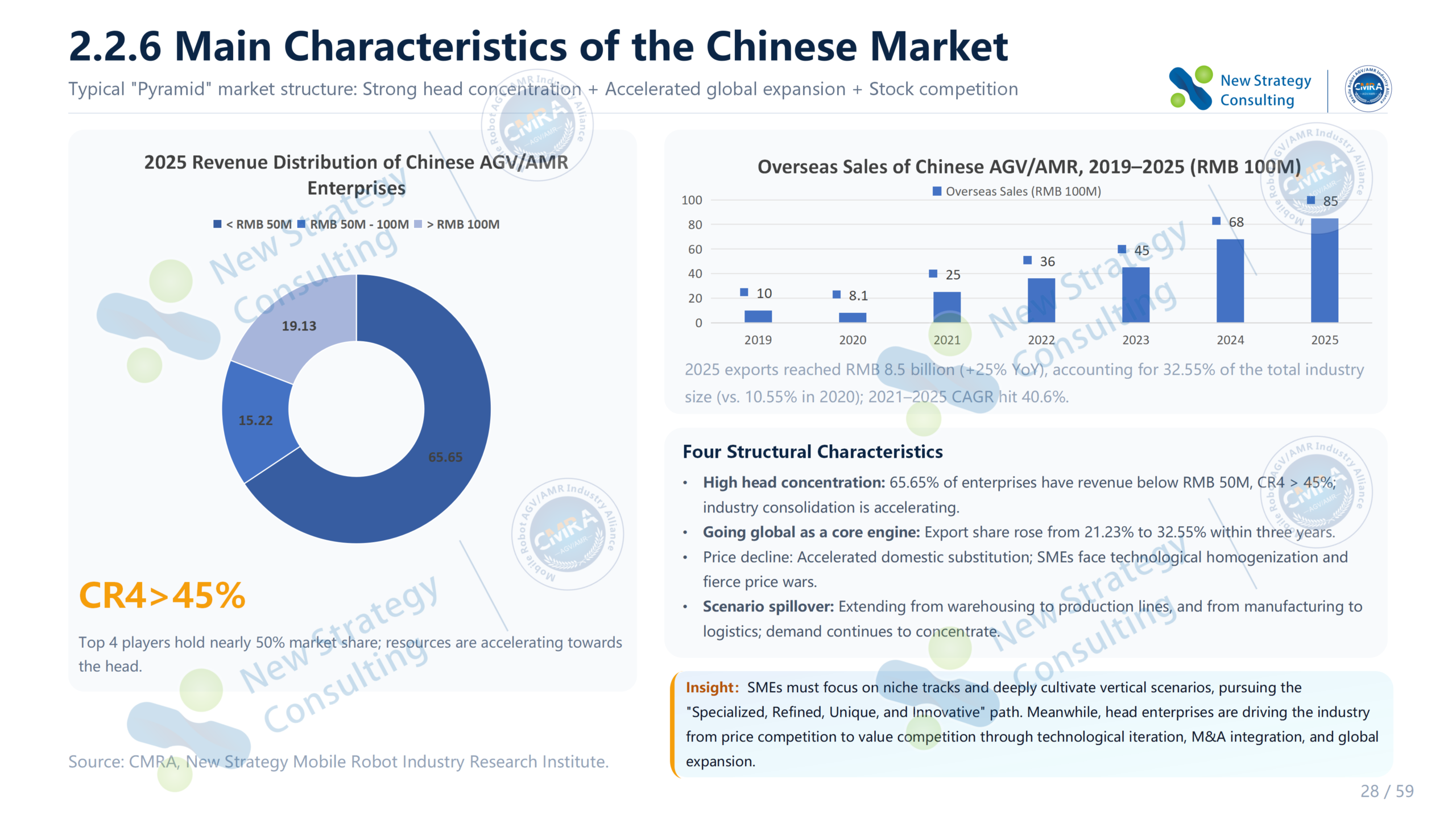
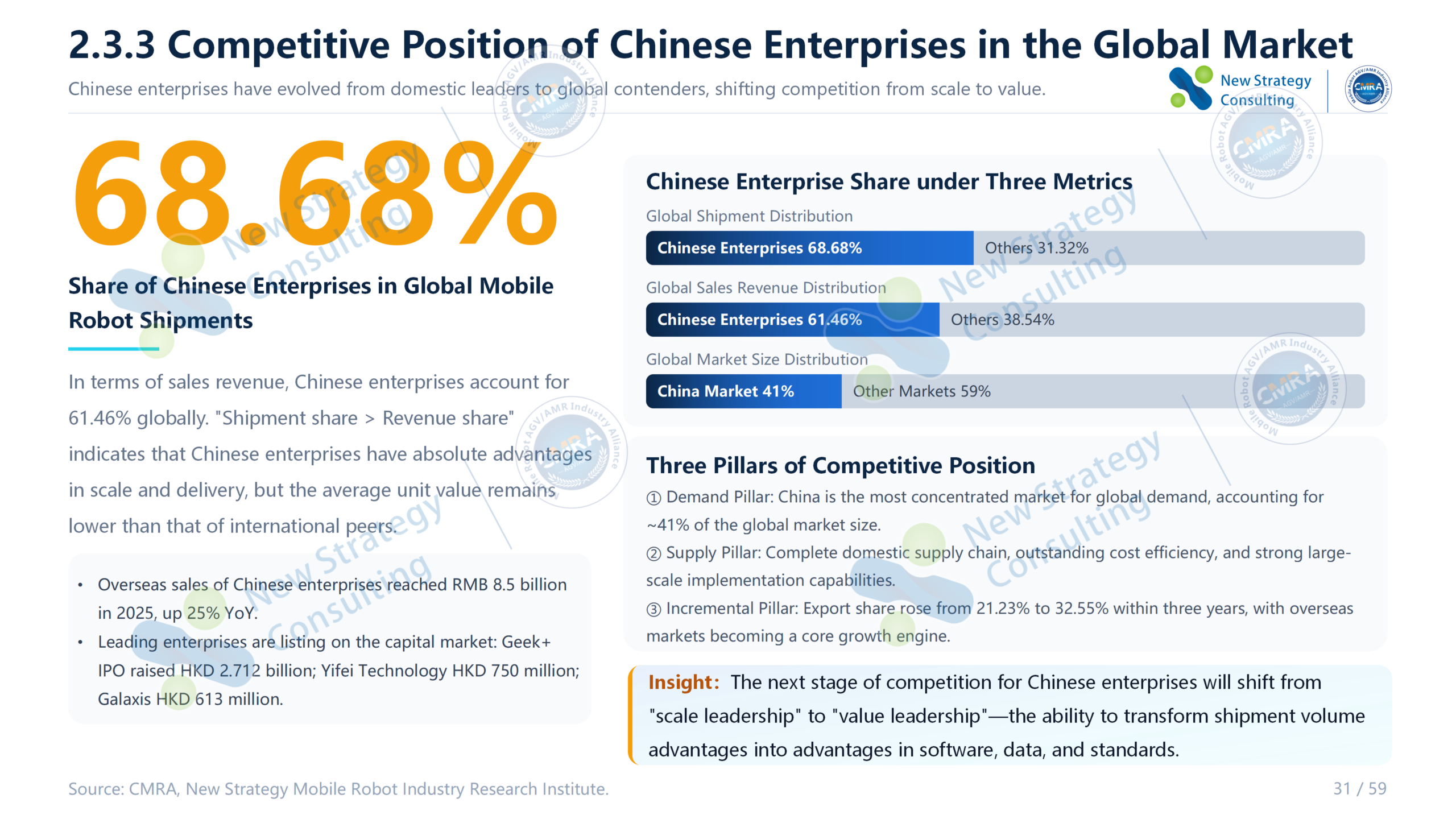
In 2025, global industrial mobile robot sales reached USD6.3 billion, a year-on-year increase of 3.77%; sales volume reached 265,000 units, a year-on-year increase of 8.57%. In the same period, China’s market size reached RMB26.1 billion, with sales volume of 182,000 units; Chinese companies accounted for 68.68% of global shipments, and overseas sales reached RMB8.5 billion.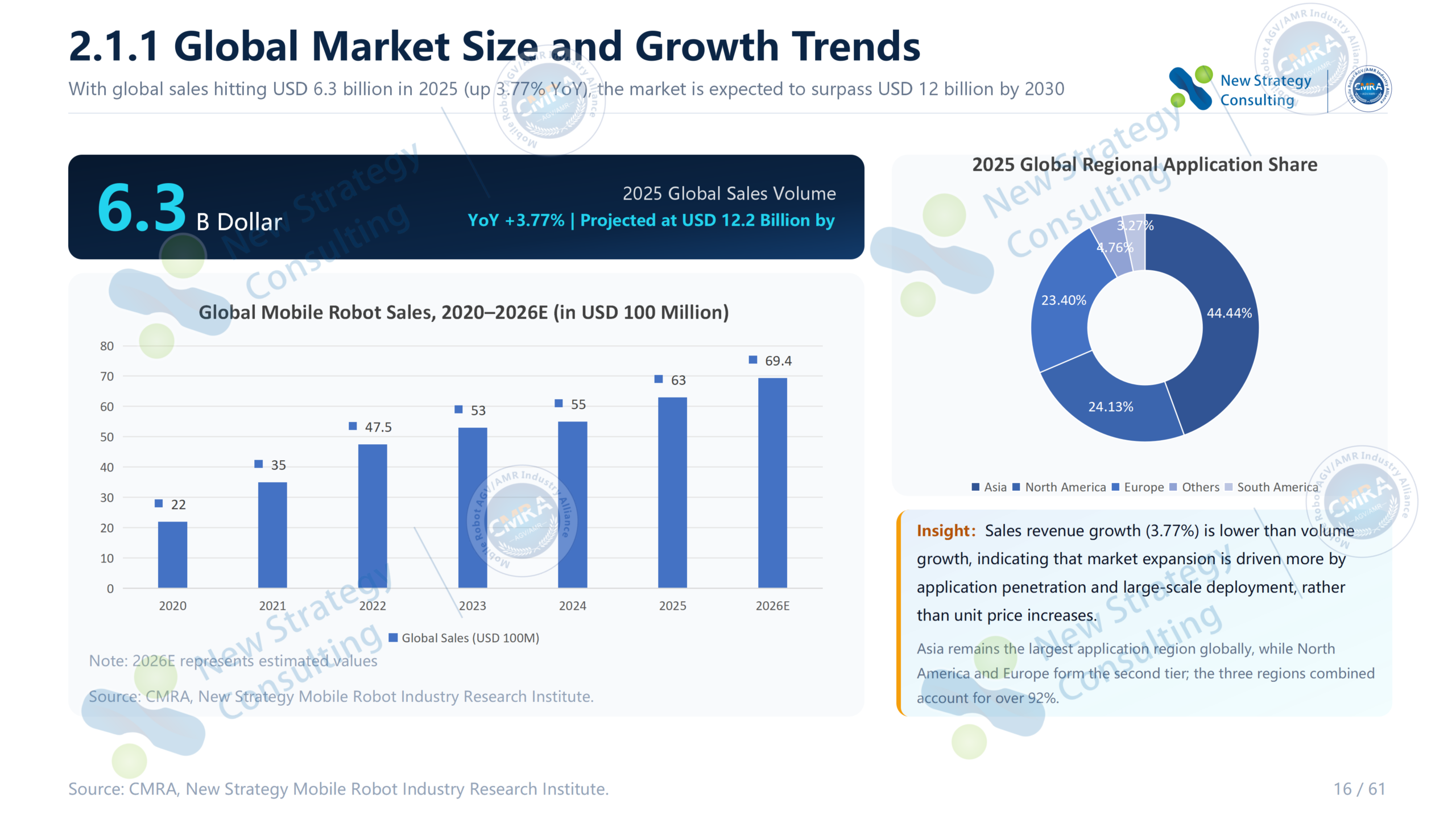
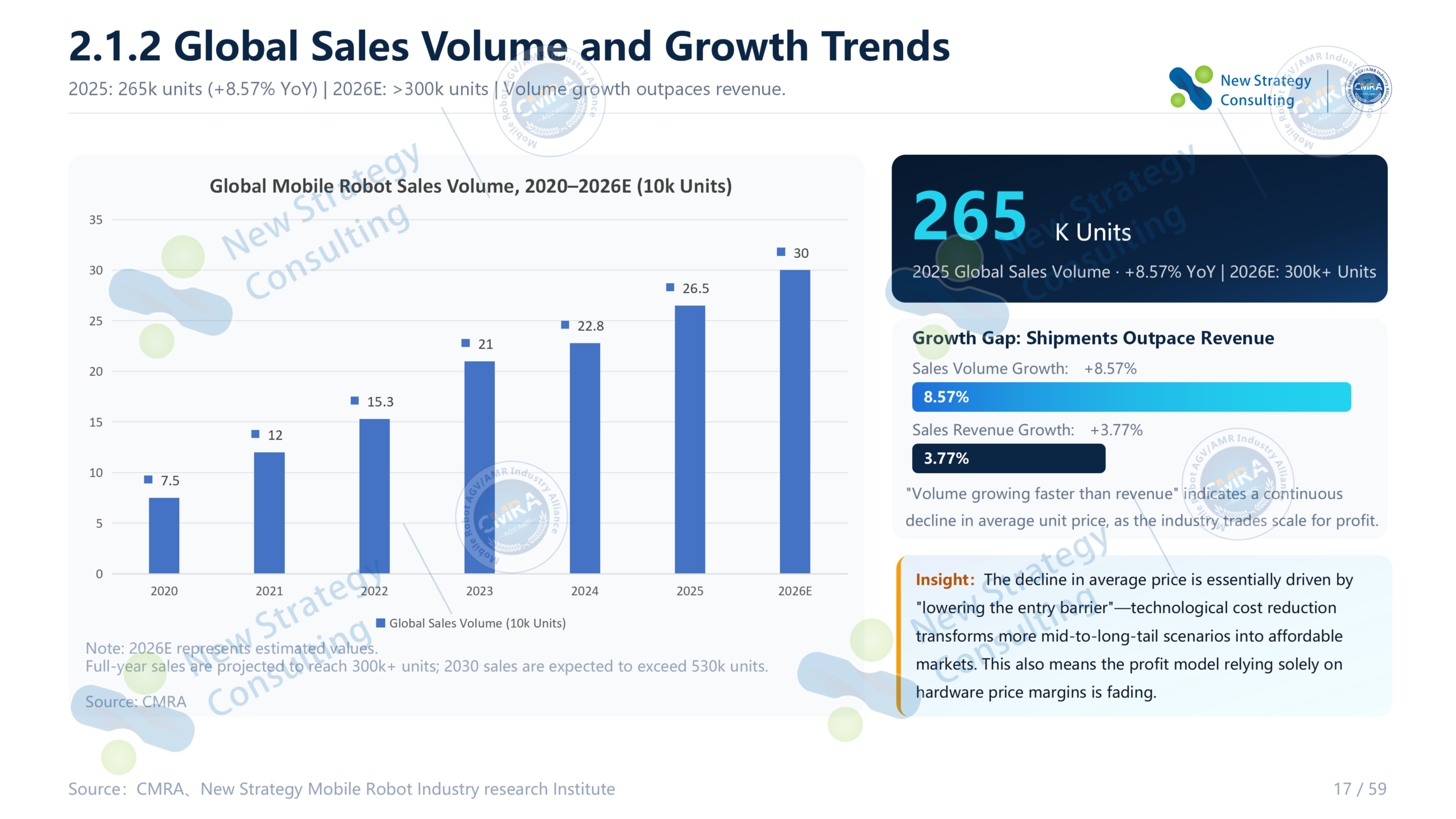
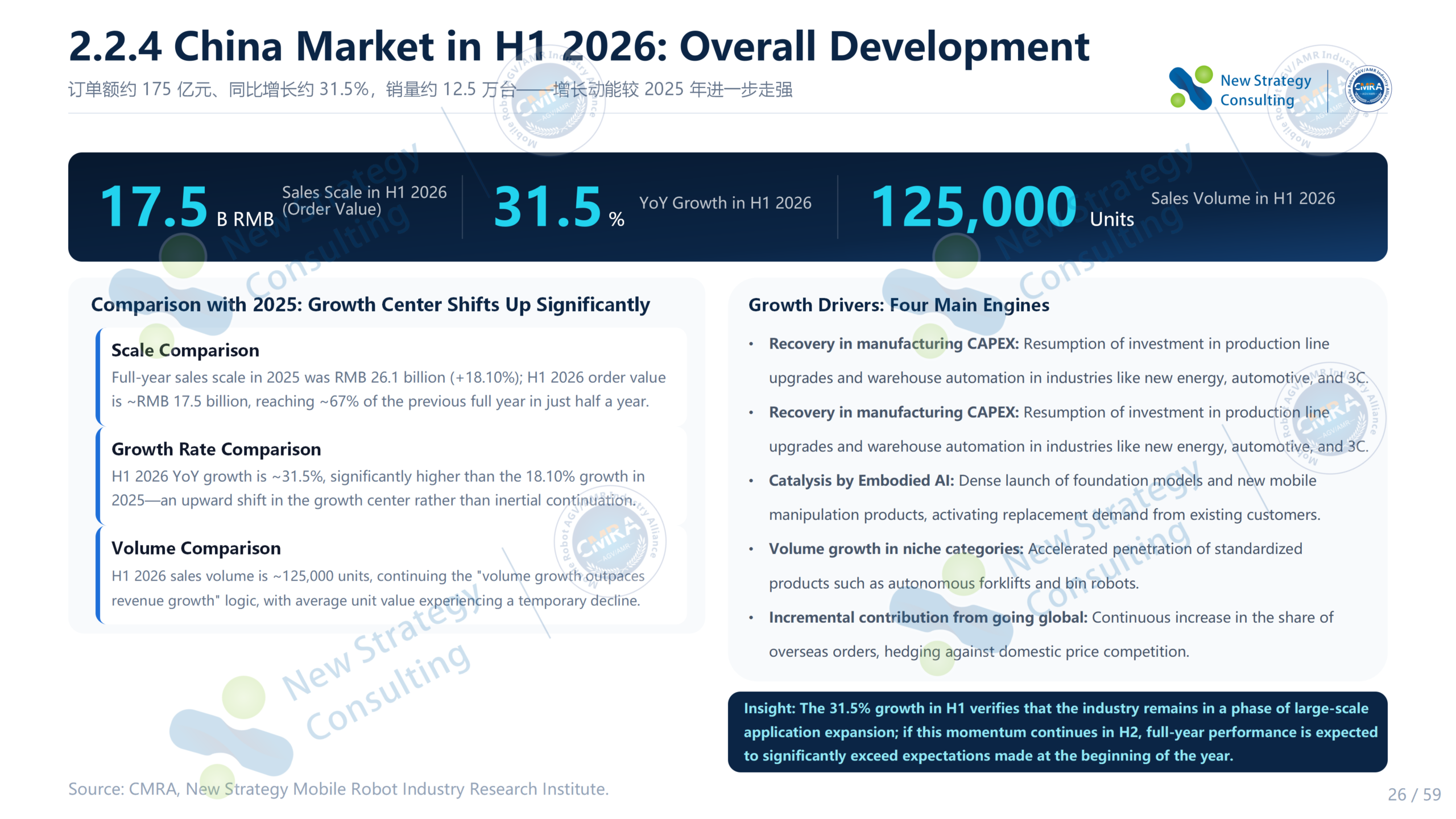
In the first half of 2026, Chinese companies’ sales reached RMB17.5 billion, a year-on-year increase of approximately 31.5%, with sales volume of approximately 125,000 units. Growth momentum further strengthened compared with 2025, and going overseas is becoming a second growth curve.
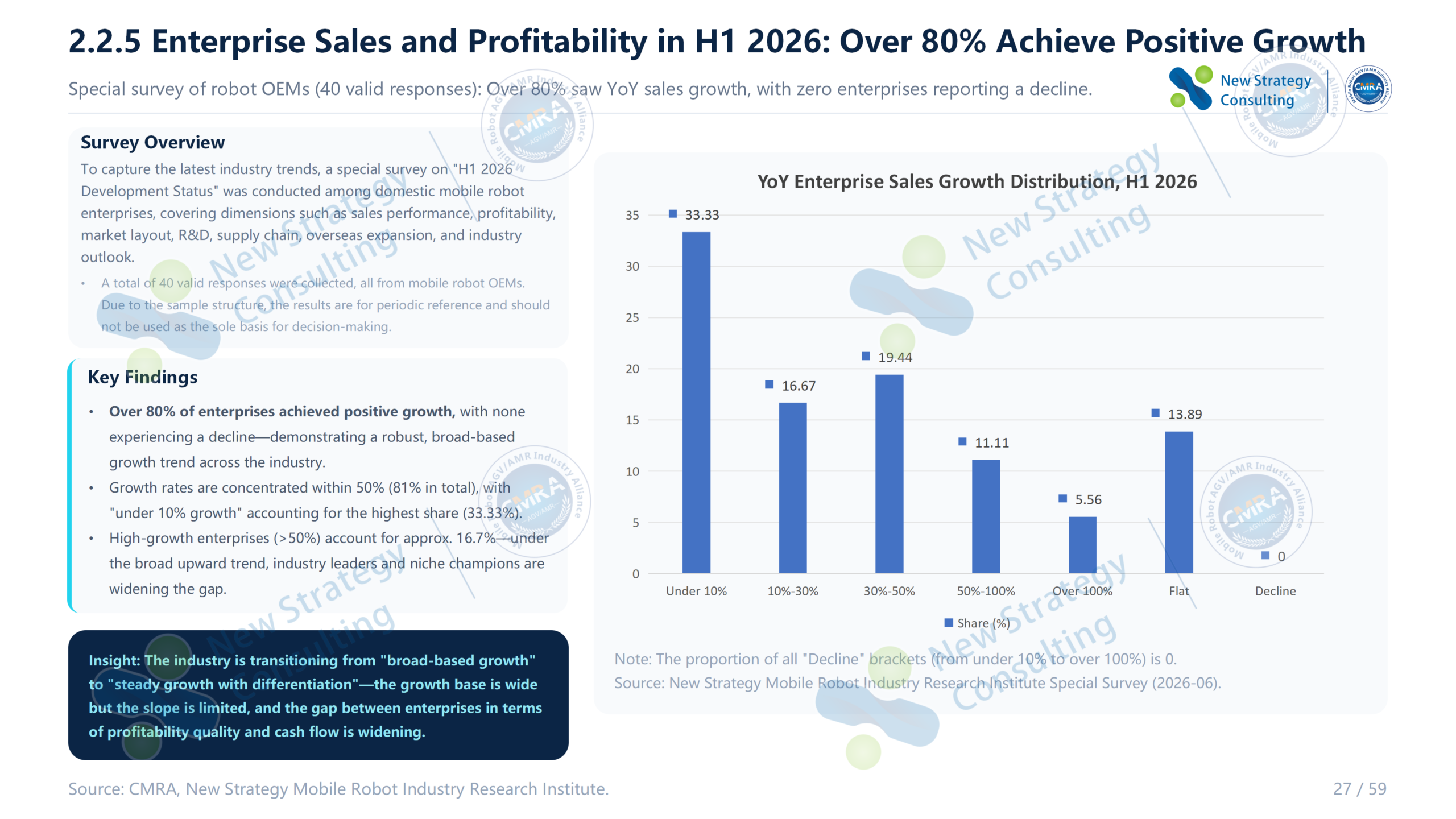
From the enterprise side, more than 80% of industrial mobile robot companies achieved positive sales growth. The industry has moved from “broad-based growth” into a period of differentiated modest growth, and leading companies and segment champions are accelerating their separation from the pack. Overseas sales reached RMB8.5 billion, with their share rising to 32.55%.
Based on current performance, the market presents four major characteristics: strong concentration of leading players, accelerated overseas expansion, downward price movement, and extension of scenarios. Looking ahead, SMEs need to focus on segmented tracks and follow the path of “specialized, refined, distinctive, and innovative” development, while leading companies need to promote the industry’s shift from “price competition” to “value competition” through technology iteration and global layout.
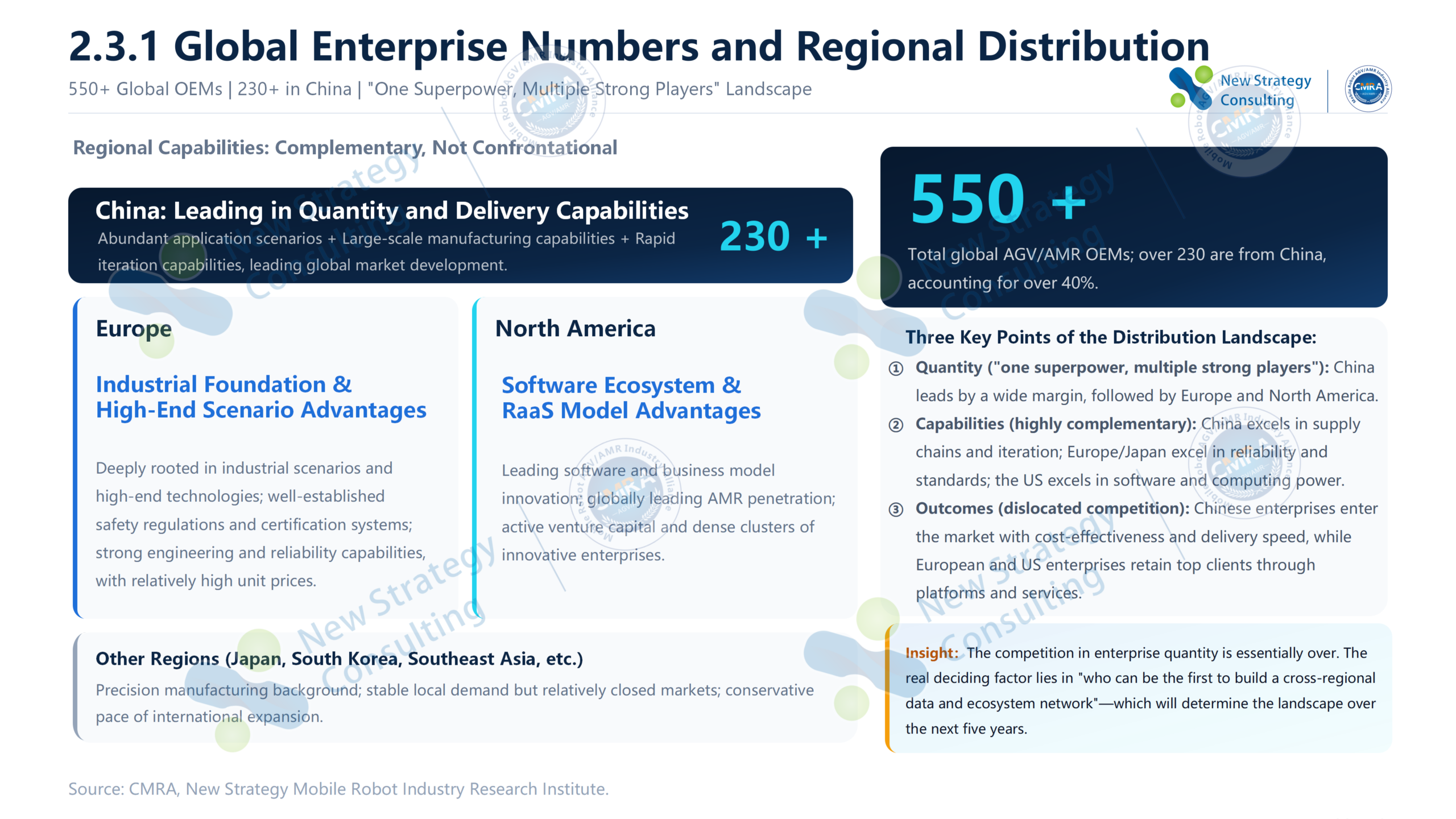
There are now more than 550 industrial mobile robot companies globally. China has 230, accounting for more than 40%, forming a “tri-polar” distribution pattern across China, Europe, and North America. With strong delivery capabilities, China accounts for 68.68% of global shipments and is facing the transformation challenge from “volume leadership” to “value leadership.”
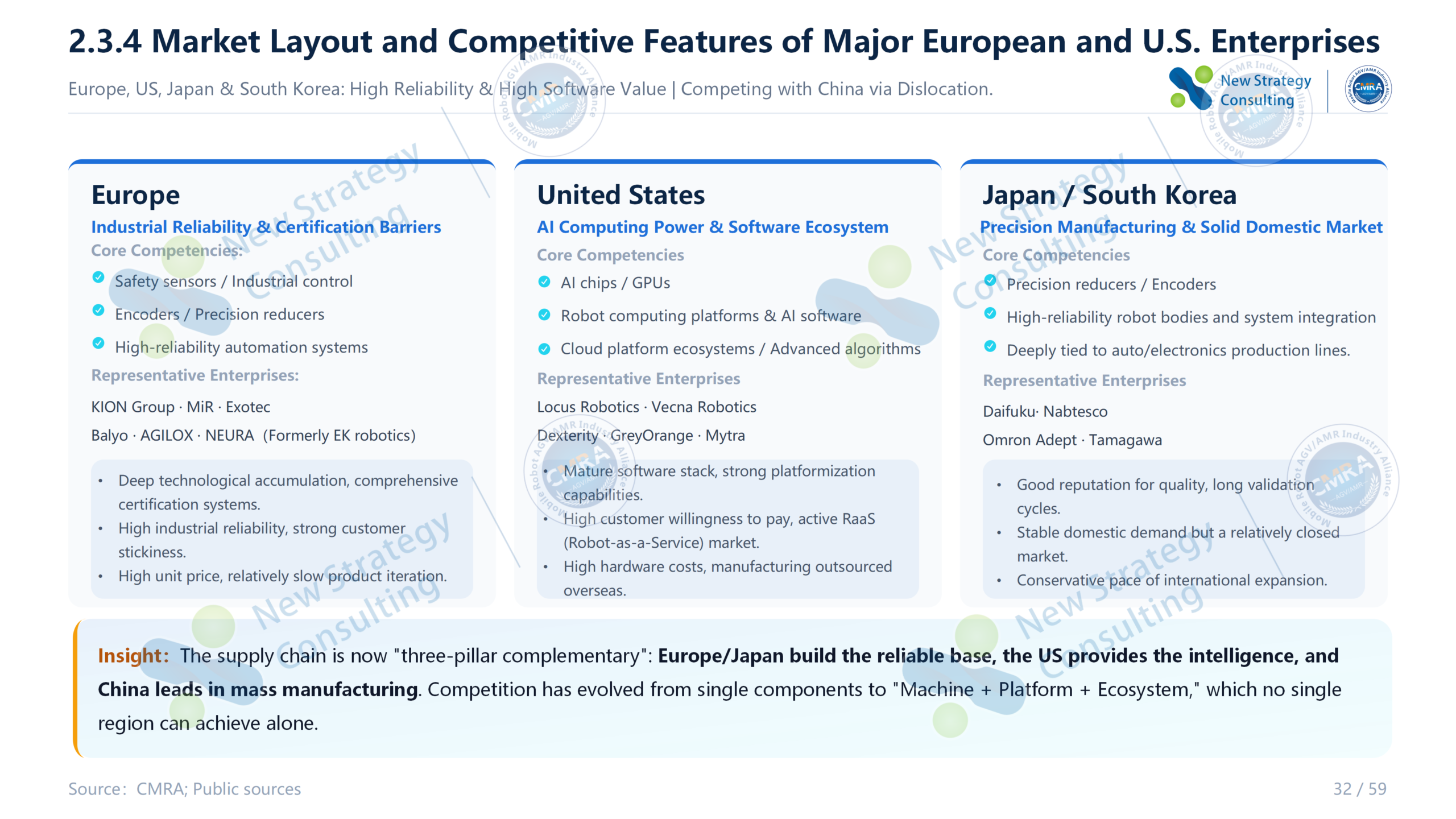
At present, European, American, Japanese, and South Korean companies occupy the two ends of “high reliability + high software value,” forming differentiated competition with Chinese companies. The logic of industry competition has shifted from single hardware comparison to a comprehensive “platform + ecosystem” contest, and evaluation criteria are shifting toward “commercial capability.” The market has officially entered a stage of “structural differentiation.” Companies with technology iteration, deep scenario cultivation, and global operations capabilities will win the future.
2027–2030: Four Mainlines and a Dual-Layer Industry Structure
The report uses 2026 as a baseline and structures its outlook around four mainlines and five stages, with key milestones marked year by year. 2027 is expected to become a market divide between project-based delivery and standardized intelligent products.
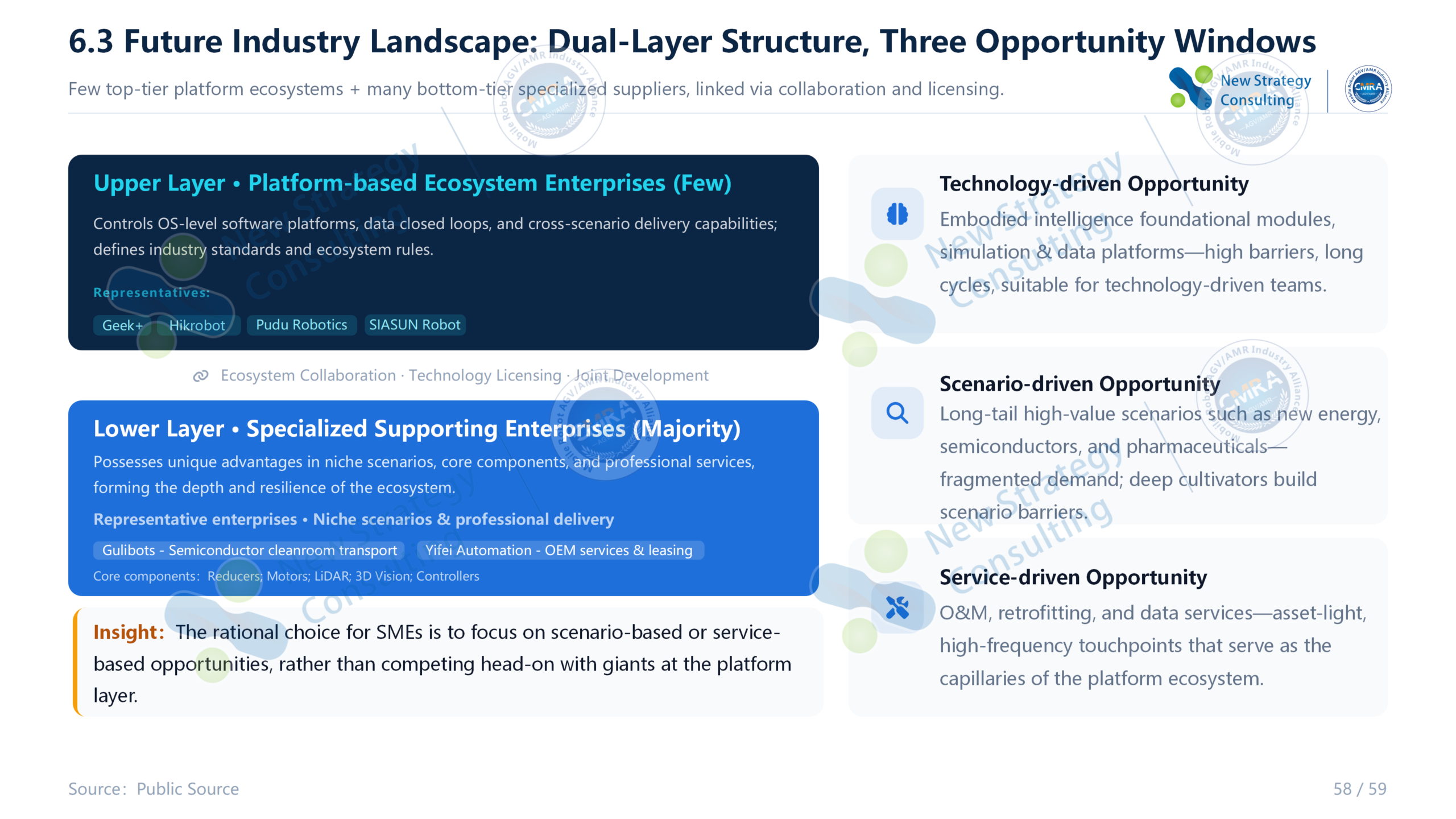
The future industry landscape will feature a dual-layer structure and three opportunity windows:
- Upper layer:a small number of platform-based ecosystem enterprises controlling OS-level software, data loops and cross-scenario delivery capabilities.
- Lower layer:many specialized supporting enterprises focused on niche scenarios, core components and professional delivery.
The three opportunity windows are:
- Technology-driven opportunities— embodied intelligence foundation models, simulation and data platforms.
- Scenario-driven opportunities— long-tail, high-value scenarios in new energy, semiconductors and pharmaceuticals.
- Service-driven opportunities— O&M, retrofitting and data services with high-frequency touchpoints.
- For SMEs, the rational choice is to focus on scenario-based or service-based opportunities rather than competing head-on with platform giants.
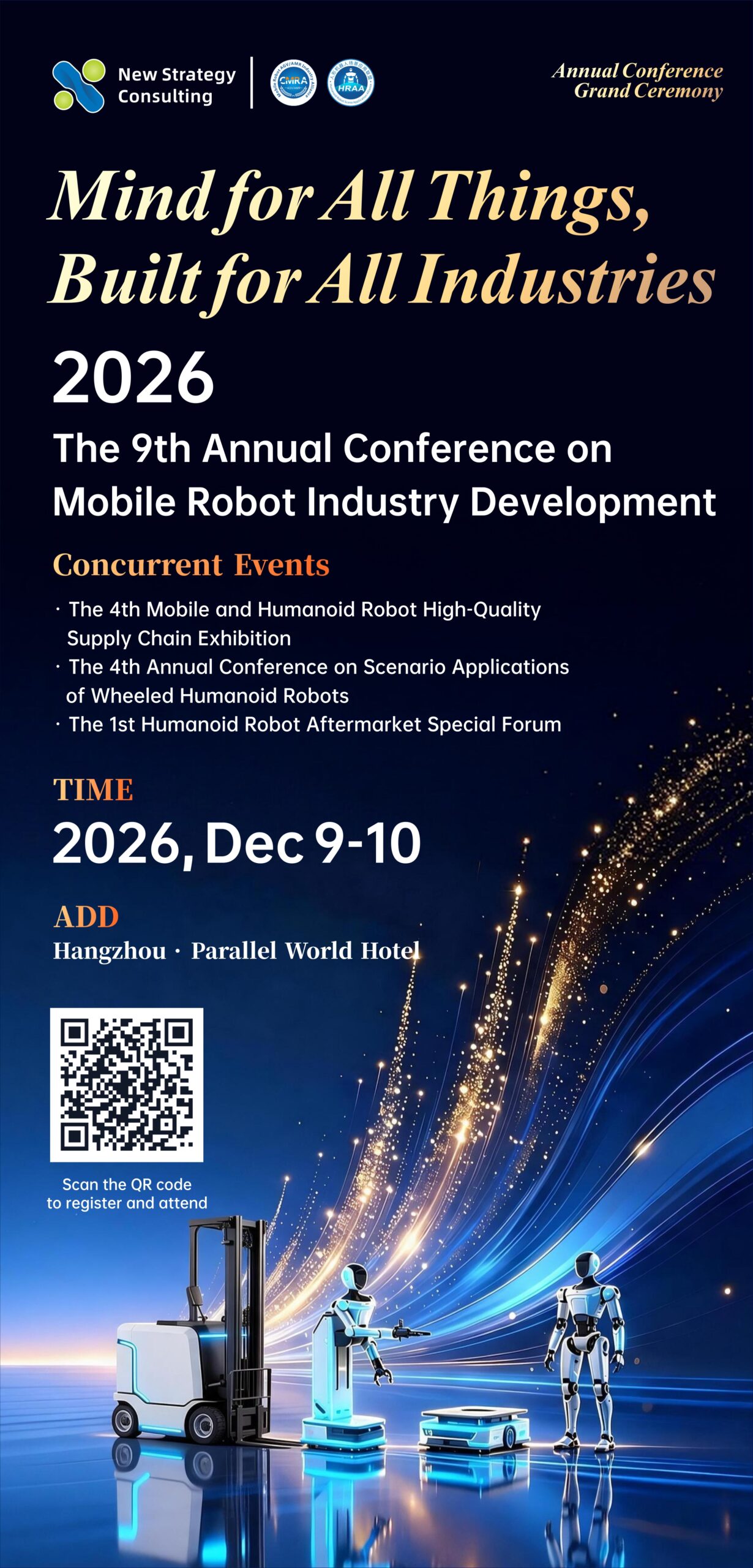
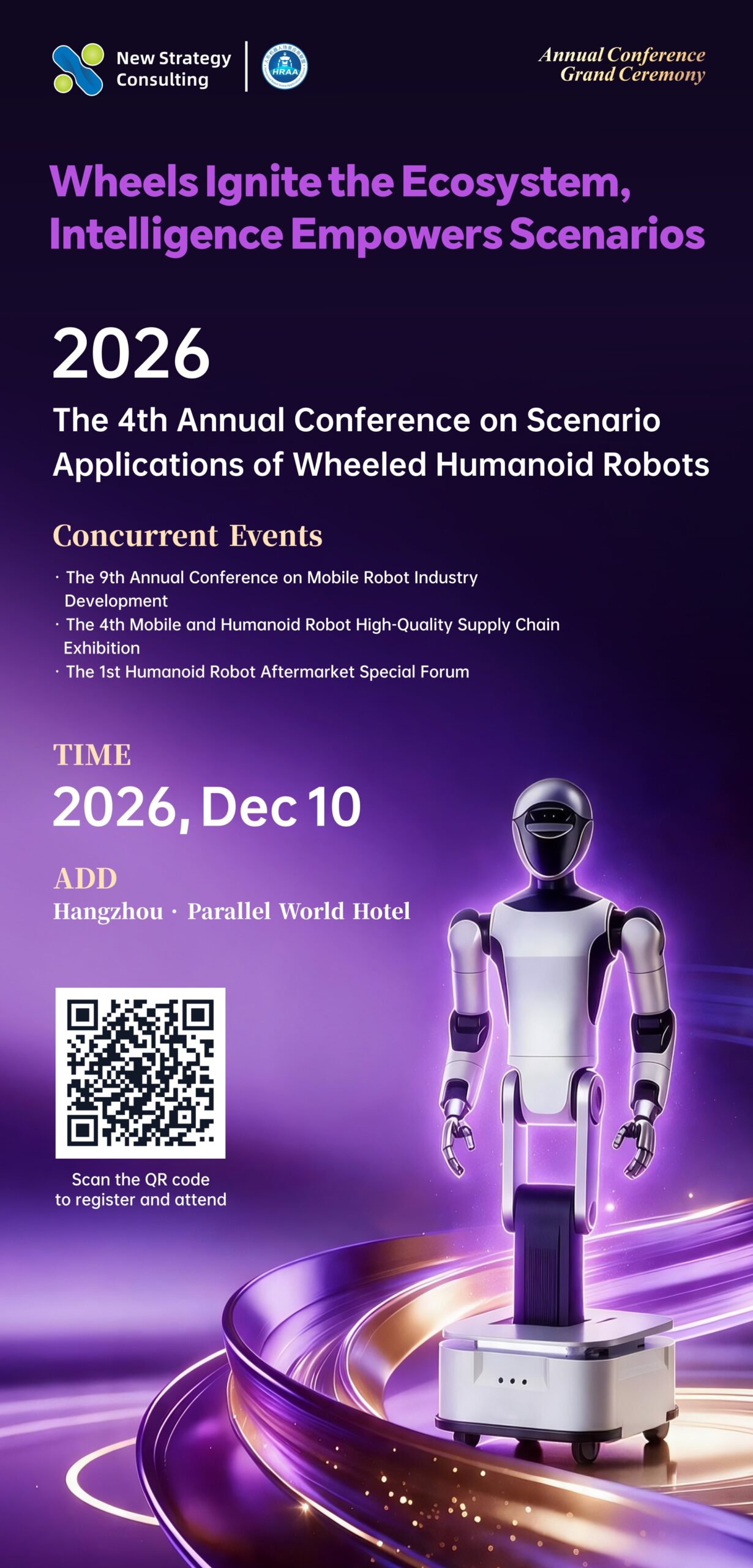
2026 The 9th Annual Conference on Mobile Robot Industry Development and the 4th Annual Conference on Scenario Applicationsof Wheeled Humanoid Robot will be held on December 9–10 at the Parallel World Hotel (Also named Hangzhou Pingxing World Hotel) in Hangzhou,China.
The conference will focus on industrial embodied intelligence deployment, motion control, chassis technology, manufacturing applications, and data collection and annotation, promoting the industry’s shift from product exploration to deep scenario deployment.