Deck: Frequent leadership changes at top companies do not equal a capital winter. As the industry moves from technical validation to commercial validation, talent flows are becoming one of the most honest barometers of the sector.
Key takeaways
As of Oct. 26, 2026, 23 senior executives in embodied AI robotics had left or changed roles, covering founders, chief scientists, CTOs, product leaders and CFOs.
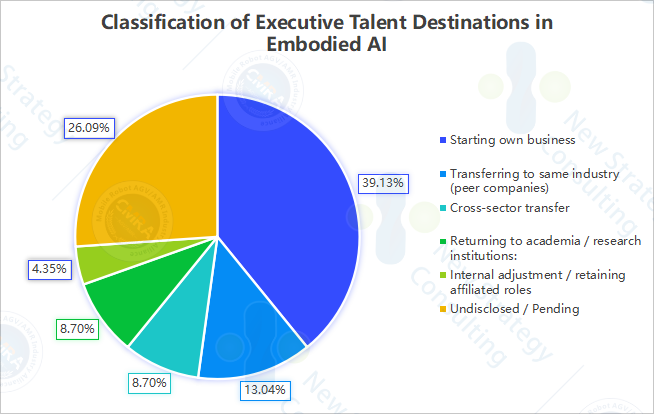
Known destinations: 39.13% founded startups; 13.04% moved to peers; 8.70% crossed into other sectors; 8.70% returned to academia or research institutions; 4.35% took internal or affiliated roles; 26.09% remain undisclosed or pending.
The core industry question is shifting from “Can robots work?” to “Can robots make money?”
Hiring demand remains strong: the embodied AI recruitment index reached 579 in January–April 2026, up sharply year on year. By July 2026, nearly 40 talents from the intelligent vehicle sector had moved into embodied AI robotics.
This is better understood as talent reallocation toward commercialization, foundation models, data systems and delivery capability—not simply a brain drain.
Capital is raising a toast in the spotlight, while key figures are leaving backstage. Companies are still accelerating R&D, mass production and IPOs, yet founders, chief scientists and CTOs are stepping down or moving on. The embodied AI robotics sector looks booming, but undercurrents are strong.
23 executive changes: which companies are involved?
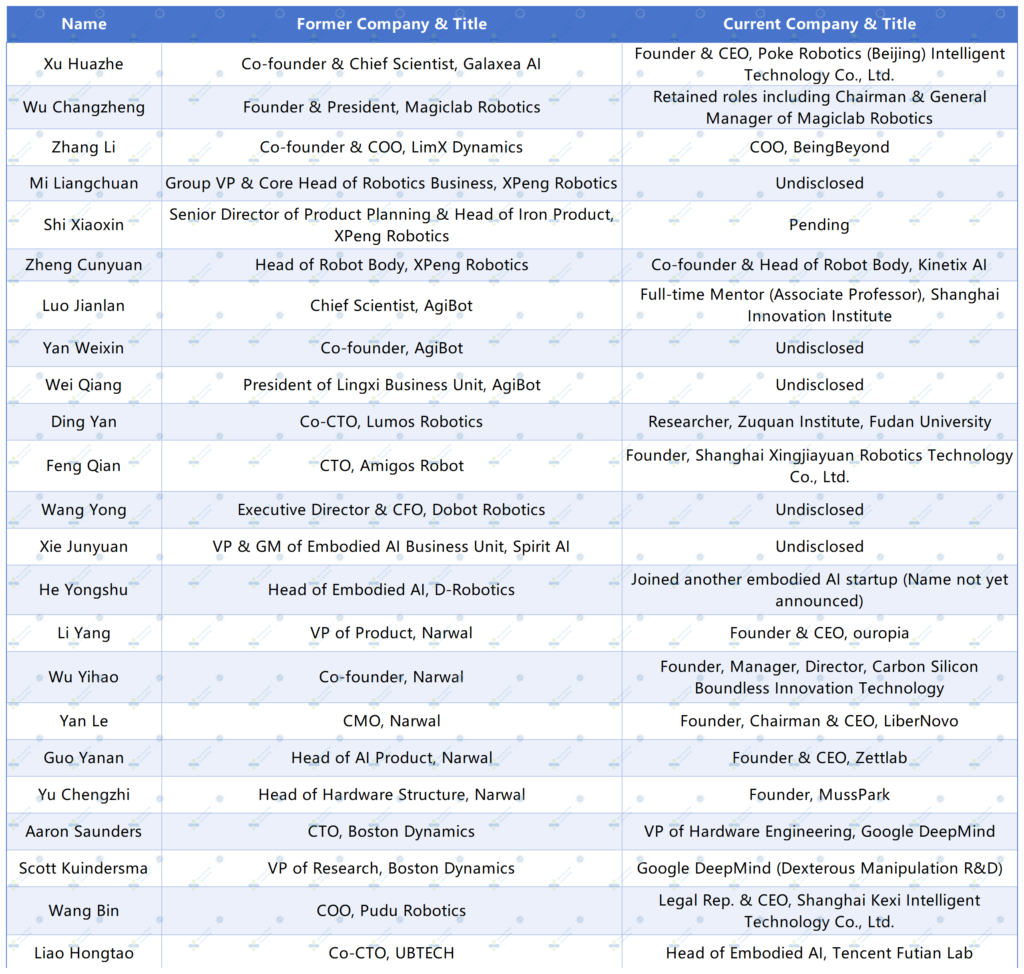
According to preliminary statistics from the Mobile Robot Industry Alliance (CMRA) and the New Strategy Mobile Robot Industry Research Institute, as of Oct. 26, 2026, 23 senior executives in embodied AI robotics had left their roles. The list covers founders, chief scientists, CTOs, product leaders and CFOs—core decision-makers and technical talent.
The companies involved include leading embodied AI startups such as AgiBot (Zhiyuan Robotics), UBTECH, Galaxea AI, Spirit AI, Unitree Robotics, LimX Dynamics, MagicAtom and Luming Robotics, as well as robotics and embodied AI teams under larger companies such as XPeng Robotics, JD.com and Alibaba DAMO Academy.
Where did the talent go? Startups, peer moves and cross-sector transitions
Among known destinations, 39.13% founded their own companies, 13.04% moved to peers, 8.70% crossed into other sectors, 8.70% returned to academia or research institutions, 4.35% took internal or affiliated roles, and 26.09% remain undisclosed or pending.
Not every departure or role change means talent loss, and adjustments across different years and of different natures should not be lumped into a single “turnover wave.” Still, the list reveals a phenomenon worth discussing: personnel changes in embodied AI robotics companies are no longer limited to one type of role. They now span technology, product, business and governance.
The core logic: from “can work” to “can make money”
The role changes of 23 core figures may look like a single wave of mobility, but they reflect a shift in the industry’s development stage.
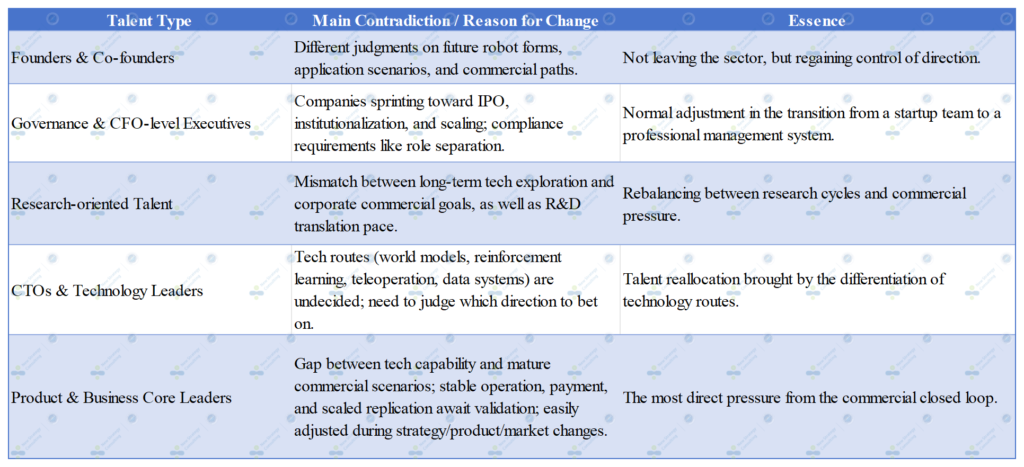
The core question is shifting from “Can robots work?” to “Can robots make money?” Founders want to regain control over product definition and technology routes. CFO changes are often tied to IPO governance and role-separation compliance. Research talent needs longer exploration cycles. CTOs must reassess technology routes. Product and business leaders face direct pressure over stable operation, customer willingness to pay and scalable delivery.
This talent flow reflects the continuing convergence of AI technology boundaries. In the future, embodied AI companies will need not only robotics experts but also people who understand AI models, data systems, engineering delivery and industrial applications.
Talent reallocation, not simply a brain drain
The current executive changes should not be simply defined as “talent loss.” More accurately, this is reallocation as the industry enters a new stage. Some people are seeking new entrepreneurial opportunities; some are exploring new technology directions; some are looking for larger organizational platforms. Companies, meanwhile, are bringing in new capabilities through recruitment and cross-sector hiring.
In January–April 2026, the embodied AI recruitment index reached 579, up sharply year on year. By July 2026, nearly 40 talents from the intelligent vehicle sector had moved into embodied AI robotics, bringing perception, simulation and engineering experience.
The next round of competition in embodied AI will not be only among robots. It will be a broader competition among talent, technology routes and organizational capability.
Source note: Based on public information and preliminary statistics from the Mobile Robot Industry Alliance (CMRA) and the New Strategy Mobile Robot Industry Research Institute. Figures are as of Oct. 26, 2026. Corrections are welcome.
China’s robotics and Physical AI sectors are experiencing a massive surge in momentum. From record-breaking international expansions in warehouse automation to massive capital inflows across... Continue reading
While the global humanoid robot industry is still struggling to refine their products for factory deployment, its most expensive component—the dexterous hand—has already concluded a... Continue reading
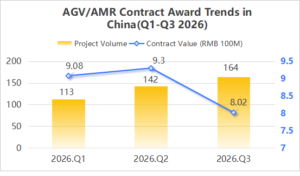
Key Takeaways: Market Volume Surges: China disclosed 419 AGV/AMR procurement projects in the first three quarters of 2026, totaling approx. RMB 2.64 billion (approx. $370... Continue reading
Key Takeaways: Unitree Leads the Volume:Leading OEMs like Unitree, UBTECH, and Leju secured high-frequency bids in September. The “Pulse” Effect: China awarded 78 humanoid robot... Continue reading
From massive funding rounds to national-level testing and 300-unit orders, Chinese robotics is accelerating commercialization. Capital Surge: AgiBot targets a RMB 50 billion valuation; Astribot raises... Continue reading