In 2026, mobile robot factory construction continues. Huaxiao Precision’s Longquan project was completed and put into production; Quicktron’s global headquarters base started production; Blue Ocean Robot’s Guangzhou headquarters passed joint completion acceptance. New projects by Zhongli and Jieluo Intelligent are also moving forward. Manufacturing expansion continues.
According to an incomplete tally by CMR Industry Alliance and the New Strategic Mobile Robot Industry Research Institute, as of Oct 27, 2026, nearly 30 companies had disclosed annual planned capacity. Among 27 companies with available data, 19 have planned annual capacity above 10,000 units. Another 14 companies are building or expanding plants or related projects this year, with total disclosed investment of about RMB 9.247 billion.
The figures refer to publicly disclosed annual planned capacity, not new capacity added in 2026 or actual current output. Some are single-base design capacities; others cover multiple bases or product types. They should be read with the specific project scope in mind.
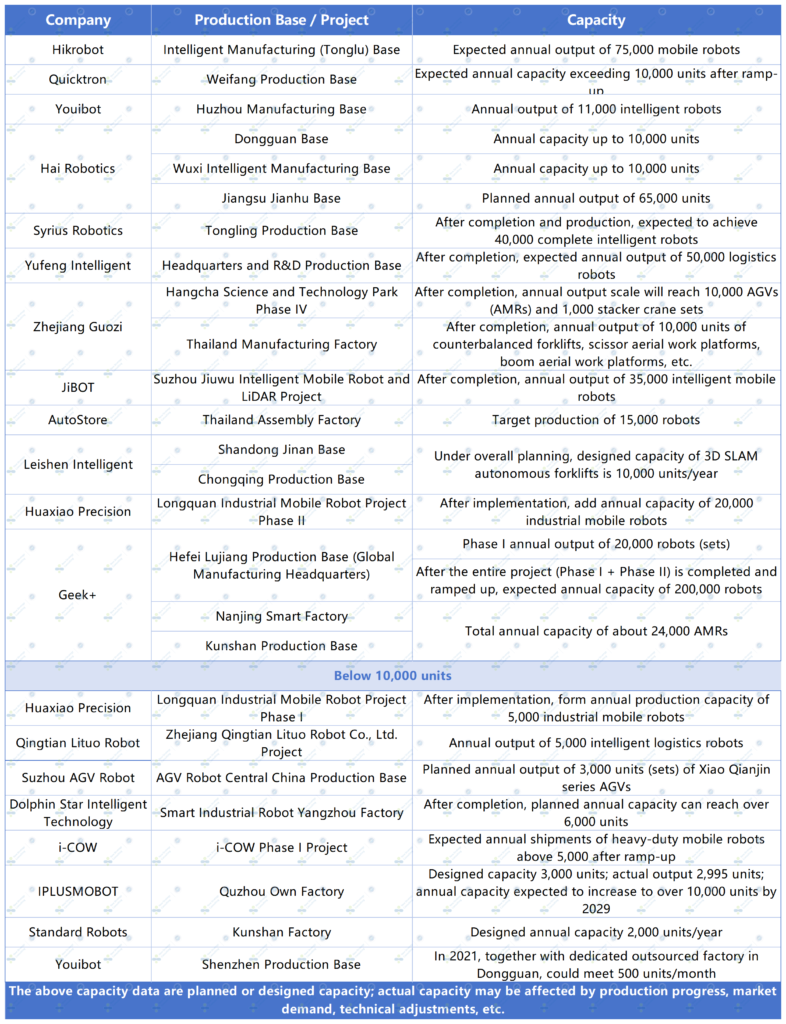
19 Companies Plan 10,000+ Units as Manufacturing Capability Rises
Capacity is moving up. Geek+’s Hefei Lujiang project is expected to reach 200,000 units a year when fully ramped. Hikrobot’s Tonglu base plans 75,000 units; Hai Robotics’ Dongguan and Wuxi bases can each reach 10,000 units, and its Jiangsu Jianhu base plans 65,000 units. These numbers show continued investment in scaled manufacturing.
However, mobile robot projects are highly customized. Factory layouts, logistics flows, cargo types and IT systems differ, requiring solution design, equipment adaptation and on-site commissioning. Only as products become more serialized and modular can manufacturing scale up. Standard warehouse robots, autonomous forklifts and heavy-duty mobile robots also differ in structure, core components, testing and validation. A 10,000-unit target is therefore not a must for every company; the key is to build a production system that fits its product mix and market demand.
RMB 9.247 Billion Invested: Turning Capacity into Output Is the Next Test
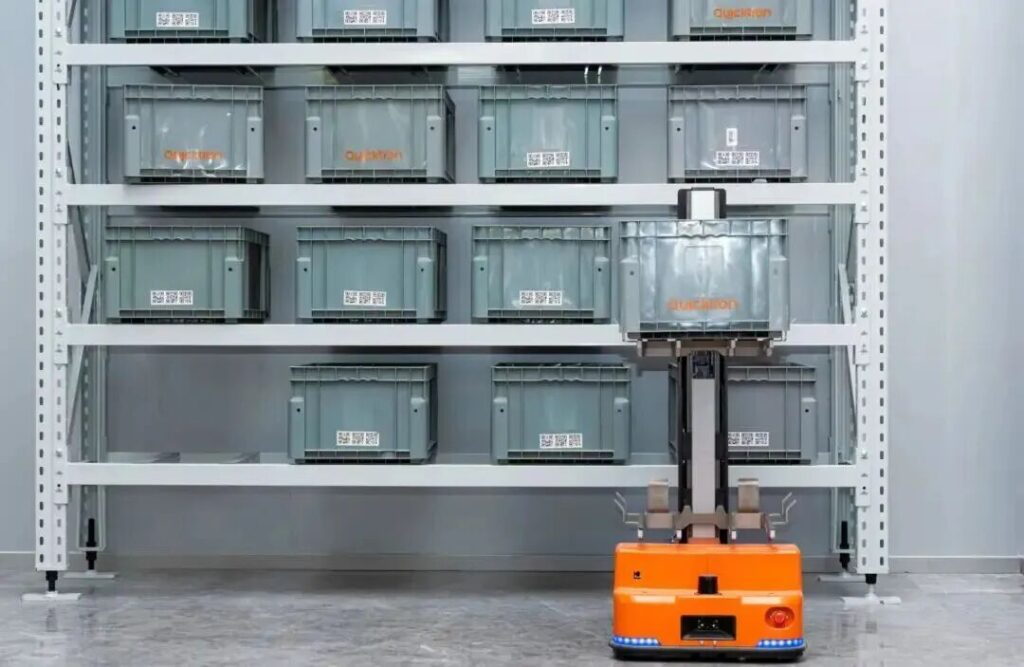
Turning capacity into output is the next test. This year, 14 companies are advancing plant or expansion projects, with about RMB 9.247 billion in disclosed investment. Representative projects include Huaxiao Precision’s Longquan phase I of 5,000 units and phase II adding 20,000 units; Quicktron’s base, put into production on April 8 with RMB 1 billion investment, is expected to generate more than RMB 2.3 billion in output value when all six lines are completed; Jieluo Intelligent’s Suzhou headquarters broke ground in August, planning 2,000 AMRs and 500 wafer smart storage units a year; Qingtian Lituo started construction on Aug 18, planning 5,000 smart logistics robots a year; Xinjie Electric’s phase I involves RMB 2.5 billion; Zhongchuang Zhiling invests RMB 619 million; Blue Ocean Robot’s Guangzhou base invests RMB 300 million and is expected to reach RMB 1.5 billion annual output value, passing joint completion acceptance on Oct 11, 2026; Standard Robots’ new Wuxi plant involves about USD 131 million, with design capacity starting at 800 units and gradually rising to 8,000 by 2030, with full operation expected in Q4 2026.
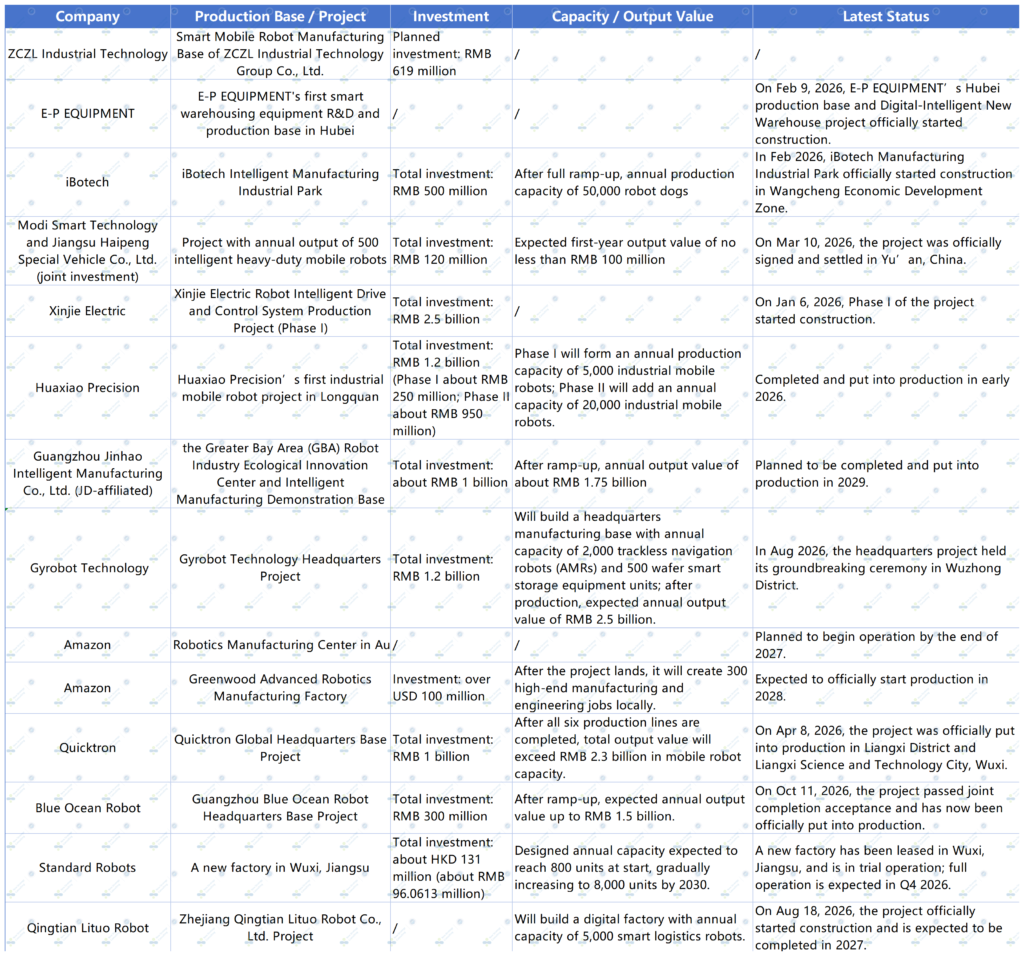
Completion, production start and full ramp-up are three different stages. A finished plant is only the base. Starting a line still requires equipment debugging, process validation, staff training and supply-chain coordination. Design capacity does not mean full-load operation. After leaving the factory, mobile robots still need on-site deployment, system integration and operational validation. Batch manufacturing capability and complex project delivery capability are two systems that must work together. To assess expansion, it is not enough to count factory area, planned capacity and investment; actual line operation, ramp-up speed, delivery cycle and order matching also matter.
From Single Plants to Supply-Chain Synergy: The Logic Is Changing
The logic of plant building is also changing. Quicktron’s base includes manufacturing, R&D testing and smart operations; ZCZL Industrial Technology emphasizes a digital factory and unified technology base; Xinjie Electric is building from core components to end equipment, with phase II extending to robot bodies and sensors. Integrated bases can shorten R&D-manufacturing communication and strengthen quality control, but they require larger fixed investment, and efficiency gains still need operational proof. Expansion by supply-chain players shows competition is extending to iteration speed, supply-chain stability and batch delivery.
Expansion Continues, but the Market Will Not Pay for Planned Capacity
Expansion continues, but the market will not pay for planned capacity alone. Planned capacity may not be released in line with demand. If orders grow, new lines can ease delivery pressure and create scale effects; if growth falls short, early large fixed assets may raise depreciation, maintenance and operating costs. In fast-iterating and diverse-demand markets, line flexibility and adjustability also shape capacity value. Companies need to clarify whether new capacity is for confirmed orders, new products, or expectations not yet fully realized. The next things to watch are delivery capability, operating performance and market share after plants start production. Capacity can be planned in advance, but effective demand cannot be cashed in early; factories can build a manufacturing base, but they do not automatically become a competitive advantage. The standard is shifting from “can we build it” to “can we deliver it consistently at reasonable cost, stable quality and sufficient efficiency.”