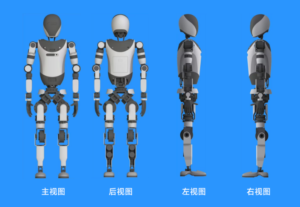
Today, Unitree Robotics, dubbed the “first stock of embodied AI” on the A-share market, officially listed on the STAR Market. The company’s stock opened at 1100 yuan per share, a 629.44% increase from its offering price of 150.80 yuan per share. Based on this opening price, a single subscription of 500 shares in Unitree Robotics would yield a profit of 474,600 yuan.
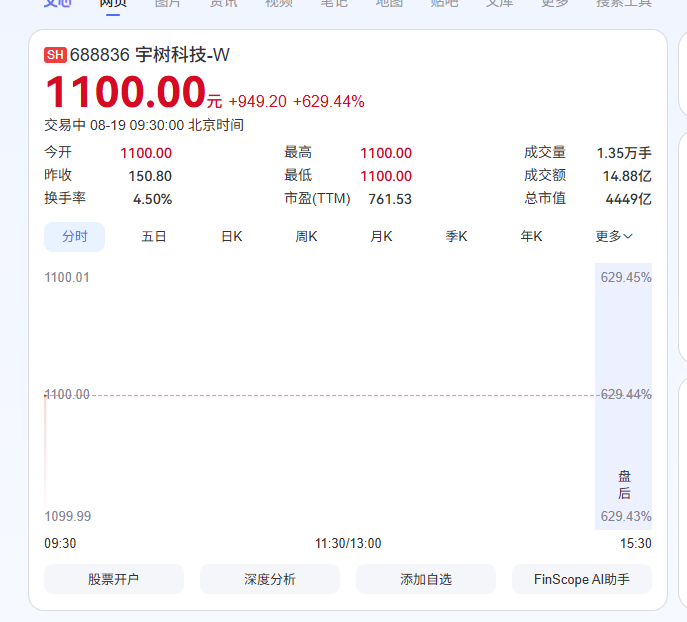
This figure also means that Unitree Robotics’ valuation was quickly pushed to a new high on its first day of trading.
Unitree Robotics issued 40.4464 million shares, accounting for 10% of the total share capital after the issuance, bringing the total share capital to approximately 404 million shares. The offering price corresponds to a market capitalization of approximately 60.993 billion yuan, raising a total of approximately 6.099 billion yuan. From the offering market capitalization to the opening market capitalization alone, Unitree Robotics’ valuation has expanded to approximately 7.3 times.
The final online subscription rate was only 0.01809759%, with approximately 9.78 million valid applications, making it one of the most watched IPOs on the STAR Market in recent years.
From its IPO application being officially accepted on March 20, to passing the review on June 1, registration taking effect on July 2, and finally listing on August 19, Unitree’s entire listing process took only about five months. For the embodied AI industry, which is still in the stage of rapid financing, product iteration, and commercialization verification, Unitree’s listing also provides the entire industry with a publicly available valuation benchmark from the A-share market for the first time.
Its revenue was 1.152 billion yuan in H1 2026, but profit growth has begun to cool down
One of the key factors supporting Unitree’s high valuation is that it has already achieved a relatively clear revenue and profit scale.
The prospectus shows that Unitree achieved operating revenue of 1.699 billion yuan in 2025, a significant increase from 159 million yuan in 2023; net profit after deducting non-recurring items reached 591 million yuan in 2025, with the gross profit margin of its main business increasing to over 60%. Compared to many humanoid robot companies that are still operating at a loss, profitability has been one of the most closely watched indicators for Unitree’ IPO.
The latest data released just before the listing shows that Unitree is transitioning from its previous phase of rapid growth to a new growth cycle.
In the first half of 2026, Unitree Robotics achieved operating revenue of 1.152 billion yuan, a year-on-year increase of 48.54%; net profit attributable to shareholders of the parent company was 274 million yuan, compared to a loss of 32.0245 million yuan in the same period last year; net profit excluding non-recurring items was 244 million yuan, a year-on-year decrease of 19.34%. The company stated that the revenue growth mainly came from the gradually expanding downstream application scenarios for humanoid robots and increased market demand.
The decline in non-recurring profit is noteworthy.
In the first quarter of this year, Unitree Robotics’ revenue was 423 million yuan, a year-on-year increase of 68.49%, but its net profit excluding non-recurring items was only 40.25 million yuan, a year-on-year decrease of 52.55%. In the first half of this year, the decline in Unitree’s net profit excluding non-recurring items narrowed to 19.34%. The company previously explained that the profit decline was mainly due to factors such as rapidly increasing R&D investment and sales expenses. Simultaneously, with the increase in the revenue base, a slight easing of industry hype, and intensified market competition, revenue growth also began to gradually decline from its previous triple-digit growth.
This also means that after its IPO, Unitree will face a more realistic issue: the market will no longer only be looking at how fast the robots can run or how many complex maneuvers they can perform, but will also continuously track revenue, profit, R&D investment, and mass production and delivery capabilities.
Humanoid robots have become the new growth engine of Unitree
Unitree was previously best known for its quadruped robots, but judging from its revenue and shipment structure, the company is rapidly shifting towards humanoid robots.

The prospectus shows that from 2022 to the first three quarters of 2025, Unitree’s cumulative sales of quadruped robots exceeded 30,000 units. Humanoid robots, on the other hand, saw rapid growth after their release of H1 in 2023. In 2025 alone, its shipments of humanoid robots exceeded 5,500 units. This figure only includes pure humanoid robots and does not include wheeled dual-arm robots.
In the first three quarters of 2025, Unitree’ revenue from humanoid robots surpassed that of quadruped robots, becoming the company’s largest single product category in terms of robot revenue.
Entering 2026, Unitree’s product line continues to expand.
In June, Unitree further reduced the starting price of its R1 humanoid robot to 29,900 yuan and began offering it for immediate purchase, continuing to target developers, scientific research and education, and a wider range of robot users.
In the same month, Unitree and NVIDIA launched the H2 Plus, based on the H2 humanoid robot and incorporating the NVIDIA Jetson Thor and Isaac GR00T platforms. The product is planned for availability by the end of 2026. Compared to the R1, which emphasizes price and accessibility, the H2 Plus is more geared towards high-performance scientific research and embodied intelligence development platforms.
Just two days before its market launch, Unitree released another “superhuman” robot, still in rapid development. Official videos show that this robot can jump 2 meters high and has a maximum speed of 12.66 meters per second. Unitree stated that the entire robot was developed in just over three months and will continue to be refined in the coming months.
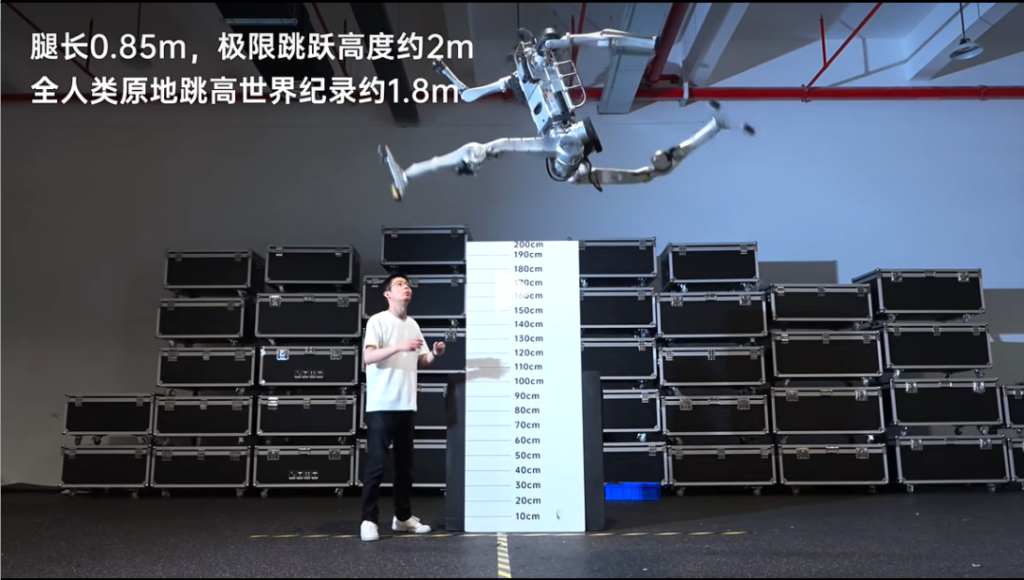
From R1 priced at 29,900 yuan to the H2 and H2 Plus, and then to experimental new products emphasizing extreme sports capabilities, Unitree has formed a multi-layered product matrix, ranging from low-cost development platforms and high-performance humanoid robots to cutting-edge technology demonstrators.
Following its 6 billion yuan fundraising, Unitree is entering a period of heavier investment
After listing on the capital market, Unitree’s next phase of investment priorities is very clear.
During the IPO application phase, the company planned to raise approximately 4.202 billion yuan, mainly for the research and development of intelligent robot models, robot body research and development, the development of new intelligent robot products, and the construction of an intelligent robot manufacturing base. Based on the final issue price of 150.80 yuan per share, the actual total funds raised in this IPO reached approximately 6.099 billion yuan.
One significant change is that Unitree is beginning to further supplement its embodied AI “brain” and data capabilities.
In its response to the audit, the company stated that its past R&D focus was primarily on the robot’s body structure and locomotion capabilities, the “body and cerebellum”, but since 2024, it has strengthened its development of embodied foundation models and has been gradually deploying models such as WMA and VLA. Since the second half of 2025, the company also plans to further increase investment inembodied foundation models, data acquisition, and scenario training.
On the other hand, the IPO projects also point to a larger manufacturing scale. According to the previously disclosed plan, after the intelligent robot manufacturing base is completed, its designed production capacity will reach 75,000 humanoid robots and 115,000 quadruped robots per year. It should be emphasized that this is the planned capacity of the project and is still significantly different from the current actual production and sales volume.
This makes the key points of observation after its listing clearer.
In the past few years, Unitree’s most prominent advantages have come from locomotion, body engineering capabilities, supply chain, and product cost control. It relied on quadruped robots to first achieve large-scale sales before quickly entering the humanoid robot market.
Next, the capital market will demand that the company prove more: beyond research, education, and demonstration needs, can it generate stable orders in industrial and commercial scenarios? How long can it maintain a high gross profit margin of over 60%? Can the continuously increasing investment in foundation models, data, and R&D ultimately translate into new revenue?
Especially with an opening market capitalization of 444.9 billion yuan, the importance of these questions is further amplified.
Unitree’ listing has established an unprecedented valuation benchmark for domestic humanoid robot companies. With other robot companies like Deep Robotics and Leju Robots pursuing IPOs, the valuation system for embodied AI companies, previously mainly determined by the primary market, is rapidly shifting towards the public market.
From today onwards, Unitree also has a new set of evaluation standards: quarterly revenue, profit, gross profit margin, and cash flow will become the basis for the market to reassess the commercialization progress of humanoid robots.
For Unitree, ringing the bell marks the completion of a phase over the past decade; for the entire industry, truly meaningful public market pricing has only just begun.