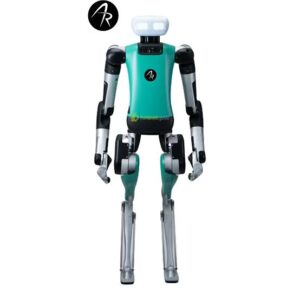
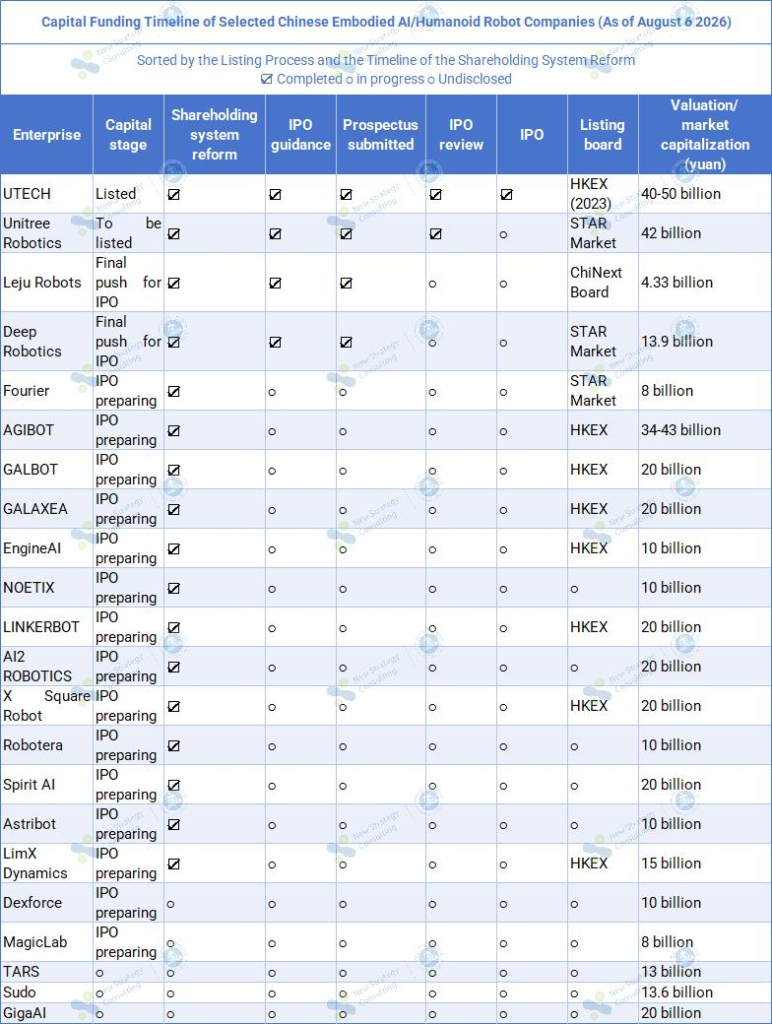
On August 5, Unitree Robotics officially launched the preliminary price inquiry phase for its IPO on the STAR Market, moving a step closer to listing on the A-share market and potentially becoming the first humanoid robotics stock in the sector. On the same day, reports emerged that AI2 Robotics had engaged investment banks to prepare for a Hong Kong IPO, with the issuance process potentially kicking off as early as 2027. The simultaneous advancement of capital market plans by these two leading embodied AI enterprises, one targeting the A-share market and the other HKEX, signals that China’s humanoid robotics industry has officially entered a concentrated “IPO era.”
In the past, industry competition centered on technical specifications and prototype demonstrations; today, the capital market’s yardstick has shifted to mass production and delivery, actual orders, and commercial viability. As a wave of robotics companies heads toward public markets, the core question facing the industry and investors is clear: what exactly underpins the valuations of these robotics enterprises? Does this wave of capital market activity represent a genuine industry turning point, or merely a speculative frenzy?
Two Waves of Listing: Distinct Paths to the Capital Market
Unitree Robotics and AI2 Robotics represent two typical development trajectories within the Chinese humanoid robotics sector, reflecting choices between the A-share and Hong Kong capital markets.
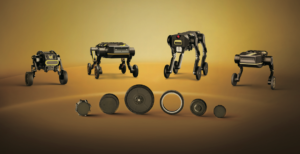
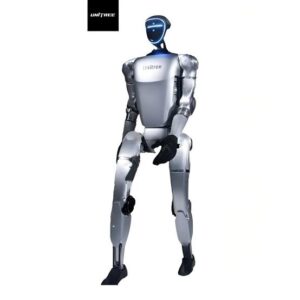
Unitree Robotics plans to raise 4.202 billion yuan, with an estimated post-issuance market capitalization of approximately 42 billion yuan. The funds are primarily earmarked for expanding humanoid robot production capacity, developing core components, and building large AI models for robotics. Leveraging its experience in the commercialization of quadruped robots, Unitree has established a complete closed-loop system spanning R&D, manufacturing, sales, and application. It possesses a mature supply chain and large-scale delivery capabilities; with projected humanoid robot shipments exceeding 5,500 units in 2025, it stands as one of the few leading robotics companies to achieve both commercialization and profitability.
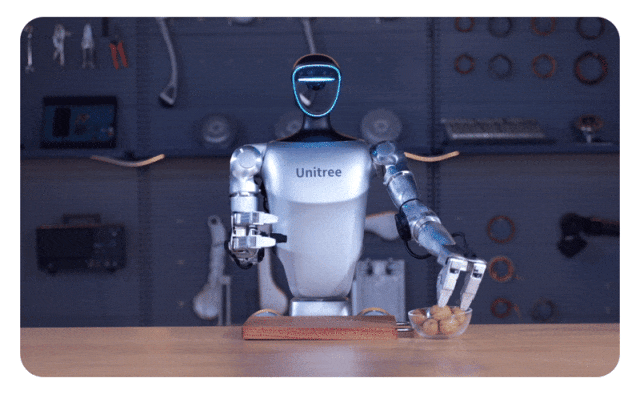
The significance of Unitree’s IPO extends beyond corporate financing and capacity expansion; it serves to establish a valuation benchmark for the entire humanoid robotics supply chain. From core components such as speed reducers, servo motors, controllers, and torque sensors to companies developing robotics AI models, the entire industry chain will gain a pricing reference in the secondary market. This will drive a revaluation of upstream supply chain enterprises and accelerate the flow of capital throughout the industry.
Meanwhile, AI2 Robotics is reportedly preparing for a Hong Kong IPO, with a post-investment valuation exceeding 20 billion yuan. The company has opted for the HKEX Specialist Technology Regime, reinforcing the growth narrative centered on its large-scale embodied AI models. Unlike Unitree, which centers its strategy on hardware, motion control, and embodied AI foundation models, AI2 Robotics focuses on an “end-to-end VLA foundation model + self-developed robot hardware + real-world scenario data closed-loop” approach. Currently, industry competition is shifting from “manufacturing robots” to “training robot intelligence.”

The choices made by these two companies reflect a divergence in the industry: A-share markets prioritize proven revenue, shipment volumes, and manufacturing capabilities, whereas the HKEX Specialist Technology Regime opens a window for embodied AI companies, which may not yet be fully profitable at scale but demonstrate outstanding potential in AI foundation models and application scenarios. Beyond these two firms, incomplete data from the Humanoid Robot Scene Application Alliance (HRAA) indicates that, as of July, nearly 20 Chinese humanoid robot and embodied AI enterprises were preparing for or planning IPOs, signaling that the window for capital market entry has fully opened for the sector.
Why the Rush for IPOs Now?
This wave of listings is not merely short-term hype; it is the result of the convergence of three factors: technological iteration, commercialization progress, and capital market demands.
The rapid evolution of foundation model technology is reshaping the logic of the robotics industry. From the generative AI boom sparked by ChatGPT to the maturing of VLA models, embodied AI has emerged as a crucial gateway for AI to enter the physical world. While the industry once focused on whether robots could be built at all, competition has now shifted to whether they can operate reliably, be delivered at scale, and generate commercial value. Prototypes and demos are no longer the primary competitive moats; instead, mass production capabilities, actual orders, real-world deployment, and data closed-loop systems have become the keys to corporate competitiveness.
Meanwhile, capital markets are seeking the next generation of platform-defining technology companies. From Apple and Xiaomi in the smartphone era to Tesla and BYD in the new energy vehicle era, and NVIDIA in AI infrastructure, major technological waves consistently give rise to industry giants. Today, embodied AI is viewed as a major growth frontier following AI, and investors anticipate the emergence of platform-level robotics companies within the sector. However, as the humanoid robot industry remains in its early stages requiring long-term capital investment for R&D, production line construction, supply chain integration, and model training, IPOs have become a vital pathway for companies to secure capital, boost brand influence, and accelerate industrialization.
As leading companies race toward the capital markets, the value chain of the humanoid robot industry is undergoing a re-evaluation, giving rise to a three-tiered industrial ecosystem comprising complete robot units, components, and AI software. Drawing an analogy with the development trajectory of new energy vehicles (NEVs), the value of the upstream supply chain is gradually unlocked once OEMs achieve initial breakthroughs.
Tier 1: OEMs serve as the pioneers of industrialization. Companies such as Unitree Robotics, Agibot, UBTECH, and Leju Robots occupy the core of the industry chain; competition focuses on robot hardware design, motion control, mass production capabilities, and the expansion of application scenarios. As leading OEMs enter the capital markets, this will further drive order growth and the scaling of the supply chain.
Tier 2: Core component manufacturers see a revaluation of their worth. Key components such as speed reducers, coreless motors, torque sensors, dexterous hands, and motion controllers directly impact robot performance and costs. With the large-scale delivery of finished robots, upstream component suppliers are poised for growth opportunities similar to those seen in the NEV supply chain; domestic production capabilities and cost advantages will become critical competitive factors.
Tier 3: AI and software companies emerge as the core of long-term value. Foundational robot models, simulation platforms, and data collection and training platforms are becoming the new high ground for competition. In the future, the industry may see the rise of “NVIDIA-plus-OpenAI” style companies providing universal intelligent capabilities for diverse robot hardware. As robots become more intelligent, the share of software and data within the robot value proposition will continue to rise.
Overall, the decision by humanoid robot companies to enter the capital markets now is not driven merely by a need for funding, but reflects a shift in the industry’s development stage. Technological breakthroughs have made it possible for robots to enter the real world, and commercialization efforts are validating market demand, while capital facilitates the transition from laboratory prototypes to large-scale industrial products.
After the IPO Boom, Three Real-World Challenges Set the Stage for Robotics Industry Consolidation
The listing ceremony is merely the starting point; public markets will scrutinize the industry’s quality using hard financial metrics, and three core challenges cannot be avoided.
First, can revenue scale justify high valuations?
The industry faces a common reality: the pace of technological iteration far outstrips the speed of commercial implementation. While humanoid robots are making continuous breakthroughs in motion control, intelligent interaction, and task execution, there remains a significant gap between prototype demonstrations or small-batch trials and large-scale delivery. Capital markets will not pay for demos and concepts indefinitely; investors focus more on delivery volumes, gross margins per unit, customer repeat purchases, scenario expansion, and manufacturing capabilities. In the future, only companies capable of achieving stable delivery, continuous cost reduction, and a closed-loop business model will gain long-term recognition.
Second, the ability to achieve large-scale deployment in real-world industrial scenarios.
Competition in the robotics sector has shifted from mere stage demonstrations of movement to the creation of value in real-world settings. The ultimate test lies in the ability to operate reliably and generate economic value in scenarios such as factory material handling, assembly, inspection, and manufacturing. The robotics industry can only achieve long-term growth by moving from proof-of-concept demonstrations to large-scale deployment, and from isolated trials to replicable business models. Currently, most humanoid robots remain in the pilot phase; companies that are the first to achieve stable delivery and scalable replication will likely emerge as industry leaders.
Third, the construction of a sustainable data closed-loop flywheel.
Hardware serves merely as an entry ticket to the market; long-term competitive advantages stem from data closed-loop capabilities. Robots continuously collect data during real-world operations, which feeds back into model training and algorithm optimization, thereby enhancing their understanding of the environment and task execution capabilities. These improved capabilities allow for deployment in a wider range of scenarios, generating more orders and data, and creating a virtuous cycle of “application deployment—data accumulation—model optimization—capability enhancement.” In the future, without the accumulation of real-world data, even the most advanced large models will struggle to evolve continuously; thus, the data closed loop will become a core competitive advantage for humanoid robotics companies.
The embodied AI industry is set to enter a phase of deep differentiation, where corporate competition shifts from a “technology race” to a contest of “industrial capabilities.”
As technical pathways mature and capital markets begin to scrutinize commercial value, a clear stratification of embodied AI companies will emerge.
The first tier consists of platform-oriented companies. Possessing capabilities across robot hardware, embodied large models, data closed loops, supply chain integration, and scenario expansion, these companies have the potential to become providers of industry infrastructure and to further extend their ecosystem influence through public listings. In the future, such companies are likely to control the critical gateways, including robot operating systems, intelligent models, and hardware platforms, and become industry standard-setters.
The second tier comprises scenario-specific companies. Rather than necessarily striving to build general-purpose humanoid robots, these companies focus on creating highly reliable, high-value solutions for vertical sectors such as warehousing and logistics, industrial manufacturing, inspection and maintenance, education and research, and commercial services. Compared to the long-term vision of “general-purpose intelligence,” these companies are better positioned to achieve a closed-loop business model early on and validate the value of their robots through actual orders.
The third tier consists of “capability-driven” enterprises that focus on critical segments of the robotics supply chain such as dexterous hands, joint modules, speed reducers, sensors, motion control systems, simulation platforms, and data acquisition frameworks. While these companies may not always deal directly with end-users, their core technological advantages position them as prime candidates to become key suppliers for or acquisition targets of leading robotics firms, major tech giants, and publicly listed companies.
The fourth tier comprises “demonstration-oriented” enterprises that rely primarily on prototype showcases, conceptual narratives, and short-lived trends to garner attention, yet lack sustained delivery capabilities, genuine orders, and meaningful data accumulation. As capital market sentiment shifts from valuing technological potential to prioritizing commercial viability, these companies will face mounting financing pressures and the risk of elimination or consolidation during the industry shakeout.
Conclusion
The launch of IPO price inquiries by Unitree Robotics, the Hong Kong listing preparations of AI2 Robotics, and the listing plans of nearly twenty other companies collectively signal a turning point: China’s humanoid robotics industry is officially moving beyond the initial phase of diverse technological exploration and entering an era of large-scale commercial competition. Future competition will no longer hinge on specifications on paper or flashy demonstrations; instead, the initiative in the next phase of the industry will belong to whichever player succeeds in establishing a closed-loop data integration across intelligent models, the robot hardware itself, and real-world application scenarios.