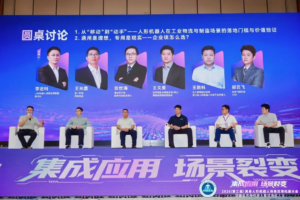
In the afternoon of June 25, a roundtable discussion focusing on ecosystem collaboration and practical applications of humanoid robots was held during the “3rd Embodied Humanoid Robot Scenario Application Expansion Conference & the First 100-Person Meeting for Embodied Humanoid Robot Integrators 2026.”
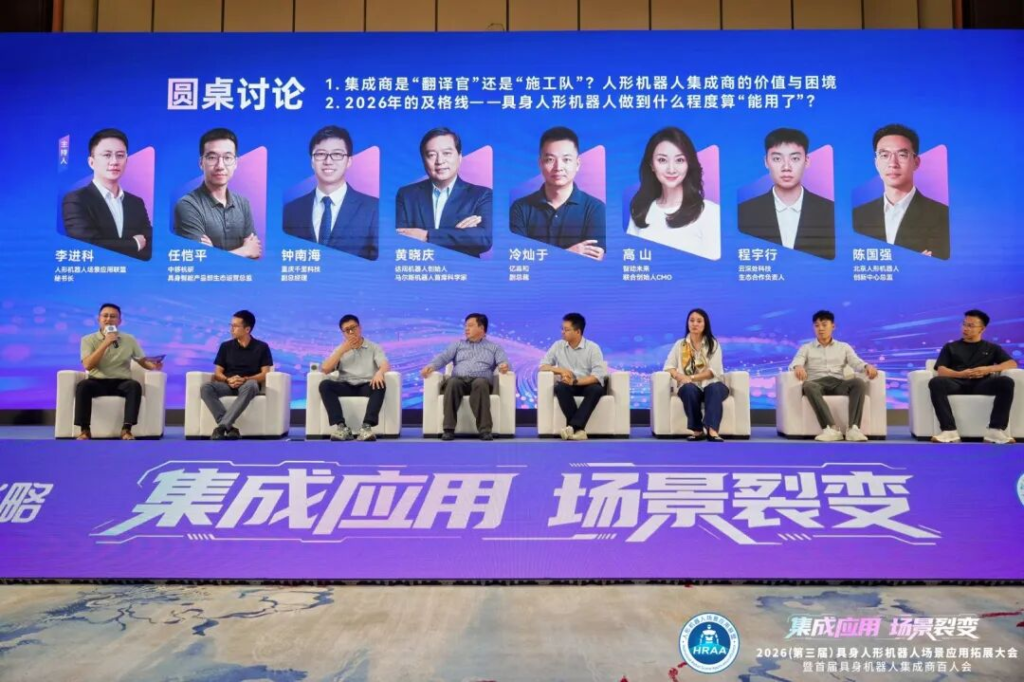
The dialogue was moderated by Jinke Li, Secretary-General of the Humanoid Robot Scene Application Alliance (HRAA). Guests included Kaiping Ren, Ecosystem Operations Director of Embodied AI Product Division, China Mobile Hangzhou Research Center, Xiaoqing Huang, Founder of Dataa Robotics and Chief Scientist of Mars Robotics, Nanhai Zhong, Deputy General Manager of AFARI, Canyu Leng, Vice President of Yijiahe, Yuxing Cheng, Head of Ecosystem Partnerships, Deep Robotics, Guoqiang Chen, Director of Innovation Center, Beijing Innovation Center of Humanoid Robotics, and Shan Gao, Co-founder & CMO of AutoLife Robotics.
Humanoid Robots Must First Clear the Value Hurdle to Achieve Commercialization
As humanoid robots transition from technical validation to real-world applications, the industry must first determine which use cases are worth prioritizing and how to establish a viable commercial ecosystem.
Canyu Leng, Vice President of Yijiahe, noted that over the past few years both large models and traditional AI have faced the challenge of being well-received in theory but not in practice. While the technologies themselves attract significant attention, their actual integration into customer budgets ultimately depends on their practical value within specific use cases. “The key lies in identifying the right application scenarios,” he said. “Only when customers derive tangible benefits from using these technologies can enterprises command a corresponding premium.”
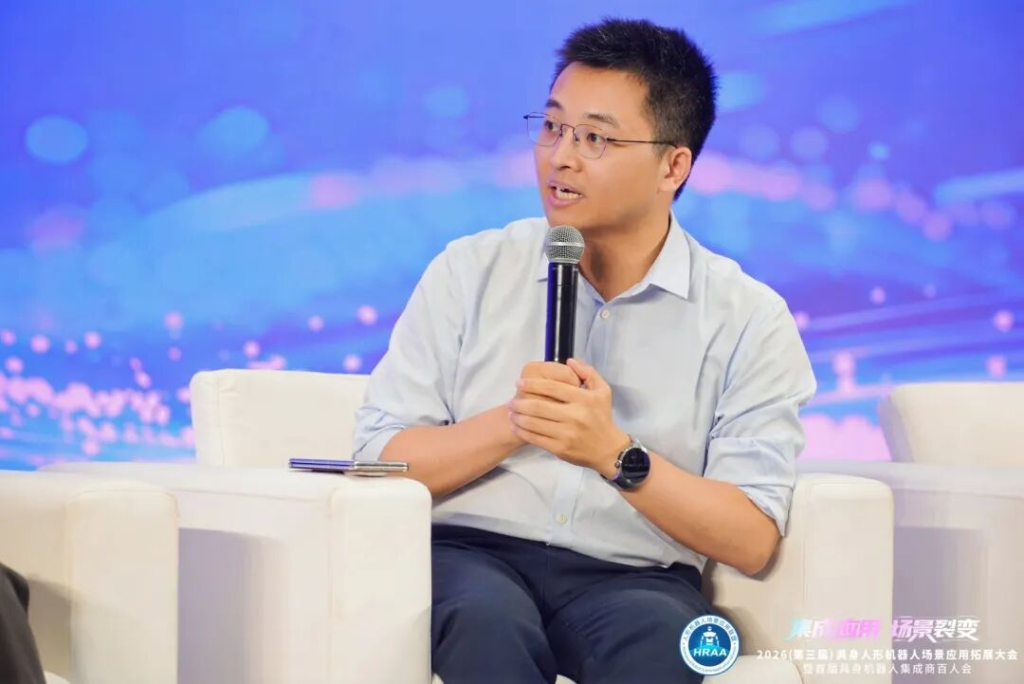
Canyu Leng, Vice President of Yijiahe
This is also the reason why Yijiahe prioritizes power and medical applications. The power sector is vital to national economy and public welfare, requiring extremely high standards for safety, stability, and efficient production, coupled with complex on-site environments and stringent regulatory requirements; similarly, the healthcare sector possesses high-value attributes and directly concerns life safety.
Leng noted that in medical settings, advanced expert services can first be extended to remote areas through 5G-based collaboration and robotic remote control capabilities, followed by gradual integration of embodied AI technologies. As for more widespread applications such as healthcare, elderly care, and cleaning services, the future potential is significant; however, this requires further advancements in cost reduction and technological maturity.
Demands from the application side make “scenario value” more concrete. Nanhai Zhong, Deputy General Manager of AFARI, shared the company’s internal criteria for selecting robots, which primarily include four aspects: long-range closed-loop capability, safety compliance, integrability, and maintainability.
Regarding long-term operational reliability, companies expect robots to operate continuously and possess a certain level of self-correction capability; in terms of safety compliance, robots must meet requirements such as collision detection, emergency stop functionality, and personal safety distances. Zhong noted that AFARI employs over 5,000 staff members internally, emphasizing that safety boundaries must be clearly defined when humans and machines work together.
Meanwhile, robots must be capable of integrating with existing enterprise systems. Manufacturers typically already utilize industrial software such as WMS; robots need to interface with these systems in real time to handle task assignment, status reporting, upgrade management, and log retrieval. After-sales service must also be well-defined: “When a robot breaks down and requires manual intervention, the supplier must clearly specify the repair timeline and provide a comprehensive after-sales solution,” said Zhong.
While application developers focus on whether robots can operate autonomously in real-world environments, Xiaoqing Huang, Founder of Dataa Robotics and Chief Scientist of Mars Robotics, discussed the long-term development direction of humanoid robots from an architectural perspective. He argued that future robots must integrate both an ontological “cerebellum” and a cloud-based “brain”: the cerebellum handles locomotion, perception, and execution, while the cloud-based brain manages planning, understanding, and task decomposition.
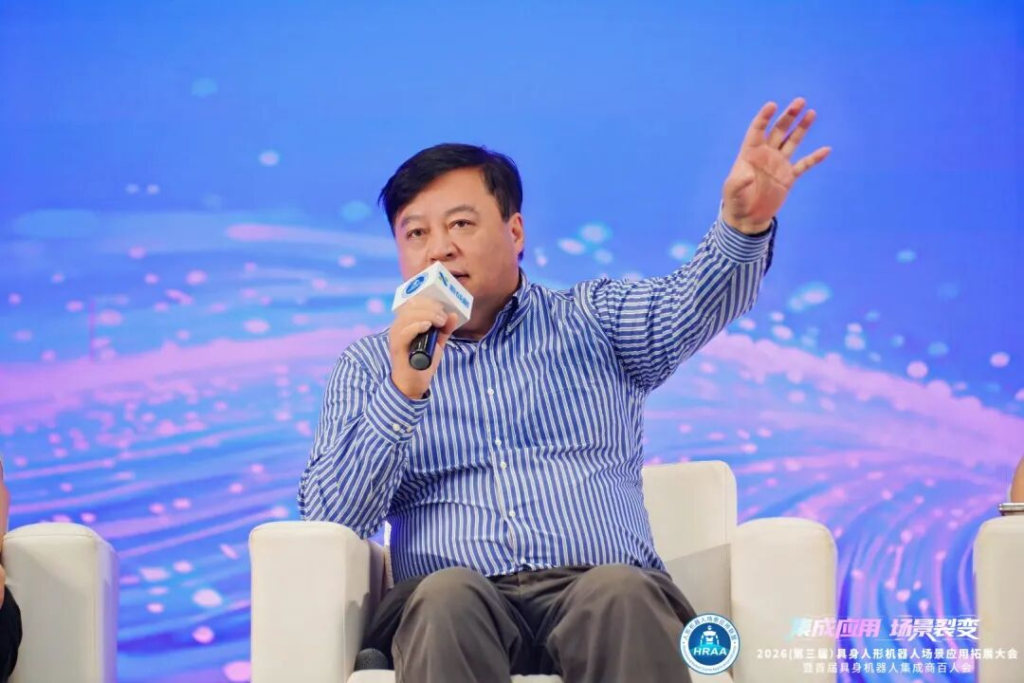
Xiaoqing Huang, Founder of Dataa Robotics and Chief Scientist of Mars Robotics
Huang noted that it is challenging to integrate all truly emergent-capable large models directly into robotic systems, making cloud-based brains a critical infrastructure. Future robot application development will progressively shift from traditional programming to leveraging natural language and human demonstrations. “Future application development will absolutely not rely on programming, but rather on teaching robots to operate through natural language and human demonstrations,” he stated.
In his view, large models can handle planning and task decomposition, while embodiment models are responsible for action execution and environmental perception. However, to truly replace humans in performing dexterous tasks, humanoid robots still require more advanced hardware capabilities—particularly dexterous hands, binocular vision, and robust body control. Huang predicted that humanoid robots will eventually become standardized, with underlying architectures resembling those of smartphone ecosystems, converging hardware platforms, and application development primarily occurring at the digital twin and operating system levels.
Kaiping Ren, Ecosystem Operations Director of Embodied AI Product Division, China Mobile Hangzhou Research Center, outlined the company’s strategic approach from the perspectives of platforms and data. Since entering the embodied AI field in 2024, the center has developed a comprehensive suite of capabilities centered on models, bodies, and platforms, with network infrastructure, computing power, and data analytics serving as its core strengths.
Ren noted that China Mobile serves a vast user base and has accumulated substantial data assets. How to leverage these data resources to enhance robot model training and real-world applications is a key focus area the company is exploring.
Currently, China Mobile Hangzhou Research Center has developed quadruped and humanoid robot products, placing greater emphasis on scenario-based applications with a focus on commercial tours, home services, and healthcare solutions. In the long term, its goal is to integrate robots into more households and serve a wider range of daily life scenarios.
Shan Gao, Co-founder & CMO of AutoLife Robotics, emphasized that robots must move beyond laboratories and be validated in real-world scenarios. Since returning from Singapore, the company’s team has provided commercial services at five-star hotels in Guangzhou, the China Import and Export Fair venue, and robot-equipped restaurants in Shenzhen.

Shan Gao, Co-founder & CMO of AutoLife Robotics
“Humanoid robots are not something particularly mysterious or high-end; they must be integrated into real-world scenarios with practical applications and user interactions,” said Gao. For companies that already possess mature product capabilities, the current priority is to demonstrate to the market what specific problems their products can truly solve and to identify more genuine customer needs and pain points.”
Yuxing Cheng, Head of Ecosystem Partnerships, Deep Robotics, explained why robotic implementation relies on industry partners by analyzing the relationship between robot manufacturers and ecosystem collaborations. Starting with legged robots, Deep Robotics discovered during the commercialization of robotic dogs that while a standalone robot can attract attention, true productivity is achieved only when integrated with industry-specific capabilities.
Cheng noted that compared to quadruped robots, humanoid robots pose greater challenges in integration and secondary development, as customers expect not only mobility but also the ability to perform real-world tasks. Consequently, manufacturers must provide more stable, cost-effective hardware and open up additional interfaces to enable industry experts and integrators to implement solutions on the platform.
Guoqiang Chen, Director of Innovation Center, Beijing Innovation Center of Humanoid Robotics, emphasized the importance of an open ecosystem. As a national-level innovation platform, the center is committed to open-source principles: it shares algorithms, datasets, and embodied AI capabilities through its open-source community, while connecting domestic and international clients, integrators, and vertical industries via its hardware and embodied AI platforms.
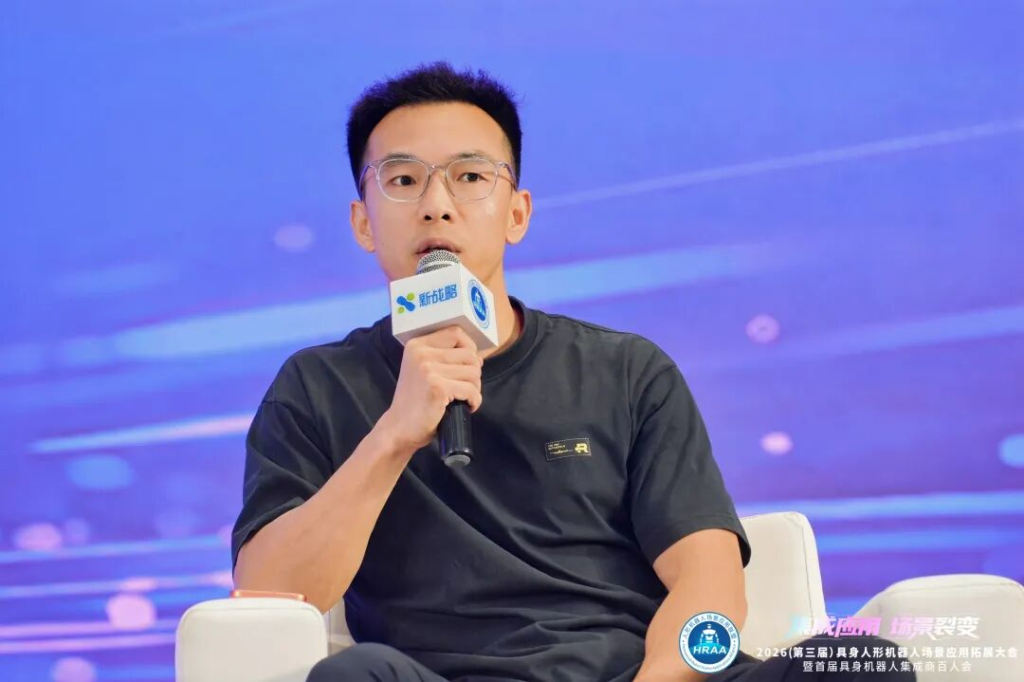
Guoqiang Chen, Director of Innovation Center, Beijing Innovation Center of Humanoid Robotics
Chen believed that the widespread attention and rapid industrial momentum surrounding humanoid robots are closely linked to an open ecosystem. Whether in platform development, policy support, or corporate collaboration, openness will serve as a fundamental cornerstone for industry growth.
Standardization and Integration Capabilities Are Critical
While the first phase focused primarily on identifying “which scenarios warrant prioritization,” the second phase delved deeper into industrial division of labor: defining the respective roles of platform providers, manufacturers, integrators, and end-users before humanoid robots achieve widespread adoption.
Guoqiang Chen stated that the Beijing Innovation Center of Humanoid Robotics must primarily undertake the role of addressing industry-wide technological challenges. As a national-level innovation platform, it will not only lead participation in major ministerial projects and the development of industry-wide technologies but also cultivate self-sustaining capabilities by supporting the center’s continuous growth through commercialization initiatives.
“We operate under one entity with two distinct identities: on one hand, we are a national-level innovation center; on the other, we are also engaged in commercialization—advancing through both approaches simultaneously,” stated Chen.
Yuxing Cheng, from the perspective of the manufacturer, explained that Deep Robotics’s humanoid robot products are primarily positioned for industrial-grade To B and To G applications. The full-size humanoid robot features IP66 protection rating, making it suitable for complex scenarios such as power infrastructure and emergency response.

Yuxing Cheng, Head of Ecosystem Partnerships, Deep Roboticsy
Cheng noted that in projects such as operating high-voltage circuit breakers for State Grid, humanoid robots enable workers to operate safely away from hazardous sites—particularly in challenging environments like rainy conditions, where their protective capabilities are a key advantage. However, he acknowledged that humanoid robots in industrial applications remain primarily used for remote operation due to its greater controllability and ability to deliver tangible value in specific scenarios.
In response, Cheng proposed that manufacturers should provide more stable and cost-effective products while offering greater interfaces to enable industry experts and integrators to conduct scenario-specific development.
From the perspective of commercial service scenarios, Shan Gao emphasizes that service robots currently find it difficult to fully replace human workers, nor is there any need to pursue complete substitution from the outset. A more practical approach involves collaborating with humans in high-frequency, high-risk, or highly standardized tasks to perform quantifiable and simplified operations.
In her view, what customers truly care about isn’t merely whether robots can save money; they’re more concerned with whether robots can help generate revenue. “We must identify customers’ absolute needs and real-world scenarios, and understand their core requirements,” she emphasized. Only by first addressing the problems customers genuinely need to solve can these scenarios remain viable, thereby opening opportunities for more models, ontologies, and application developers to enter the market.
From the perspective of telecom operators, Kaiping Ren noted that over the past two to three decades, China Mobile has primarily focused on connecting people. As user numbers approach their ceiling, the company must now consider how to serve new types of “silicon-based terminals” such as robots.

Kaiping Ren, Ecosystem Operations Director of Embodied AI Product Division, China Mobile Hangzhou Research Center
In his view, To B and To C are not mutually exclusive; they can seamlessly integrate. Taking the campus setting as an example, robots can perform security tasks such as visitor registration and facial recognition, or serve as teaching assistants or educational tools on campus. Leveraging China Mobile’s channel network and computing capabilities, the company will continue seeking industry partners to expand embodied AI solutions across diverse scenarios.
Canyu Leng focuses on two key issues: product adaptability and the limitations of large models in embodied AI. He argued that different scenarios impose varying requirements for sensors, sensing components, and hardware configurations; however, developing separate hardware solutions for each scenario would incur prohibitively high costs. Therefore, a more ideal approach in the future is to establish a universal foundation and standardized interfaces, enabling functional expansion through methods such as hot-swapping.
Regarding large models, Leng emphasized that embodied AI and large models differ fundamentally in their cognitive mechanisms. While these models possess strong generalization capabilities, they also suffer from issues such as black-box behavior, lack of interpretability, hallucinations, and bias. When deployed in industrial settings, enterprises must focus on leveraging data flywheels to drive model iteration, while ensuring the reproducibility and deployability of model performance across diverse scenarios.
Xiaoqing Huang summarized the future direction as “standardization.” In his view, for humanoid robots to achieve large-scale deployment, unified standards must be established across all components—from cloud-based brains and body-specific cerebella to sensors, APIs, and application platforms. Vertical-domain applications also require substantial adoption scales; for instance, reaching tens of thousands of units in a single scenario is essential to drive rapid cost reductions in manufacturing.
Huang believed that scenarios such as wellness care, traditional Chinese medicine, and family companionship all hold significant potential, with the key requirement being that robots must deliver tangible value to users. Only when multiple applications at the tens-of-thousands level are validated can the industry scale up to hundreds of thousands or even millions of units.
From the perspective of capital-industry integration, Nanhai Zhong noted that while embodied AI has garnered significant attention from capital markets, the focus must ultimately return to its intrinsic value. He places greater emphasis on the core capabilities of the industry’s middle tier—specifically, the capacity building of integrators.
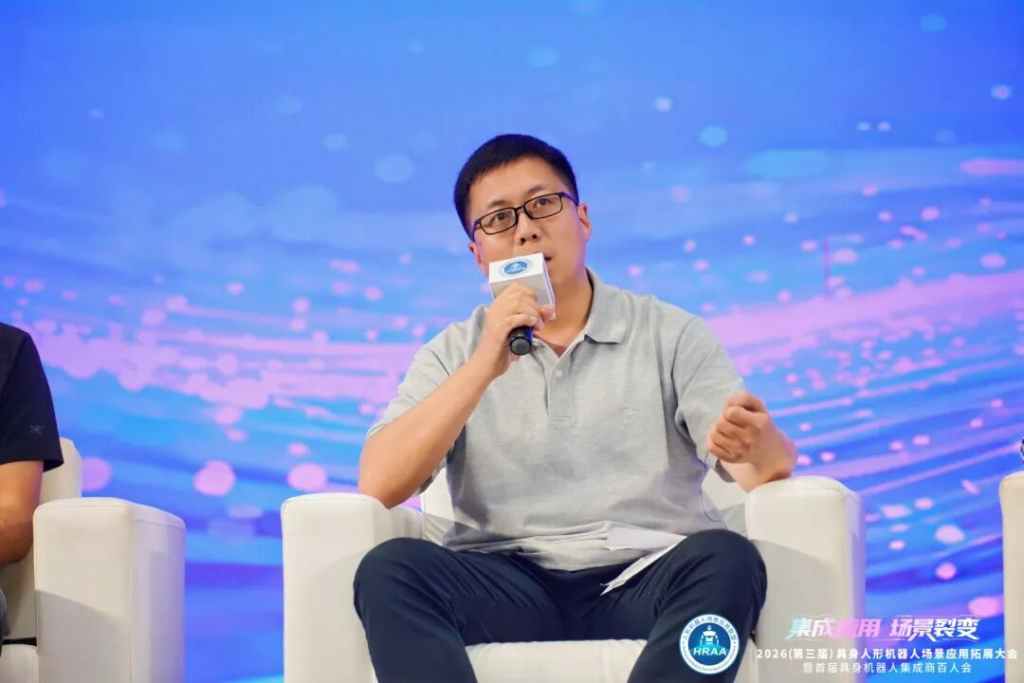
Nanhai Zhong, Deputy General Manager of AFARI
Zhong summarized the capabilities of outstanding integrators as “translation” and “construction”: the former refers to the ability to understand customer requirements and develop design solutions, while the latter entails the capability to transform those solutions into tangible products and deliver them on-site. In his view, what humanoid robots currently lack most between their physical design and end-user applications is a team that combines industrial-grade design expertise, supply chain understanding, and mass production and delivery capabilities. Only by addressing this gap can the reliability, stability, and consistency of robots be significantly enhanced.
Conclusion:
Finally, Jinke Li, Secretary-General of HRAA, concluded: For enterprises, what truly matters is not how advanced a robot appears to be, but its ability to operate reliably and deliver value in real-world scenarios across power, healthcare, industry, security, wellness, and commercial services.
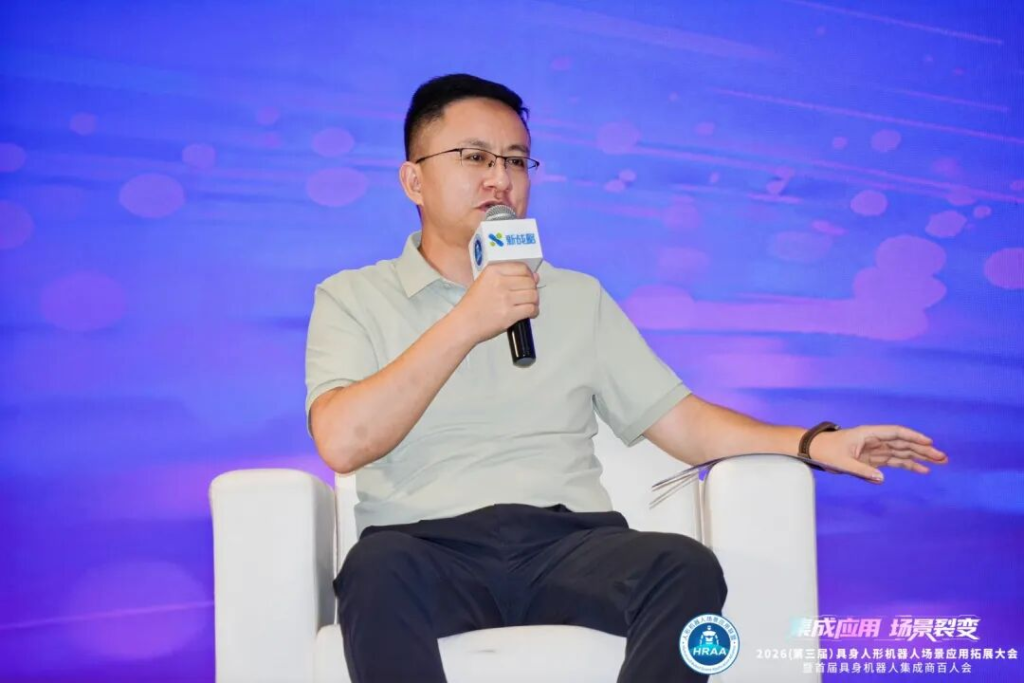
Jinke Li, Secretary-General of HRAA
The end-users require secure, reliable, and maintainable systems; the manufacturers need to provide an open and stable foundation; while integrators must translate requirements into deliverable solutions. In the future, HRAA will continue to connect manufacturers, integrators, end-users, and industry resources, fostering the opening of more real-world scenarios and solution validation. The large-scale deployment of humanoid robots can ultimately only be achieved through replicable and sustainable applications.

1-300x168.png)