
Why composite mobile robots (56.1%) and China’s hardware supply chain are reshaping global industrial automation in 2026.
The global mobile robotics industry reached a major milestone in 2026, with 178 new AGV/AMR products launched in the first three quarters (Q1–Q3), according to research from the CMRA and the New Strategy Mobile Robot Research Institute.
The defining narrative of 2026 is China’s overwhelming lead in hardware innovation:
- Chinese Original Equipment Manufacturers (OEMs)introduced 145 out of the 178 new models (81.5%), underscoring China’s dual role as both the world’s largest deployment market and the epicenter of mobile robot form-factor innovation.
- Western Manufacturerscontributed 33 models (18.5%), maintaining a deliberate, highly targeted “quality over quantity” approach focused on high-barrier industrial niches.
1. Q3 Market Dynamics: A Pivot to Commercial Execution
The cadence of global product rollouts shifted noticeably through 2026:
- Q1:31 new launches (Initial market warmup)
- Q2:81 new launches (Peak activity driven by global industrial trade shows)
- Q3:66 new launches (52 Chinese, 14 international)

Complete list of 66 new AGV/AMR products launched globally in Q3 2026, compiled by CMR Industry Alliance.
Click here to view the high-resolution chart
Rather than signaling a slowdown, the Q3 drop from Q2 represents a healthier, execution-focused transition. After unveiling new prototypes during the Q2 exhibition season, manufacturers spent Q3 focusing on pilot deployments, client validation, and supply-chain readiness. The market moved from showing off features to delivering ROI in real warehouse environments. As the market transitions toward scenario-specific commercialization—similar to the surge seen in low-speed autonomous vehicles—manufacturers are spending Q3 focusing on pilot deployments and real-world execution
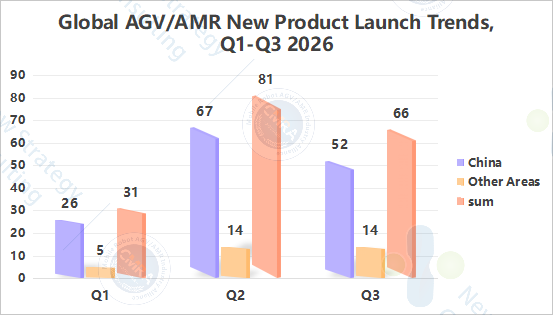
Global AGV and AMR new product launch trends 2026
2. Product Form Factors: Composite AMRs Steal the Spotlight
The product mix in Q3 reveals where commercial demand is concentrating:
The Surge of Composite AMRs (56.1% in Q3 / 52% YTD)
Composite robots—traditionally viewed as niche “mobile chassis + articulated arm” experiments—have become the dominant category. Driven by advancements in Embodied AI, 2026 composite AMRs now feature unified perception, motion planning, and manipulation capabilities.
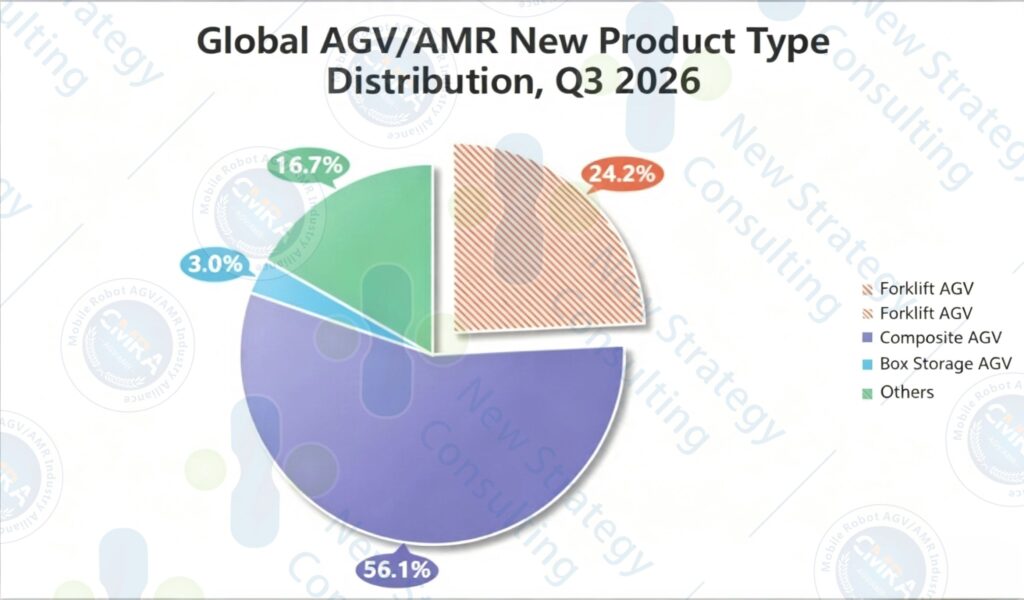
Q3 2026 global AGV AMR product type distribution
The competitive benchmark has fundamentally changed:
- Old Question:“Can the robot navigate from Point A to Point B reliably?”
- New Question:“Once it arrives, what complex operational tasks (machine tending, inspection, bin-picking) can it perform autonomously?”
Automated Forklifts Remain the Operational Baseline (24.2% in Q3 / 26.8% YTD)
Automated forklifts continue to hold a massive share of new product development. As warehouses face persistent labor shortages globally, manufacturers are pushing narrow-aisle efficiency, higher payload durability, and faster commissioning times.
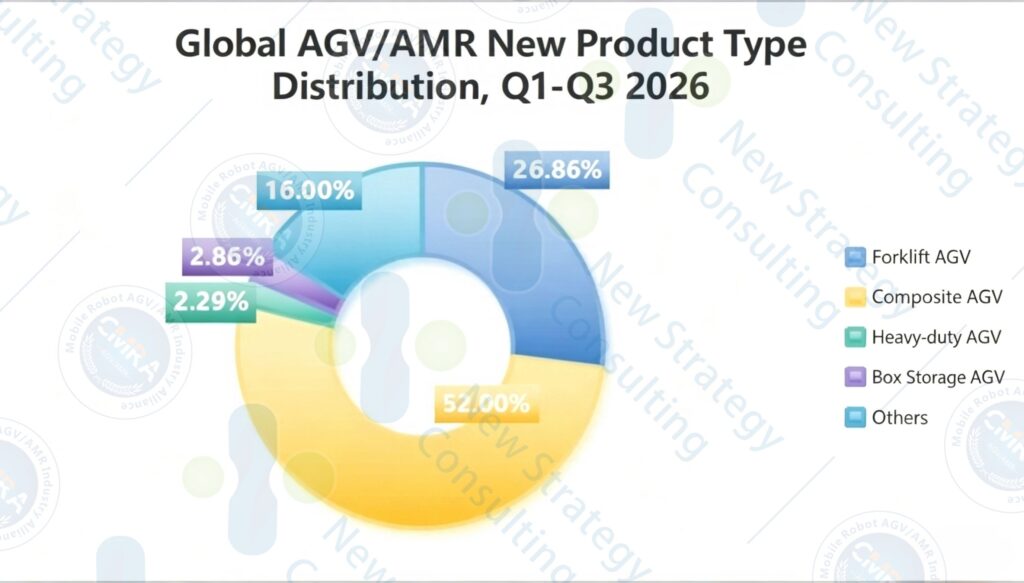
Q1-Q3 2026 mobile robot product type distribution
3. Geographic Divide: Agile Ecosystem vs. Deep Optimization
The regional distribution of the 178 launches highlights two contrasting operational philosophies across the globe:
- The China Playbook (Agile & Scenario-Driven):
Backed by a hyper-dense component ecosystem and vast local manufacturing facilities, Chinese suppliers iterate hardware at unmatched speed. They rapidly launch targeted form-factors for hyper-specific industrial applications (e.g., photovoltaics, lithium battery gigafactories, dark warehouses).
- The Western Playbook (Focused & High-Barrier):
U.S. (18 models) and European (5 models) vendors remain conservative in product quantity. Facing high labor costs, strict safety certifications (ISO/CE), and stringent customer buying cycles, Western OEMs prioritize software robustness, safety standards, and long-term hardware reliability over quick catalog expansions.
Key Takeaways for Industrial Buyers & Investors
- Hardware Commoditization Is Accelerating:With over 140 Chinese AMRs entering the market in 9 months, basic mobility hardware is fast becoming commoditized. Future profit margins lie in specialized software, embodied AI workflows, and system integration.
- Composite AMRs Are Ready for Scale:End-users should re-evaluate composite robots for automated machine-tending and assembly lines, as Embodied AI has significantly reduced setup and integration times.
- Global Sourcing Opportunities:Overseas buyers seeking cost-effective automation options can leverage China’s mature AMR supply chain, though proper localization and compliance testing remain essential.



1-300x168.png)