
Genisom AI, a Chinese startup that makes quadruped and humanoid robots, has closed a Series B round worth several hundred million yuan. The round was led by UAE-based Stone Venture. Hongshan Capital, Technology Financial Group, Wuzhong Rongyue and Wuzhong Innovation Investment also invested, as did several industry backers: Neusoft, OpenTech, Yuanjian Capital and Riying Electronics.
Following this funding round, the company will focus its continued investment on the robot hardware platform, embodied “brain-cerebellum” systems, and task execution capabilities; it will also advance the iteration of its GSD (Genisom Self-Driving) autonomous navigation technology and strengthen the robot’s ability to perform tasks in real-world industrial application scenarios.
Genisom was founded in December 2023 and says it now covers everything from core components to robot bodies, embodied-intelligence software and industry applications. It has nearly 400 employees, about 70% of them in research and development. In Suzhou it operates a complete-robot manufacturing center and a joint-module factory, which handle component production, assembly, testing, quality inspection and burn-in validation.
The company describes its technology as four layers: the robot body, a “brain” that handles navigation, understanding surroundings and deciding what to do, a “cerebellum” that handles motion control and ties perception to movement, and the applications built on top.
It also lays out four stages of development: locomotion, spatial, cognitive and swarm intelligence. Navigation is a current focus. Through GSD, Genisom wants robots to depend less on fixed maps, preset routes and project-by-project setup, so they can locate themselves, plan routes and work in complex real-world environments. The company has also published developer tools, including its MATRiX simulation platform, an open-source navigation framework and SDKs for its L1 and M1 robots.
Its products center on quadrupeds. The Genisom L1, its first mass-produced model, is a small industrial robot that carries 8 kg while walking, climbs 40-degree slopes and has an IP54 rating. It is used for security patrols and for research and education, and comes in a wheel-legged L1-W version and an L1 EDU version for developers. The Genisom M1 is built for heavier work, with a 30 kg continuous payload, 45-degree climbing and an IP67 rating. Genisom targets it at power utilities, firefighting and emergency rescue. The newest model, the Genisom L2, launched in June. It carries 16 kg, clears 70-centimeter obstacles, has a 756 Wh battery and an IP66 rating, and runs on up to 86 TOPS of computing power. Genisom said it is the first of its robots to ship with navigation as a standard feature rather than a per-project add-on, using LiDAR and satellite positioning to work indoors, outdoors and across multiple floors.
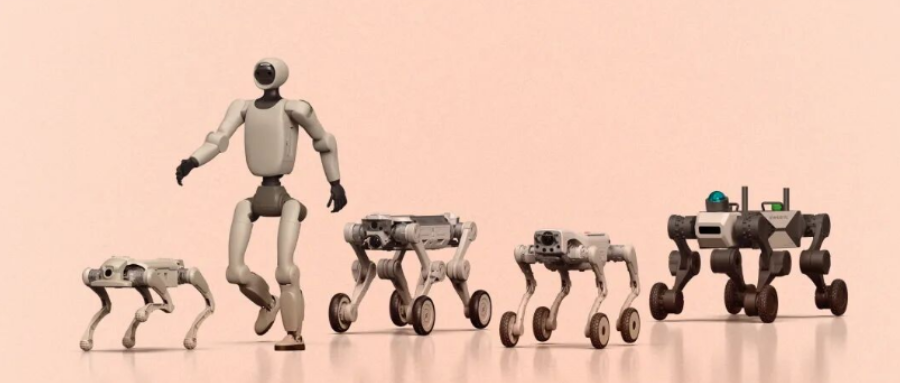
In the field of humanoid robots, the company has launched the Genisom Yinyi NE01 series, comprising the Yinyi NE01, Yinyi NE01 Ultra, and Yinyi NE01 Pro.
On shipments, Genisom said it had delivered a cumulative 5,000 robots by the end of 2025, with annual revenue above 100 million yuan. By June 2026, the total had passed 15,000, a threefold increase in about six months. Its robots are used in industrial inspection, security patrols, emergency rescue, energy and power, education and research, and entertainment, sold through channel and scenario partners.


1-300x168.png)