By 2025, China low-speed autonomous driving industry has traversed five years of refinement, from conceptual emergence to large-scale implementation, completing a crucial leap from technology verification to commercial explosion. With cost reduction, scenario-based deployment, and policy support as its core pillars, it has built the initial framework of a market worth hundreds of billions of yuan, achieving a substantial transformation from “experimental samples” to “essential needs of people’s livelihoods.”
Now, looking back to the past in 2025, the final year and the year that has laid the foundation for the industry’s landscape:
The explosive growth in market size over the past five years is the most striking feature. According to data from China Low-Speed Automated Driving Industry Alliance (LSAD) and statistics from the New Strategy Low-Speed Automated Driving Industry Research Institute, the sale amount in the industry reached 12.3 billion yuan in 2024, a year-on-year increase of 45%, and the annual sale volume was 33,000 units, a significant leap compared to 2020. The sales volume is projected to exceed 60,000 units in 2025, further expanding the market size.
The widespread implementation of scenarios over the past five years is the most vivid testament to this progress. Core sectors like unmanned delivery have achieved mass and even large-scale deployment; the unmanned sanitation sector has seen several breakthroughs, marking several “firsts,” and the market worth hundreds of billions is poised for explosive growth; the unmanned mining sector has achieved a leap from “following the trend” to “leading the trend,” leading globally in technological innovation, business models, and large-scale applications; in unmanned ports, autonomous terminals and unmanned trucks working together have become standard features in newly built ports, moving from pilot projects at individual berths to systematic intelligent upgrades of the entire hub port area.

Over the past five years, technological and product innovation has been the most crucial breakthrough. Sensor technology has gradually evolved towards solutions that deeply integrate solid-state/semi-solid-state LiDAR, high-performance millimeter-wave radar, and cameras, resulting in a significant cost reduction and clearing the biggest obstacle to large-scale deployment; general-purpose computing devices are gradually being replaced by automotive-grade domain controllers designed specifically for autonomous driving; the rise of domestically produced chips provides more cost-effective and secure supply chain options; “single-vehicle intelligence” is moving towards “vehicle-road-cloud collaborative intelligence”; furthermore, the pace of innovation in integrated products and solutions is accelerating, and product reliability and stability are continuously improving, driving faster commercialization.
Now, looking ahead to the future in 2025, a year of significant growth and the start of a new chapter:
The next five years will be a period of accelerated market scaling. In the unmanned delivery sector, China Post and JDL have successively announced plans to deploy thousands and even millions of unmanned vehicles. Platform companies such as Meituan and Alibaba are also accelerating the construction of unmanned transportation networks, driving a systemic restructuring of last-mile delivery from “labor-intensive” to “human-machine collaboration.” In unmanned sanitation, many local governments have included unmanned cleaning vehicles in their smart city infrastructure procurement lists, with orders for dozens or even hundreds of vehicles being placed, promoting the gradual maturation of overall service models based on streets and industrial parks. In closed scenarios such as ports and mining areas, the industry has entered a stage of mass replication, moving from single-point demonstrations to cross-regional output, and gradually building fleets of hundreds of unmanned vehicles.
Meanwhile, as government-led plans for thousands and tens of thousands of vehicles are gradually implemented, centralized procurement and deployment based on specific scenarios will become the new normal, and the industry will move from “sporadic development” to “regional consolidation.” It is projected that by 2030, the overall market size of the industry will exceed tens of billions of yuan, accelerating its march towards a market worth hundreds of billions of yuan.
The next five years will be a period of affordable technological innovation. On the hardware side, with the maturity of the supply chain and the expansion of mass production, the costs of core components such as LiDAR and computing units will continue to decline, pushing vehicle prices towards the “sweet spot” of large-scale application. On the software side, AI, large-scale models, and closed-loop data-driven approaches will accelerate algorithm evolution, enabling vehicles to more intelligently handle “long-tail scenarios.”
The next five years will also be a period of accelerated evolution in ecosystem competition. The industry competition will shift from single-technology contests to system-level stability, energy efficiency, and total lifecycle costs. The competitive landscape will evolve from the “lone battles” of a single company to a collaborative “army-like” operation across the entire industry chain. Whoever wins the battle for ecosystem integration will gain the initiative in the next stage of the breakthrough.
———————————————————————————————————————————————————————————————————————————
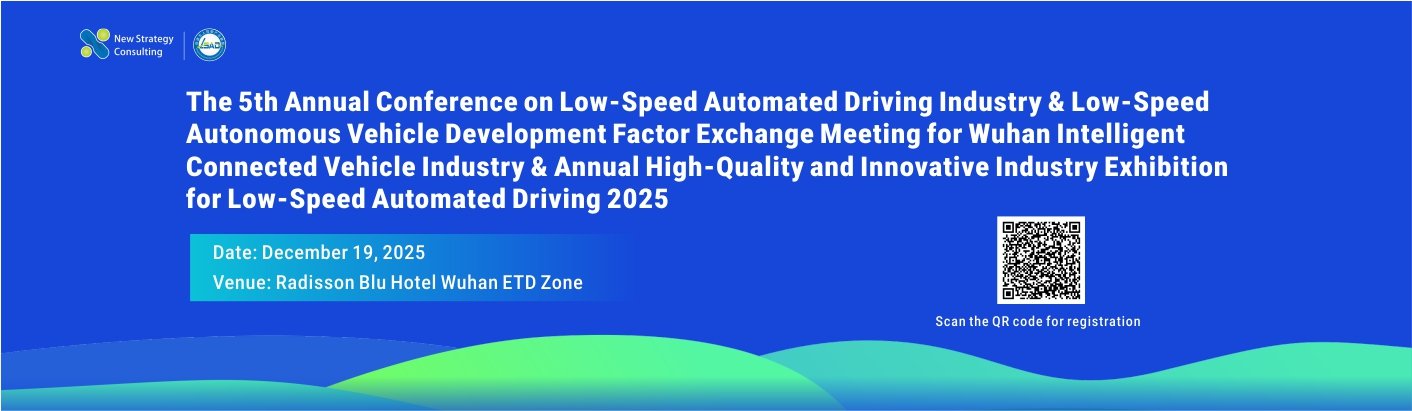
On December 19, 2025, China Low-Speed Automated Driving Industry Alliance (LSAD) and Wuhan Junshan New City Technology Investment Group Co., Ltd. will jointly host the “5th Annual Conference on Low-Speed Automated Driving Industry” in the National Intelligent Connected Vehicle (Wuhan) Test Demonstration Zone. At the conference, the Annual Report and Forecast of Low-Speed Autonomous Driving Development for the Next Five Years will be released offline. Stay tuned!