In the narrative of global supply chain restructuring, Southeast Asia is transitioning from a “receiving region” to a “reshaper.” In recent years, manufacturing has been decentralized from China to countries such as Vietnam, Thailand, and Malaysia, while cross-border e-commerce and local e-commerce have exploded simultaneously. Ports, bonded zones, and industrial parks have been densely constructed within the region.
Platforms like Shopee and Lazada have rapidly expanded into Indonesia, Thailand, and the Philippines, while TikTok’s e-commerce ecosystem continues to penetrate these markets. This has fundamentally redefined the efficiency of warehousing and fulfillment systems. Frequent order fluctuations and compressed delivery cycles have transformed automation from an optional feature into a core competency for businesses participating in global division of labor. Against this backdrop, mobile robots tailored for warehousing and manufacturing scenarios have emerged as a pivotal element in Southeast Asia’s industrial transformation.
In the future, Southeast Asia is likely to become a key window for observing global industrial spillover and rebalancing. Based on our analysis and research of domestic mobile robotics enterprises across 11 Southeast Asian countries, we aim to outline the true profile of this market.
The Pattern of Mobile Robot Enterprises in 11 Southeast Asian Countries
If Southeast Asia is viewed as a homogeneous entity, it is easy for outsiders to readily draw a generalized conclusion of ‘weak industrial foundations.’ However, once macro-level labels are transcended and the analysis is delved into at the enterprise and country levels, the true landscape of this market proves far more complex than imagined.
Southeast Asian countries exhibit significant disparities in technological accumulation, industrial demands, and policy environments. These fundamental differences have directly shaped distinct development trajectories for local mobile robotics enterprises, resulting in a clear hierarchical differentiation across the industry.
The term “disparity” aptly captures the supply landscape of mobile robotics in Southeast Asia. The region features both technology hubs like Singapore and Malaysia, manufacturing-driven application hotspots such as Vietnam and Thailand, and underdeveloped markets including Laos and Brunei. Based on the operational activity and growth potential of local mobile robotics enterprises, the 11 Southeast Asian countries can be clearly categorized into three tiers.
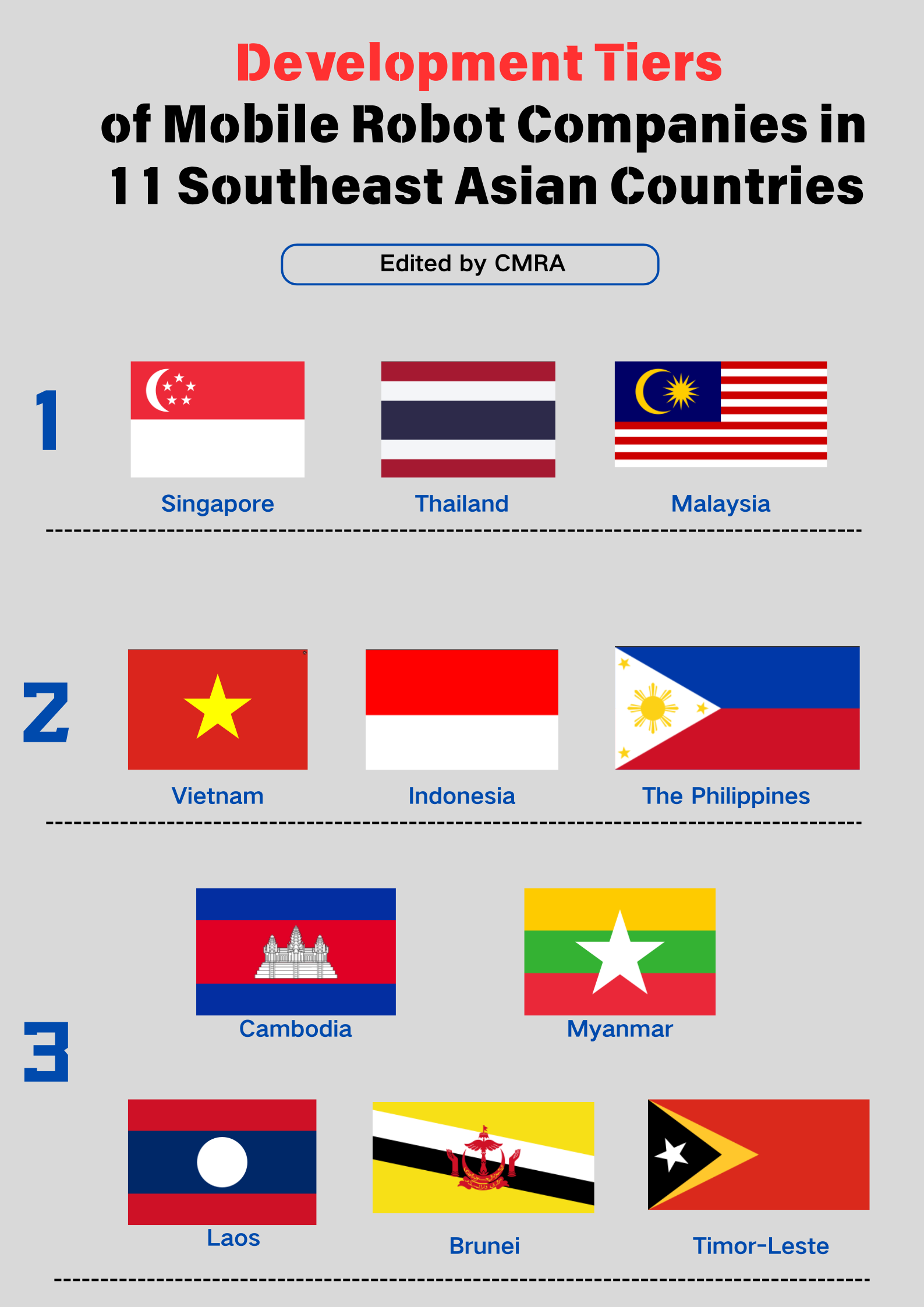
Chart: The Development Ranking of Mobile Robot Enterprises in 11 Southeast Asian Countries
Tier 1: Singapore, Thailand, Malaysia
Singapore
Singapore is undoubtedly the first-tier leader in the mobile robotics market of Southeast Asia. As a regional financial and technological hub, Singapore has consistently maintained a pioneering position in robotics research and development, testing, and application. This industrial advantage has directly empowered the growth of local mobile robotics enterprises.
While Singapore’s domestic mobile robotics enterprises may not be numerous, they demonstrate remarkable technological density, spanning multiple core sectors including AMRs, AGVs, unmanned forklifts, and composite robots.
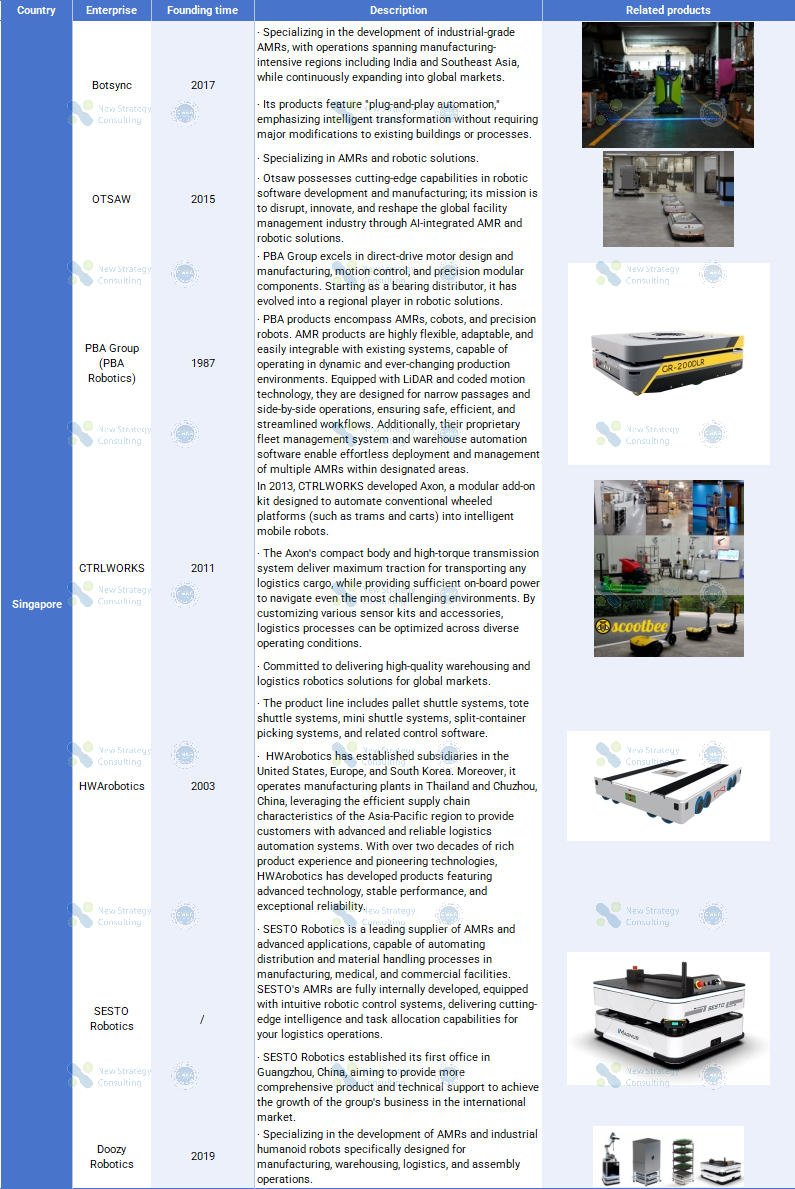
Chart: Overview of Mobile Robot Companies in Singapore
Specifically, various enterprises have developed distinctive growth models leveraging their unique strengths. PBA Group (PBA Robotics), a veteran local automation company, entered the mobile robotics sector through years of technical expertise in industrial automation, demonstrating mature engineering implementation capabilities in industrial material handling and production line logistics scenarios. OTSAW began its AMR initiatives in 2015, utilizing cutting-edge robotics software development and manufacturing capabilities to deliver multiple industry-ready application projects. Botsync, established in 2017, focuses on AMR and smart warehousing solutions with enhanced software scheduling and system integration capabilities. Its operations now span manufacturing-intensive regions including India and Southeast Asia, while continuously expanding into global markets.
These enterprises are generally small in scale, but their distinctive features include relatively mature algorithmic capabilities and system integration skills, with business models that lean toward high-value-added solutions. This further solidifies Singapore’s position as a regional hub for technology export.
Malaysia
Although the number of mobile robotics enterprises in Malaysia is not large, their development is closely tied to the country’s mature semiconductor and electronics manufacturing industries. Multinational semiconductor companies such as Intel and Texas Instruments have long established operations in Malaysia. The stringent requirements for precision manufacturing scenarios continue to drive the gradual accumulation and maturation of local automation service capabilities.
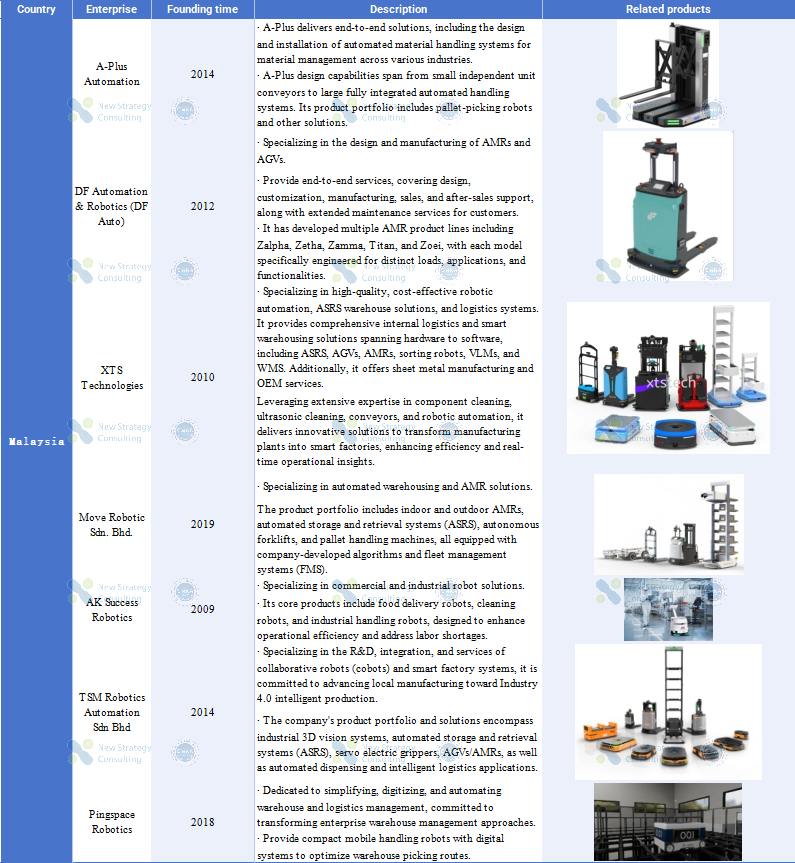
Chart: Overview of Domestic Mobile Robot Companies in Malaysia
DF Automation & Robotics (DF Auto) stands as a leading player in Malaysia’s mobile robotics industry. Founded in 2012, the company has independently developed multiple AMR product series including Zalpha, Zetha, Zamma, Titan, and Zoei, catering to diverse payload capacities and application scenarios while offering end-to-end services spanning design, manufacturing, and after-sales support. Established in 2010, XTS Technologies specializes in internal logistics and smart warehousing solutions, providing integrated hardware-software packages that encompass AGVs, AMRs, and picking robots. Move Robotic Sdn. Bhd., founded in 2019 as a rising industry player, focuses on automated warehousing and AMR solutions with product lines covering indoor/outdoor autonomous mobile robots, automated forklifts, and pallet handling equipment, emerging as a prominent new force in the local market.
Furthermore, companies such as A-Plus Automation, AK Success Robotics, TSM Robotics, and Pingspace Robotics collectively form Malaysia’s relatively comprehensive domestic automation service ecosystem, with operations spanning material handling, collaborative robots, warehouse picking, and other specialized sectors. Overall, Malaysian enterprises have established a solid foundation in hardware manufacturing and system integration. However, there remains room for improvement in core scheduling software development and large-scale robotic swarm control capabilities.
Thailand
Thailand stands as one of Southeast Asia’s most densely populated countries for mobile robotics adoption. This phenomenon is underpinned by two key drivers: the region’s most concentrated automotive manufacturing ecosystem and rapidly expanding modern logistics infrastructure fueled by e-commerce boom. The nation hosts factories from global automakers including Toyota, Honda, and BMW. The Japanese manufacturing culture’s strong embrace of automation has cultivated a robust local system integrator ecosystem and a stable end-user base.
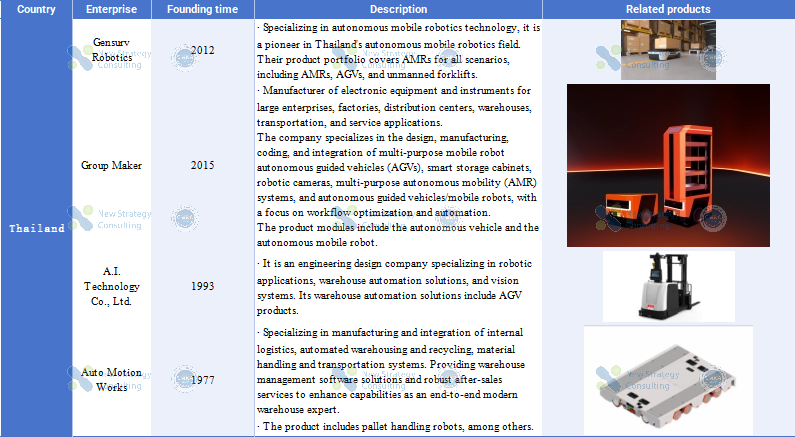
Chart: Overview of Domestic Mobile Robot Companies in Thailand
The development of Thailand’s indigenous mobile robotics enterprises is closely aligned with local manufacturing demands, particularly focusing on core sectors such as automotive assembly and electronics manufacturing. Gensurv Robotics, established in 2012, stands as a pioneer in Thailand’s autonomous mobile robotics industry, offering comprehensive product solutions across various scenarios including AMRs, AGVs, and unmanned forklifts. Group Maker, founded in 2015, specializes in providing AGV/AMR systems and smart storage cabinet solutions for large-scale factories and distribution centers, while strategically expanding its presence in both industrial and commercial sectors.
It is worth mentioning that at the policy level, the Thai government’s “Thailand 4.0” strategy has listed intelligent manufacturing as a core driving force, and the large-scale construction of the Eastern Economic Corridor (EEC) has attracted a number of international enterprises to layout robot-related industries. This is also a key reason why many China mobile robot companies prioritize Thailand when expanding into the Southeast Asian market.
Tier 2: Vietnam, Indonesia, the Philippines
Vietnam, Indonesia, and the Philippines collectively form the second tier of the Southeast Asian mobile robotics market. All three countries are experiencing a period of rapid growth in industrial demand, yet the number of domestic mobile robotics enterprises remains relatively low. Their overall technological capabilities are still in the cultivation stage, and they have not yet established large-scale, systematic core competitiveness.
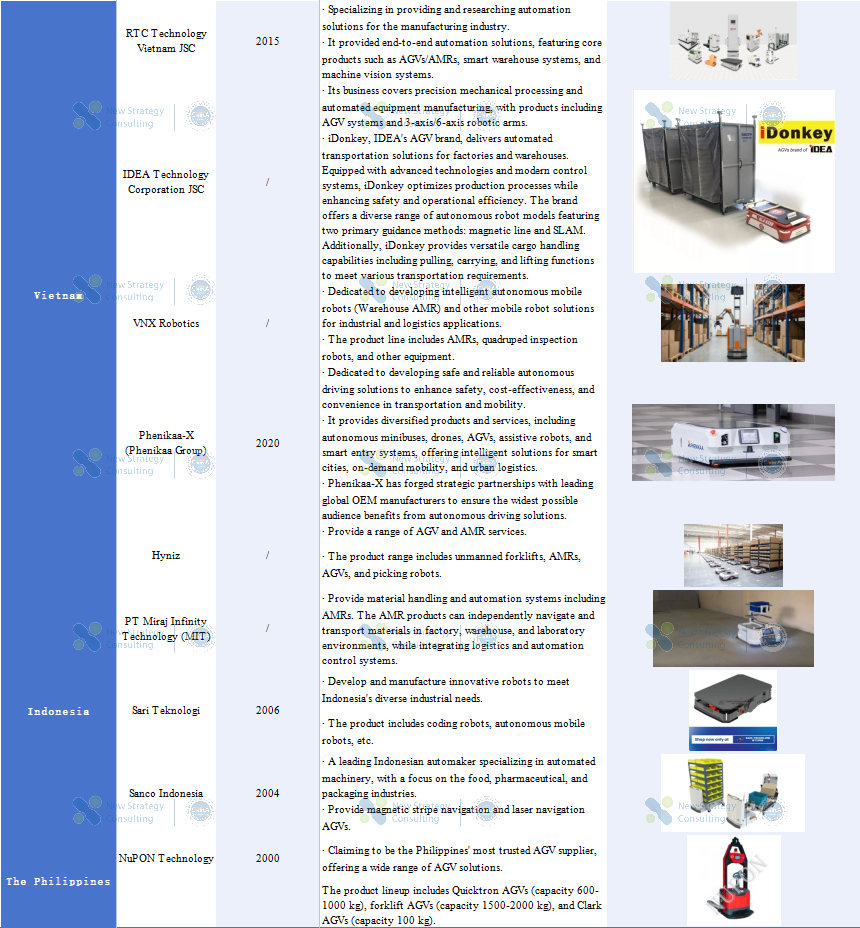
Chart: Overview of Mobile Robot Companies in Vietnam, Indonesia, and the Philippines
As the most direct beneficiary of the global manufacturing shift, Vietnam’s electronics and light manufacturing industries continue to expand, with industrial parks densely established, directly generating strong demand for automation. Local companies such as VNX Robotics and RTC Technology Vietnam JSC have emerged in the logistics and warehousing robotics sector, but the overall industry remains in its infancy and has yet to form a scalable competitive edge. The current Vietnamese market exhibits distinct characteristics of robust demand and high dependence on foreign investment, particularly dominated by China’s mobile robotics brands. Local enterprises still lag significantly behind China’s leading companies in terms of R&D depth and product maturity. This gap not only represents an urgent shortcoming for Vietnam’s domestic automation industry but also reserves a favorable market window for Chinese enterprises.
Leveraging its vast consumer market and mature e-commerce ecosystem, Indonesia has been steadily expanding its warehousing infrastructure while unlocking the potential of its mobile robotics sector. However, the domestic manufacturing landscape remains underdeveloped, with limited local players like Sarot Teknologi and Sanco Indonesia offering only basic automation equipment and entry-level AGV systems. These companies possess limited technical expertise, leaving major automation projects heavily reliant on imported machinery and foreign system integrators. Furthermore, Indonesia’s geographically fragmented islands result in uneven infrastructure development, making project implementation far more complex than in countries like Vietnam or Thailand. This geographical diversity may delay the market’s explosive growth, but once operational, it could unleash significant economies of scale.
The market landscape in the Philippines bears striking similarities to Indonesia’s. With a weak foundation in domestic automation industries, only a handful of companies like BAGO Technology specialize in mobile robotics equipment, where the market remains dominated by standalone device sales without developing systematic solution capabilities. As awareness of automation grows across local retail and logistics sectors, market demand is gradually emerging. However, mature industrial-grade mobile robotics products and integrated solutions still heavily rely on external suppliers.
Notably, both Indonesia and the Philippines are markets where demand growth rates far exceed domestic supply capabilities. As Southeast Asia’s most populous nation, Indonesia has witnessed remarkable progress in e-commerce warehouse infrastructure development. However, most local robotics companies remain concentrated in educational and service robotics sectors, with industrial mobile robotics supply remaining virtually non-existent. The Philippines faces similar challenges, as rising automation demands in logistics and retail sectors lack mature domestic industrial robotics manufacturers. These significant structural supply-demand gaps have created substantial market opportunities for international mobile robotics brands.
Tier 3: Cambodia, Myanmar, Laos, Brunei, Timor-Leste
In countries such as Cambodia, Myanmar, Laos, Brunei, and East Timor, the mobile robotics industry remains in its infancy or even non-existent. Domestic enterprises lack large-scale production capabilities, with automation projects predominantly undertaken by external system integrators. Due to limited industrialization levels in some nations, mobile robotics has yet to integrate into mainstream manufacturing and warehousing systems. The relatively small market size makes it challenging to establish an independent industrial ecosystem in the short term.
However, this does not imply the absence of long-term space. With the extension of regional manufacturing chains, these countries may potentially bypass the traditional automation phase and directly transition to more digitalized and intelligent system deployment models in the future. Nevertheless, at present, local supply capacity remains virtually non-existent.
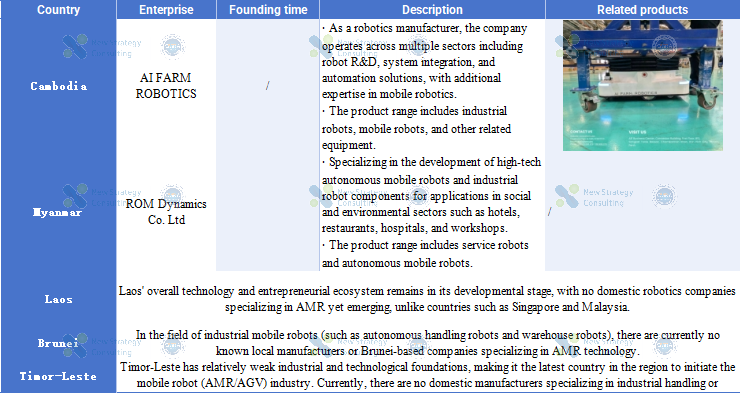
Chart: Overview of Mobile Robot Companies in Vietnam, Indonesia, and the Philippines
Conclusion: Synergy is emerging
The stratified landscape of domestic enterprises across 11 countries reveals that Southeast Asia’s mobile robotics industry remains in its structural formation phase. First-tier nations have established foundational technological and engineering capabilities; second-tier countries demonstrate robust demand but lack mature local supply systems; third-tier nations remain largely unexplored, with their industrial ecosystems yet to achieve complete closed-loop development.
At this critical juncture, the large-scale entry of China’s mobile robotics enterprises has brought a key variable to regional industrial development. In recent years, leading companies such as Geek+, Hikrobot, and Quicktron have successively focused on Southeast Asia, becoming a significant force in driving local automation upgrades.
From a pattern perspective, Chinese enterprises entering Southeast Asia can be roughly divided into three approaches. The first is to establish regional headquarters in countries such as Singapore and Malaysia as footholds to expand into neighboring markets. The second involves deep collaboration with local system integrators, who undertake project implementation and after-sales services to reduce operational costs. The third approach is “customer-following overseas expansion,” where Chinese manufacturers with existing factories in Southeast Asia deploy automation systems locally.
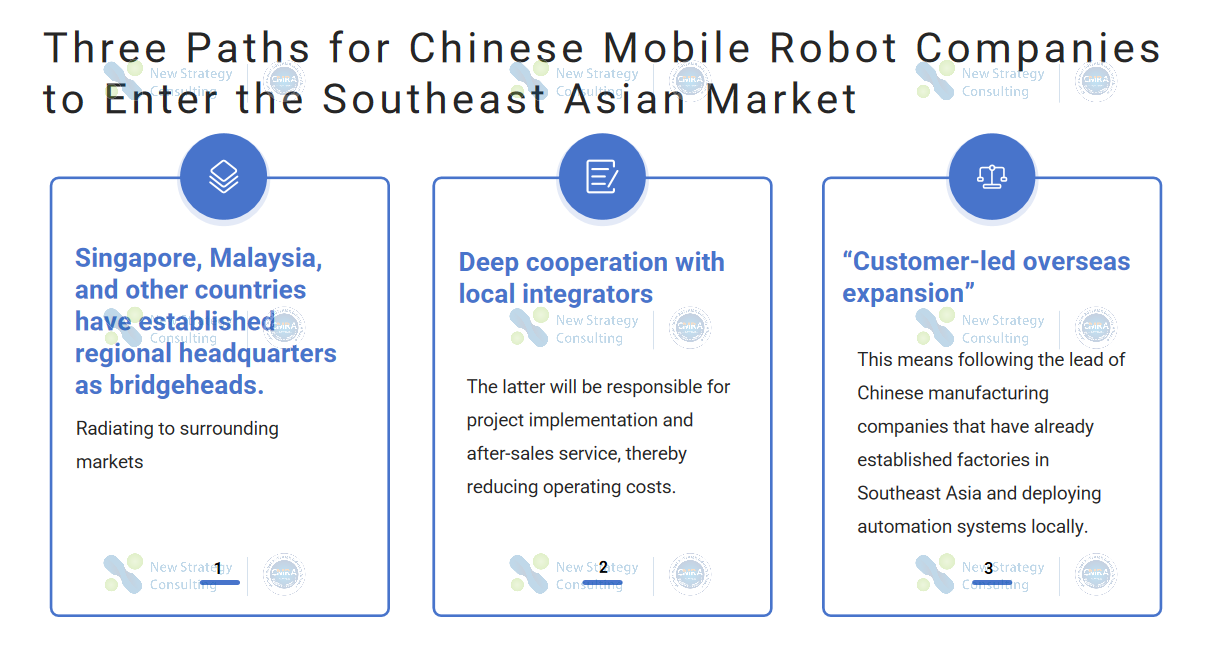
Chart: Three Paths for China Mobile Robot Companies to Enter Southeast Asia
Cost-effectiveness and efficient delivery are the core competitiveness of the China brand. Compared with other overseas enterprises, China’s enterprise solutions are more flexible, respond more quickly, and offer prominent price advantages, making them highly suitable for the cost-sensitive markets in Southeast Asia. However, going global is not a simple replication of domestic models. The fragmented characteristics of the Southeast Asian market, along with differences in language, regulations, and business culture, have gradually made local service capabilities, channel development, and long-term trust relationships surpass pricing as the core of competition. Industry competition is shifting from “equipment competition” to “ecosystem rivalry.”
The current mobile robot market in Southeast Asia is still in its early growth phase, with demand continuously released but low penetration rates. Domestic companies are building momentum for growth, while overseas brands are accelerating their entry, and the market landscape is far from solidified. This presents both a golden opportunity for China enterprises to expand their overseas footprint and a crucial litmus test for their global operational capabilities.
With the improvement of China’s mobile robot competitiveness overseas, the importance of industrial collaboration has become increasingly prominent. Focusing on supply chain upgrading, digital transformation of manufacturing, and logistics efficiency enhancement, cross-regional exchanges and project alignment have become an inevitable trend.
The “Supply Chain Asia Forum 2026 · Logistics Supply Chain Mobile Robotics Application Exchange Conference” will be held by China Mobile Robot Industry Alliance (CMRA) and Supply Chain Asia on May 14, 2026 in Thailand, aiming to build a more efficient communication platform for China enterprises and local industries in Southeast Asia.

At a critical juncture of industrial restructuring, network connectivity often proves more vital than isolated breakthroughs.