China’s market enters a period of structural correction.
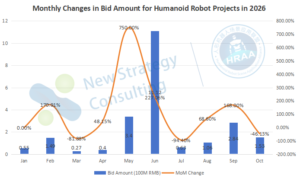
According to data from the Low-Speed Autonomous Driving Industry Alliance and the New Strategy Low-Speed Autonomous Driving Industry Research Institute, China recorded over 52 newly awarded low-speed autonomous driving projects in October 2026, with disclosed total contract values exceeding RMB 1.1 billion.
Compared with September, project numbers edged down, while disclosed contract values fell by 45%. After strong growth in Q3, with monthly contract values exceeding RMB 2 billion, October marked a structural adjustment across project sizes, application scenarios, and procurement patterns.
1.Project Structure: Large Deals Become Less Frequent
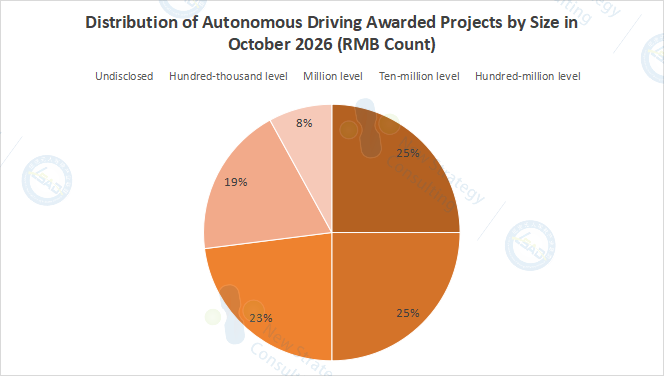
In October, four projects exceeded RMB 100 million, with a combined value of over RMB 700 million. Another 10 projects were valued between RMB 10 million and RMB 100 million, totaling more than RMB 360 million. There were also 13 projects each in the million-yuan and hundred-thousand-yuan categories.
2. Application Scenarios: Autonomous Sanitation Remains Dominant
Autonomous sanitation remained the largest application segment, with 16 projects and disclosed contract values exceeding RMB 800 million, accounting for nearly three-quarters of the total.
Projects in Wuxi, Yangzhou, Changsha, and Zigong have increasingly incorporated autonomous sanitation vehicles into mandatory tender specifications and evaluation criteria, signaling a shift from optional incentives to stricter procurement requirements.
The mining sector recorded five projects, but total contract value fell below RMB 1 billion due to the absence of mega-projects. Procurement models are also shifting from direct vehicle purchases toward leasing and outsourced transportation services.
Autonomous delivery, inspection, and education and training accounted for nearly 30 projects combined, but most remain at the early commercialization stage, with relatively small contract values.
3. Procurement Trends: From Pilot Projects to Performance Requirements
Government procurement remained the primary market driver. However, following concentrated procurement in Q3, October saw a slowdown as projects moved into evaluation and tender restructuring stages.
Procurement requirements are becoming more stringent, with vehicle deployment numbers, acceptance criteria, and delivery milestones increasingly included in quantitative evaluations.
Meanwhile, state-owned platforms are taking the lead in project contracting, technology providers supply equipment, and operating companies handle service delivery. Private enterprises are also favoring leasing and outsourced services over one-time purchases.
From Demonstration Projects to Operational Performance
Overall, China’s low-speed autonomous driving market entered a phase of adjustment in October, characterized by smaller projects, more practical application scenarios, and stricter procurement requirements.
The industry is shifting from demonstration-driven development toward operational commercialization, with delivery quality, operating efficiency, and life-cycle returns becoming increasingly important.
2026 The 9th Annual Conference on Mobile Robot Industry Development and the 4th Annual Conference on Scenario Applicationsof Wheeled Humanoid Robot will be held on December 9–10 at the Parallel World Hotel in Hangzhou.
The conference will focus on industrial embodied intelligence deployment, motion control, chassis technology, manufacturing applications, and data collection and annotation, promoting the industry’s shift from product exploration to deep scenario deployment.