Key Takeaways:
- Unitree Leads the Volume:Leading OEMs like Unitree, UBTECH, and Leju secured high-frequency bids in September.
- The “Pulse” Effect: China awarded 78 humanoid robot projects totaling ~$39M in September, but this spike was primarily driven by a few massive government/education platform deals, not a universal upgrade in industrial purchasing.
- Structural Reality: Education and R&D form a stable baseline (average project value ~$540K), but normalized, large-scale commercial adoption in factories has not yet arrived.
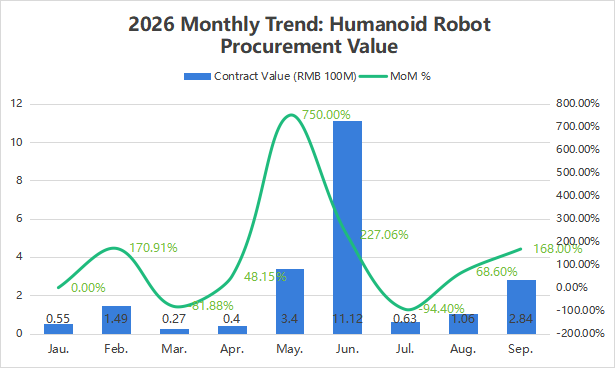
Following the concentrated release of mega-deals in July and a steady August dominated by small-to-medium projects, China’s humanoid robot procurement market experienced a significant rebound in September, with RMB 100-million-level (approx. $14 million) orders returning after a three-month hiatus.
The $39M Spike: Driven by Mega-Deals, Not Universal Growth
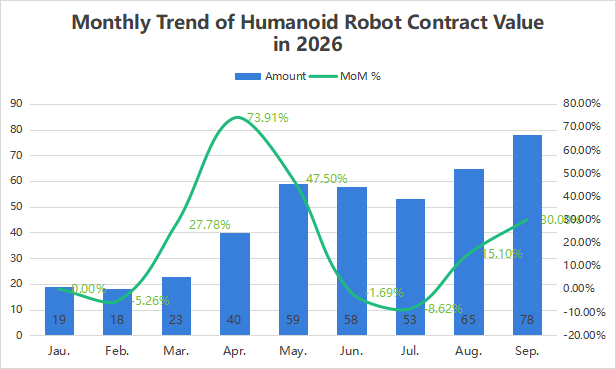
According to incomplete statistics from the Humanoid Robot Scene Application Alliance, in September 2026, 78 publicly disclosed humanoid robot and embodied AI procurement projects were awarded in China, with a total disclosed contract value of approximately RMB 284 million (approx. $39 million). (Note: Data excludes K12 desktop educational devices, construction projects, and micro-leasing projects under RMB 100,000; five undisclosed contracts are excluded from the total.)
Compared with August, the number of projects increased by roughly 30% month-over-month (MoM) (from 60+ to 78). The total contract value surged from RMB 106 million to RMB 284 million, a massive 168% MoM increase.
The Buyers and the Use Cases
Looking at the project structure in September, the demand side of the Chinese market shows distinct characteristics:
- Highly Concentrated Buyers: Education/Research and Local Governments are the Two Core Drivers
- Universities and Vocational Schools (Primary Buyers):Including Double First-Class universities like Northeastern University and Tongji University, as well as numerous vocational colleges. They primarily purchase to build “training labs” or conduct secondary development.
- Government and Public Institutions:Local DRCs, emergency management bureaus, and science museums, mainly for public displays, safety inspections, or building local industrial innovation platforms.
- K12 Schools:Small-volume purchases by schools in Shenzhen, Wuxi, and other places for AI science education.
- Vendor Landscape: Top OEMs vs. Local Integrators
Top brands like Unitree, UBTECH, and Leju are winning high-frequency bids.
However, a large number of orders from vocational schools and K12 schools are secured by local tech companies and educational equipment distributors. This shows that deployment in the mass education market still relies heavily on localized channels and services.
- Demand Evolution: From “Buying Hardware” to “Buying Platforms”
The vast majority of procurement targets are “humanoid robot development platforms” or “embodied AI training platforms,” which universities use for algorithm validation.
A small portion of demand involves public displays (e.g., marathons, opening ceremonies) and specialized industry applications (e.g., substation inspections, emergency security).
The Reality Check: From "Pulse" Spikes to Normalized Adoption
Despite the impressive headline figures in September, the industry must remain clear-headed: the massive increase in value this month was primarily driven by a few massive industrial procurement orders (such as platform construction and local bulk purchases), rather than a universal upgrade in procurement specifications across the entire industry.
The data confirms this: the average value per project in September was about RMB 3.9 million, higher than August’s RMB 1.63 million, but still far below June’s peak of RMB 19.17 million.
Looking at the full-year perspective, two underlying trends remain clear:
- The market foundation is expanding:From fewer than 20 projects at the beginning of the year to 78 in September, education and R&D have formed a stable and sustainable procurement demand.
- The market is highly dependent on “pulse-like” mega-deals:The presence or absence of platform construction or industrial bulk procurement directly determines the monthly market volume, causing massive fluctuations between months.
Crossing the Chasm from "Pilots" to "Normalized Adoption"
While September’s overall data is impressive, the foundation built by China’s education and R&D sector is only the first step. The core pain point remains: normalized, large-scale procurement from the industrial and commercial sectors has not yet become mainstream.
Rather than focusing on the single-month total value surge, what is more worth tracking is: can the massive pilot projects in universities mature into replicable solutions that truly spill over into real industrial and commercial scenarios, thereby driving sustained procurement on the industry side?
Going forward, as embodied AI innovation platforms are implemented across various regions and industrial pilots continue to advance, whether the industry can continuously produce more non-pulse, normalized bulk orders will become the key metric for judging the maturity of China’s humanoid robot market.