Recently, Agility Robotics and Churchill Capital Corp XI filed their latest S-4 registration statement with the U.S. Securities and Exchange Commission (SEC), bringing the American humanoid robot company one step closer to going public. Previously, the two companies had announced a merger agreement, with the transaction corresponding to an equity value of approximately $2.5 billion, and expected to bring Agility over $620 million in funding. For a humanoid robot company still in the early stages of mass production and not yet profitable, the importance of this funding is self-evident.
However, with the release of the latest financial data, Agility’s true operating situation is presented to investors in a more complete form for the first time. In 2025, the company’s net sales were only $1.782 million, a year-on-year increase of approximately 474%, but its loss from operations reached $140.2 million, and its net loss reached $138.1 million; as of the end of 2025, the company’s cash and cash equivalents were approximately $103 million. Meanwhile, the company is pursuing an IPO with an equity value of approximately $2.5 billion.
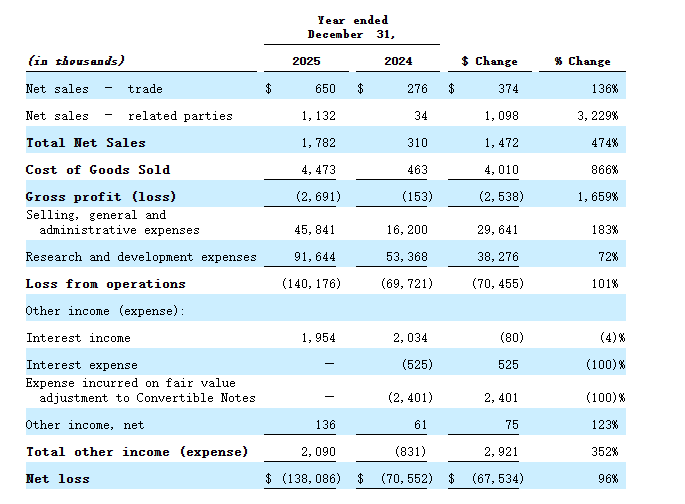
Source: Agility Robotics S-4 Filing
This combination of figures transforms Agility’s IPO from merely a story of “humanoid robots entering the capital market” into a more pressing question: can the company leverage the funds raised from its IPO to achieve a leap in commercial scale despite continuously increasing cash burn?
1. Why is Agility in such a hurry to go public?
From a financial structure perspective, Agility’s most critical issue isn’t the lack of revenue growth, but rather that its revenue is still far from sufficient to cover its R&D, manufacturing, and operational investments. In 2025, the company began generating revenue from robot sales and deployment services through Digit, but overall commercialization remained in its early stages.
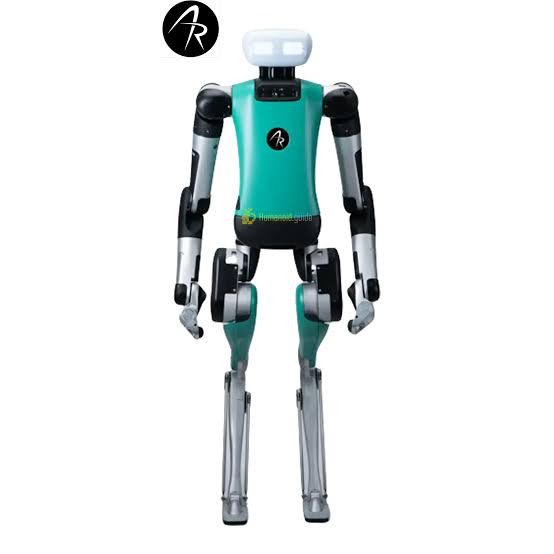
Meanwhile, Agility’s R&D investment has reached a high level. In 2025, R&D expenses exceeded $90 million, with a net loss of $138 million for the year. High R&D investment is not unexpected for humanoid robot companies still in the early stages of product scaling, but Agility’s real pressure lies in its ability to quickly transition from technological R&D to large-scale commercial delivery while maintaining high investment.
As of the end of 2025, the company’s cash and cash equivalents were approximately $103 million. This means that if R&D, manufacturing, and operational investments continue at high levels, the company will need to continuously secure new funding.
Therefore, this IPO is primarily a race for cash reserves for Agility. The expected transaction amount of over $620 million will provide greater financial resources for Digit v5 mass production, customer order fulfillment, and subsequent R&D.
But this is only the first step.
Agility’s real challenge is not how to obtain more funds, but how to utilize these funds to scale up commercialization.
2. Can the $300 Million Orders Truly Convert into Revenue?
If the financial data reflects the pressure Agility faces, then orders are currently the company’s most important commercial support.
The company disclosed that as of May 2026, it has secured multi-year Digit v5 orders exceeding $300 million, involving approximately 1,000 robots and a three-year RaaS contract. Simultaneously, Digit has entered actual working environments such as manufacturing, logistics, and warehousing, with customers including GXO, Schaeffler, and Toyota Motor Manufacturing Canada.
This means Agility has crossed a crucial hurdle in the early stages of humanoid robot commercialization: customers are starting to actually pay for the robots and are willing to sign multi-year commercial contracts.
However, for Agility, the question has now shifted from “whether there are customers” to “whether delivery is possible.”
Because a $300 million order does not equal $300 million in revenue. Multi-year orders represent future contract value, which only becomes apparent on the company’s financial statements after production, delivery, deployment, and revenue recognition according to contract terms.
Therefore, Agility needs to prove whether orders can consistently translate into actual shipments.
If customers can gradually scale from dozens of pilot units to hundreds or even thousands, Digit has the opportunity to move from a project-based product to a large-scale product. As deployments increase, RaaS revenue will further grow and is expected to become a more stable and recurring source of income.
Conversely, if orders remain at the contract level for a long time, while production and delivery are slow, then the improvement to the company’s cash flow from huge orders will be very limited.
Therefore, the first key turning point in Agility’s commercialization is not breaking the $300 million order mark, but rather: whether the orders can truly translate into robots.
3. Can $620 Million in Funding Lead to Mass Production?
After securing orders, Agility’s next challenge is whether it can mass-produce and deliver the robots to customers.
This is the very reason for RoboFab’s existence.
Agility’s RoboFab factory in Salem, Oregon, is designed to produce 10,000 Digit robots annually. This means the company has begun building manufacturing capabilities to meet future large-scale market demand, rather than remaining in the small-batch production and R&D verification phase.
However, it’s important to note that 10,000 designed units does not equate to 10,000 actual shipments.
From designed capacity to actual revenue, there are multiple stages involved, including capacity ramp-up, supply chain issues, production yield, customer deployment, and revenue recognition. If order growth is insufficient or production ramp-up is slower than expected, large-scale manufacturing facilities could actually increase the company’s fixed costs and cash flow pressure.
Therefore, what RoboFab truly needs to verify is: can Agility utilize the additional funding to improve capacity utilization and reduce the manufacturing cost per robot through mass production?
This is the true value of the over $620 million in funding.
If orders continue to grow and RoboFab gradually increases production, Agility could achieve economies of scale: lower manufacturing costs, improved gross margins, and optimized unit economics, thereby reducing cash burn.
Conversely, if order growth and actual deliveries cannot keep pace with capacity expansion, the funds raised may be consumed more by R&D, personnel, and manufacturing infrastructure than transformed into robot assets that can generate sustainable revenue.
Therefore, the key after the IPO is not “how much money Agility has,” but rather: can this money be converted into more robots, higher revenue, and better gross margins?
4. How far is Agility from profitability?
This is probably the question the capital market will ultimately care about most.
From the current situation, Agility is still significantly far from true profitability. In 2025, the company’s revenue will only be in the millions of dollars, while R&D and operational investments will already reach hundreds of millions of dollars. Even if all $300 million in multi-year orders are successfully executed, the company will still need to go through a process from small-scale delivery to large-scale deployment.
Therefore, instead of simply predicting “which year Agility will be profitable,” it’s better to observe three more direct indicators.
The first is actual delivery volume. Whether Agility can consistently convert its approximately 1,000 Digit v5 orders into actual deployments will determine whether revenue growth can truly accelerate. For companies still in the early stages of commercialization, shipment volume is more important than order value.
The second is the unit economic model. As production scales up, whether robot manufacturing costs can decrease, and whether RaaS revenue can cover manufacturing, maintenance, software, and field operation costs, will determine whether Agility can move from “revenue growth” to “gross profit improvement.”
The third is the rate of cash burn. If revenue growth gradually outpaces cost growth, cash burn should begin to decline; if the company’s revenue growth still cannot cover high R&D and operating expenses, then even with over $600 million in funding this time, further financing may be necessary in the future.
These three indicators actually constitute a very clear path to profitability: Increased delivery volume → Revenue growth → Improved unit economic model → Improved gross profit margin → Decreased cash burn → Profitability.
From this perspective, Agility is not yet on the verge of profitability, but has just obtained its “ticket” to profitability.
A pre-money valuation of $2.5 billion reflects the capital market’s expectations for Digit’s future commercialization potential; multi-year orders exceeding $300 million demonstrate that real market demand has begun to emerge; and over $600 million in funding provides Agility with a funding window for continued expansion.
However, all these conditions ultimately hinge on one outcome: whether Digit can become a sustainably profitable business.
If Agility can rapidly increase delivery volumes, improve the economic model per robot, and gradually reduce cash burn as revenue grows, then this IPO could be a crucial turning point in its transformation from a technology company to a large-scale commercial enterprise.
Conversely, if orders cannot be quickly converted into deliveries, and manufacturing costs and R&D investment remain high, then the IPO will likely only extend the company’s cash runway.