On August 21, the Stock Exchange of Hong Kong (HKEX) adjusted the validity period for new listing applications. According to the HKEX announcement, under certain conditions and safeguards, the validity period for eligible new listing applications will be extended from six months to 12 months. This arrangement will be implemented from August 21, 2026, for a period of three years, ending on August 20, 2029.
This change may seem like just a time adjustment in the listing process, but it is significant for robotics companies currently in an accelerated capitalization phase.
Previously, after submitting an A1 listing application, if a company failed to complete the hearing and subsequent listing process within the six-month validity period, the application might lapse, requiring the company to resubmit the application and update its financial, legal, and other relevant information. With the increasing number of IPO applications and longer waiting periods in recent years, “filing—lapse—refiling” has become an unavoidable problem for some companies.
The extension of the validity period to 12 months effectively provides eligible companies with a more ample window of opportunity for listing.
Robotics companies are enjoying a more flexible timeline for listing
The robotics industry is characterized by long technology verification cycles, slow commercialization ramp-up, and complex supply chains. From product development to large-scale delivery, and then to revenue growth and business model maturity, a considerable period is often required.
Therefore, compared to traditional industries, robotics companies are more susceptible to time constraints during the IPO process.
This rule adjustment mainly brings three impacts:
First, a more flexible listing pace.Companies have more time to cope with reviews, hearings, and changes in market windows, reducing the pressure of being forced to resubmit their applications due to insufficient time.
Second, reduced costs of repeated filings. Refiling after it expires often means that financial data, legal documents, and related due diligence work need to be updated. Extending the validity period helps reduce redundant investment by companies and intermediaries.
Third, better continuity in the listing process. For robotics companies still in a rapid development phase, a longer application period can reduce repeated adjustments caused by time pressure.
However, it should be noted that this adjustment does not mean a lowering of the IPO review threshold in Hong Kong. Companies still need to meet the relevant listing requirements of the HKEX and continue to be subject to audits regarding finance, compliance, business model, and investor protection.
In other words, the HKEX is addressing the issue of companies “not having enough time,” rather than lowering the threshold for companies “to be listed.”
Over 40 robotics companies are aiming for Hong Kong listings
Behind the HKEX’s rule adjustments lies the increasingly strong demand for capitalization within the robotics industry.
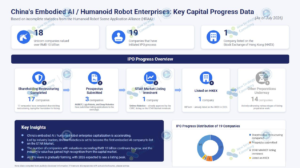
According to statistics compiled by China Mobile Robot Industry Alliance (CMRA) and the New Strategy Mobile Robot Industry Research Institute (NSRI) based on publicly disclosed information from the HKEX, as of August 25, 2026, a total of 37 robot manufacturers were queuing for listing, and another 8 companies had announced clear plans to list in Hong Kong.
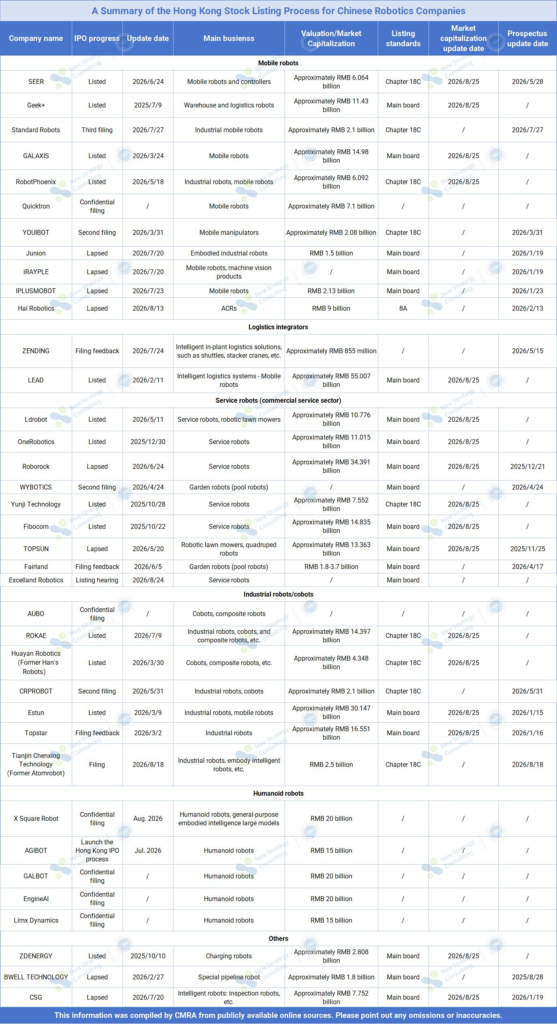
This means that currently, over 40 robotics companies are actively pursuing Hong Kong IPOs.
From the perspective of the listing process, robotics capitalization has already covered multiple sub-sectors.
Mobile robots are currently a relatively mature area. Companies such as Geek+, GALAXIS, SEER, and RobotPhoenix have already entered the capital market or completed the listing process; companies such as Standard Robots, YOUIBOT, and Quicktron are also pushing forward with their listing plans.
Some companies previously experienced lapsed IPO applications. For example, Standard Robots refiled due to expiration, and the listing filings of companies like Hai Robotics, Junion, iRAYPLE, and IPLUSMOBOT also had lapsed. With the new regulations, these companies are expected to have a more ample window for listing.
Industrial robots and cobots are also accelerating their capitalization. Companies like Estun, ROKAE, Huayan Robotics, and LEAD have already entered the capital market, and related companies in the industry chain are actively pursuing listing plans.
Service robots have become another important IPO track. Companies like Yunji Technology,Ldrobot, and OneRobotics have completed their listings, Excelland Robotics has entered the hearing stage, and other companies are also preparing for listing.
In the rapidly growing field of humanoid robots and embodied AI over the past year, capitalization expectations have further intensified.
Companies such as X Square Robot, AGIBOT, GALBOT, EngineAI, and Limx Dynamics have all attracted market attention and are reportedly preparing for Hong Kong stock listings. Meanwhile, companies such as Galaxea AI, NARWAL, Pudu Robotics, PaXini, Robotera, AI2 Robotics, COOWA, and DEXFORCE have also been included in the list of potential IPO candidates.
The robotics IPO market enters a stage of “multi-track development”
From mobile robots to industrial robots, and then to service robots and humanoid robots, the capitalization paths of Chinese robotics companies are significantly broadening.
Early robotics IPOs mainly focused on areas such as industrial robots and mobile robots that had already achieved commercialization validation; now, with the rapid development of embodied AI and humanoid robots, a new batch of high-growth companies are also entering the capital market’s field of vision.
This means that the listing logic of the robotics industry is changing:
From “mature companies listing” to “multi-track, multi-stage companies simultaneously capitalizing.”
On the one hand, companies that have already achieved stable revenue and large-scale delivery capabilities are seeking long-term capital through IPOs; on the other hand, leading companies in emerging tracks such as humanoid robots are also beginning to proactively position themselves in the capital market.
For robotics companies, the importance of the capital market is also extending beyond a simple financing tool to include R&D investment, capacity expansion, supply chain integration, and globalization.
The Hong Kong IPO boom for robotics companies enters a critical stage
The HKEX has extended the validity period for eligible new listing filings from 6 months to 12 months, providing robotics companies with a more ample window for listing.
With over 40 robotics companies currently vying for Hong Kong IPOs, the robotics industry is experiencing a wave of capitalization covering mobile robots, industrial robots, service robots, and humanoid robots.
It is foreseeable that as more robotics companies complete commercialization validation, revenue growth, and capital market preparations, the number of Hong Kong-listed robotics companies is likely to increase further.
For robotics companies pursuing IPOs, the new regulations reduce “time anxiety” during the listing process; what truly determines whether a company can ultimately enter the capital market remains its commercialization capabilities, core technologies, market competitiveness, and sustainable growth potential.
This competition among robotics companies for Hong Kong IPOs may have only just entered a crucial stage.