Boston Dynamics has emerged as one of the clearest beneficiaries of the market’s growing appetite for humanoid robots and “physical AI”, with its valuation rising nearly 20-fold to around $20bn in recent private market transactions, according to the Korea Herald.
The sharp repricing places the robotics group—long known for its engineering prowess but limited commercial scale—at the centre of a broader investor rotation into technologies that extend artificial intelligence beyond software and into the physical world.
A Re-rating Driving by Humanoid Expectations
For much of its history, Boston Dynamics occupied an ambiguous position in the technology landscape: admired for its cutting-edge robotics, yet often viewed as a costly research platform with uncertain paths to profitability.
That perception is now shifting, driven in large part by rising expectations around humanoid robots as a potential general-purpose labour solution. Advances in large-scale AI models and embodied intelligence are prompting investors to reconsider whether such systems could eventually operate across logistics, manufacturing and service environments.
“Physical AI” — a term gaining traction across the industry — reflects the idea that value will increasingly accrue to systems capable not only of processing information, but of executing tasks in real-world environments. Humanoid robots are widely seen as the most direct expression of that vision.
Strategic Ownership, Limited Disclusure
Since its acquisition by Hyundai Motor Group in 2021, Boston Dynamics has pursued a more commercial strategy, focusing on industrial applications for its Spot inspection robot and Stretch warehouse system.
At the same time, its humanoid platform Atlas has re-emerged as a focal point for future growth, particularly as the company explores use cases that extend beyond fixed-function machines toward more flexible, task-adaptive systems.
However, like many privately held robotics companies, it discloses little financial detail, making it difficult to assess whether revenue growth is keeping pace with rising expectations.
IPO Prospects – and Constraints
Market participants increasingly view Boston Dynamics as a potential listing candidate within the next several years, with 2027 often cited as a potential timeline.
Yet a successful flotation would likely depend on more than narrative momentum. Investors are expected to demand clearer visibility on margins, unit economics and repeatable demand—areas where humanoid robotics, in particular, remains at an early stage of commercialisation.
A Crowded Race to Build General-Purpose Robots
Competition is intensifying as a new generation of humanoid robotics companies—including Agility Robotics, Apptronik and Figure AI—moves quickly to commercialise general-purpose systems.
At the same time, Chinese robotics groups such as UBTECH Robotics and Unitree Robotics are accelerating development, leveraging strong domestic supply chains and increasing policy support to push humanoid platforms toward industrial deployment.
Unlike earlier industrial robots designed for specific tasks, these next-generation systems aim to replicate human versatility, raising the prospect of deployment across a wide range of labour-intensive industries.
The growing presence of both US and Chinese players is compressing development timelines and intensifying competition, while also highlighting diverging approaches to commercialisation—ranging from enterprise-led deployment models to faster iteration cycles driven by hardware cost advantages.
Platform Support, but Focus on Real-World Capability
Recent developments at NVIDIA GTC 2026 have reinforced the broader industry direction, with NVIDIA outlining tools and infrastructure to support robotics development.
More notably, Boston Dynamics has used recent industry events to demonstrate that its humanoid robot is moving beyond the prototype stage.
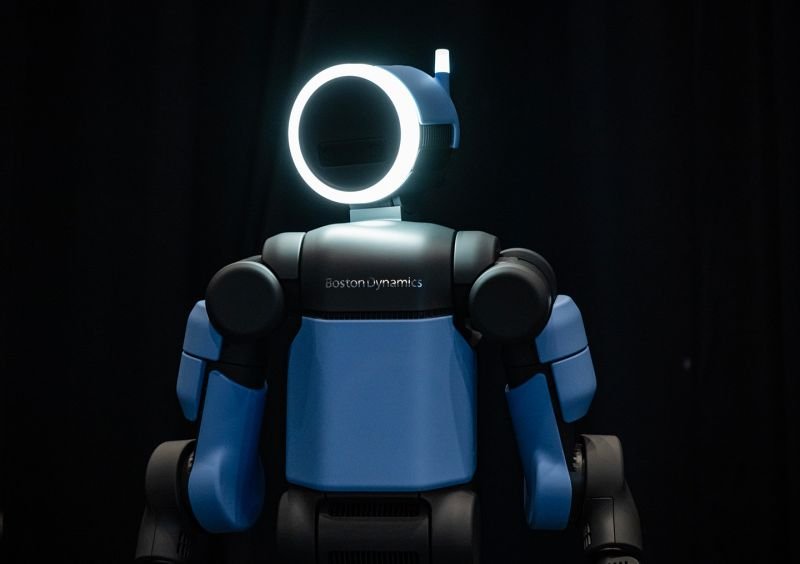
Its latest Atlas robot—now a fully electric, production-oriented system—has been showcased performing basic industrial tasks such as material handling, component sequencing and workplace navigation, while also demonstrating stable bipedal mobility and human-like motion in live settings.
The company has also indicated that Atlas is being designed for real-world deployment in manufacturing environments, including automotive assembly, marking a shift from experimental robotics toward commercially viable humanoid systems.
For investors, the significance lies less in the enabling tools and more in whether such demonstrations can translate into reliable, repeatable performance at scale.
From Narrative to Numbers
Boston Dynamics’ rising valuation underscores a familiar dynamic in emerging technology cycles: capital tends to move ahead of proven business models.
For humanoid robots, the central challenge is shifting from technical demonstration to economic viability—whether such systems can be produced, deployed and maintained at costs that justify widespread adoption.
Outlook
The company’s trajectory reflects a broader inflection point in the AI economy. As advances in software begin to intersect with physical systems, humanoid robots are being positioned as a potential cornerstone of future industrial automation.
Whether Boston Dynamics can convert that positioning into durable financial performance will determine if its current valuation marks the beginning of a sustained growth story—or the early stages of another cycle of inflated expectations.