Capital is concentrating at the top, EU and US rules are raising barriers, and Chinese players are moving from exports to global operations.
In 2026, divergence in the yard robotics sector is intensifying. Capital is concentrating at the top, while some mid-tier and smaller companies are entering liquidation or restructuring. The EU and US are raising barriers for foreign robotic products through trade investigations and market-access rules. For China, the core of global competition is shifting from “can the product be sold?” to “can the business operate sustainably within the rules?”
Capital Divergence: Funding and IPOs Concentrate at the Top
In the robot mower market, capital remains active. As of September 22, 2026, nearly RMB 1.6 billion in financing had been deployed in the sector. Sunseeker raised nearly RMB 500 million in Series B, and Yarbo raised about RMB 200 million in Series B+. Most other deals were in the tens of millions of RMB range. In May, Yarbo, AIRSEEKERS, LDRobot, and LYMOW completed financing; in August, PANDAG and XCANBOT each raised tens of millions of RMB.
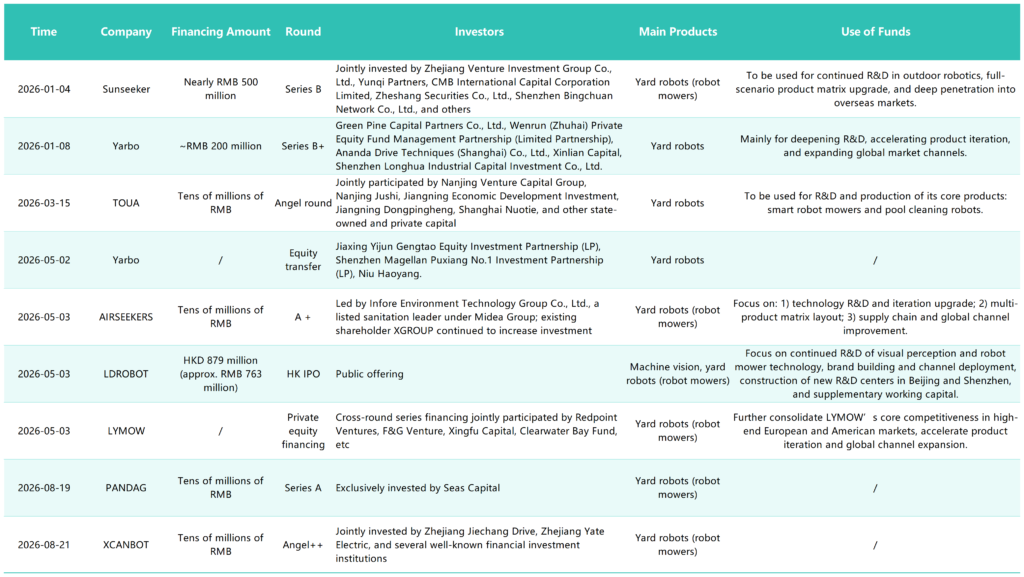
Chart: Robot Mower Financing at a Glance (As of September 23, 2026)
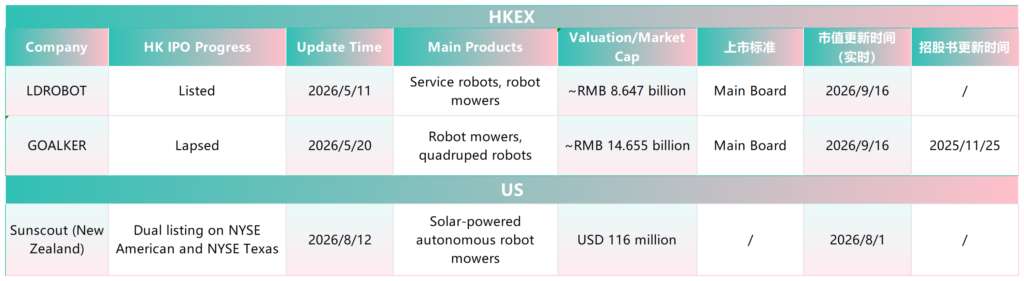
Chart: Robot Mower IPO Landscape at a Glance
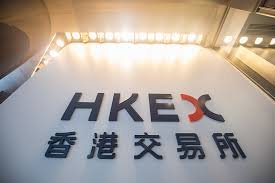
On the public market, LDRobot listed on HKEX in May, with its market value exceeding HKD 20 billion. New Zealand-based Sunscout completed a dual listing on NYSE American and NYSE Texas in August. In pool cleaning robots, WYBOTICS and FAIRLAND filed for Hong Kong listings, while SUBLUE’s STAR Market IPO entered review. Leading companies are expanding market share through scale manufacturing, overseas channel resources, and brand influence.
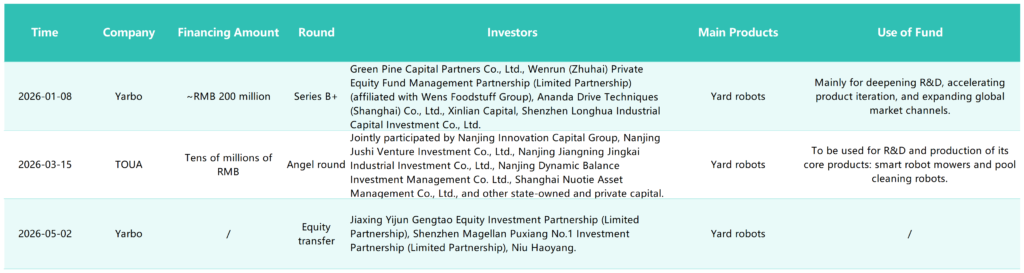
Chart: Pool Cleaning Robot Financing at a Glance (As of September 23, 2026)
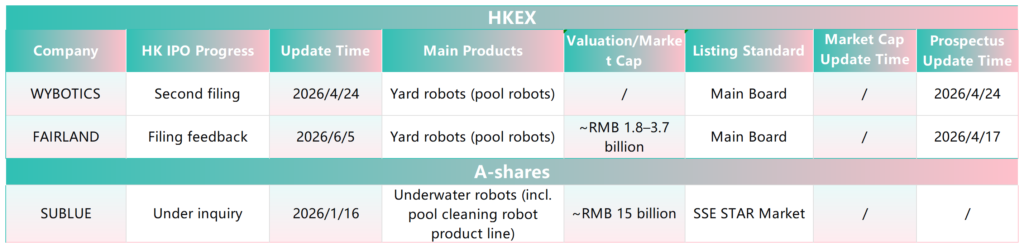
Chart: Pool Cleaning Robot IPO Landscape at a Glance
But market attention does not mean all companies can survive the cycle. UK-based Kingdom Technologies liquidated earlier this year; iRobot shut down its robot mower business in 2025; some early-stage Chinese companies exited the market; and SMOROBOT (Zhicheng Power) was subject to a bankruptcy restructuring application by creditors. Capital is shifting from broad bets to selective bets.
How Chinese Competitiveness Is Evolving?
Judging from 2026 financing and IPO cases, Chinese companies’ competitiveness is expanding from single-product advantages to technology, supply chain, capital, and compliance.
On technology, routes such as visual navigation, boundary-free positioning, and solar-powered mowing have achieved scale export capability.
On supply chain, On supply chain, Sunseeker and Yarbo are directing their funding primarily toward R&D, product iteration, and overseas market expansion; AIRSEEKERS is further developing core technology upgrades, product matrix improvement, and a global supply chain.
On capitalisation, multiple companies are advancing listings, with proceeds directed to R&D, capacity, and overseas channels.
On compliance, leading companies are adjusting overseas capacity and preparing relevant data.
Overseas Regulatory Variables: EU Anti-Dumping and US FCC Rules
On November 19, 2025, the EU launched an anti-dumping investigation into Chinese robot mowers. On June 19, 2026, it decided not to impose provisional anti-dumping measures, but the investigation continues and the final ruling remains uncertain. On July 28, 2026, the US FCC added foreign-produced “advanced robotic devices” to its covered list; some Husqvarna robot mowers received conditional approval.
Leading companies face higher operating costs, but this may reinforce industry concentration; SMEs face pressure from tariffs, certification, and local operations.
Strengthening Global Operational Capability Will Be the Goal of Chinese Companies
For overseas integrators and end users, the competitiveness of Chinese yard robotics suppliers is diverging. Companies with overseas production capacity, compliance capabilities, and global channel systems are more likely to maintain stable supply and after-sales support in a tightening regulatory environment.
When selecting suppliers, beyond product performance and price, supply chain resilience, compliance readiness, and localisation capabilities are becoming increasingly important evaluation dimensions. Chinese yard robotics companies are moving from “product exports” to “global operations”—a trend that presents both choices and opportunities for overseas buyers.
The next stage of competition is no longer just about technology routes and product capabilities, but a contest around global operational capability. Companies that can build a stable supply chain, improve their overseas footprint, and maintain long-term compliance are more likely to remain in the global market.