In the first half of 2026, the mobile robot industry avoided a vicious cycle of cutthroat competition and instead elevated the rivalry from price wars to a new dimension focused on scenario-specific capabilities through intensive product innovation.
According to incomplete statistics compiled by China Mobile Robot Industry Alliance (CMRA) and the New Strategy Mobile Robot Industry Research Institute (NSRI) based on publicly disclosed new product information from various companies, the mobile robot manufacturers at home and abroad launched a total of 96 products in the first half of 2026, a nearly 60% increase from the 60 products released during the same period in 2025, which indicates that an average of more than three new mobile robot products were introduced each week, showing that market enthusiasm has not only persisted but has further accelerated amid the wave of embodied intelligence.
A Sprint: The “Race” Behind 96 New Products
In the first half of 2026, mobile robot companies at home and abroad collectively launched 96 products, among which Chinese companies contributed 78 models, accounting for as high as 81.25%, while foreign companies released only 18 models, representing 18.75%. This trend not only reinforces China’s dominant position in innovation and iteration within the market but also accelerates further compared to the 74% domestic share recorded in the first three quarters of 2025, which reflects China’s highly comprehensive robotics supply chain system and the exceptional sensitivity of local enterprises to specific application scenarios.
In stark contrast to China’s fast-paced approach of “rushing ahead with full-scenario coverage,” international companies maintain a more restrained and focused strategy in launching new products. Their 18 new releases primarily address gaps in specific high-end scenarios, emphasizing system stability improvements and targeted micro-innovations.
This difference in approach precisely demonstrates that, in the current global context, China is not only the largest market for mobile robot applications but has also become a substantive “cradle” for innovation in mobile robot product designs worldwide.
However, this “race” was not evenly distributed across months. Monthly trends show slight variations in new product launches during the first half of the year: 7 products in January, 7 in February, 12 in March, 22 in April, 11 in May, and 37 in June.
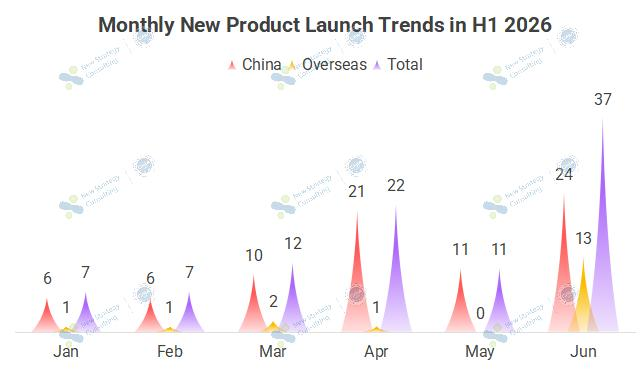
April and June emerged as the two most concentrated “release windows” in the first half of the year, with a total of 59 products launched during these two months, accounting for 61.5% of the annual total; June alone contributed 37 products, representing nearly 40% of the total.
This concentrated surge was no accident. In late June, Automate 2026, the largest automation exhibition in North America, was held in Chicago, where U.S. companies such as Mantis Robotics, Robot.com, and Big Joe Autonomous Solutions all chose to showcase their products during the event. Meanwhile, China also saw a flurry of exhibitions in June, with EP Equipment lone unveiling nearly 10 new products during 629 event.
Composite Products Overtaking Unmanned Forklifts, the Track Is Filled with Wheeled Humanoid Robots
In the first half of 2026, among newly launched mobile robot products domestically and internationally, composite products led the list with 41 models (42.7%); unmanned forklifts followed closely with 30 models (31.3%); heavy-duty models and ACRs accounted for 3.1% and 4.2%, respectively, while other categories combined accounted for 18.8%.
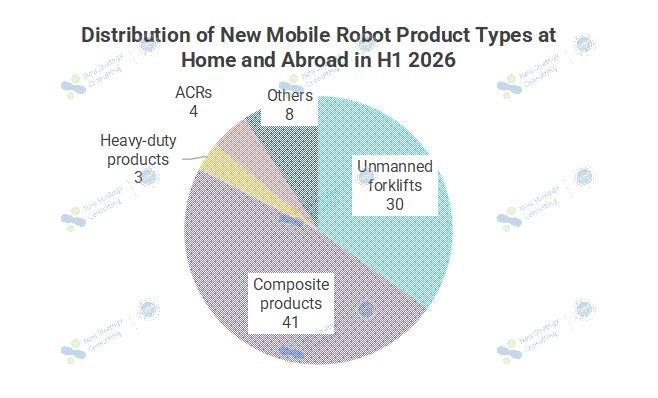
The surge in composite product offerings is primarily driven by the wheeled humanoid robot segment. In the first half of the year, 33 new products were launched in this category, accounting for 80.5% of all composite products and 34.3% of all new releases. Notably, these launches came from a highly diverse range of entities: specialized humanoid robot manufacturers (such as GALBOT, AGIBOT, UniX AI, and Unitree), players in the traditional mobile robotics sector (like Geek+, YOUIBOT, and EP Equipment), as well as cross-industry companies such as China Mobile and Faraday Future. This diversity of participants not only highlights the appeal of this market segment but also significantly influences product design trends.
Currently, most new composite products focus pragmatically on enhancing the mobility efficiency of wheeled chassis and the practical operational capabilities of dual-arm systems, targeting core industrial needs such as material handling, inspection, distribution, and loading/unloading. Meanwhile, some companies are moving beyond the traditional “wheeled chassis + robotic arm” paradigm; for instance, EP Equipment’s newly launched arm-shaped robot demonstrates another possibility for morphological innovation, indicating that the boundaries of composite products continue to expand.
Despite the rapid growth of composite handling solutions, unmanned forklifts, the backbone of industrial material handling, continue to maintain a strong pace of product innovation. In the first half of the year, their product segmentation has deepened significantly, with a diverse range of models emerging, including latent,, high reach, side loader, stacker, and counterbalanced variants, covering various warehousing scenarios from short-distance handling to high-altitude stacking. Representative products such as Filics’ new-generation Filics Unit, Hefei MiMA’s reach forklift, Beacon Robot’s latent intelligent handling forklift, EP’s dual-sided fork narrow aisle stacker robot, and its 1.6-ton indoor reach forklift collectively define the competitive landscape of this sector.
Beyond composite products and unmanned forklifts, heavy-duty models and ACRs have established a solid foothold in their respective market niches. The heavy-duty category includes products such as Hangzhou Haosheng’s high-speed heavy-duty AGV, Hefei MiMa’s 6-ton dual-drive oscillating axle AGV ME60, and Burro’s Grande 44; the ACRs feature exemplars like Brightpick Gridpicker and Cainiao’s climbing robot ZeeBot, each precisely tailored to meet diverse warehouse operation requirements.
Other product categories, accounting for approximately 18.8%, further refine this strategy of deep market segmentation into even more specific segments, covering areas such as inspection robots and construction robots. For example, the intelligent spraying robot developed by Siasun in collaboration with China MCC 5 Group directly targets the construction industry, a traditional sector characterized by non-standardized processes and heavy physical demands; while ExRobotics’ ExR-2.5 inspection robot is designed for complex terrain environments. These products generally adhere to a “specialized-purpose” approach, establishing strong customer loyalty and irreplaceability within their respective niche markets, collectively forming the industry’s long-tail base.
Conclusion
Based on the deployment scenarios of new products in the first half of 2026, traditional industrial sectors such as manufacturing and warehousing remain the core applications, but technological advancements are breaking down conventional application boundaries. With the emergence of novel robot types like wheeled humanoid robots and arm-shaped robots, mobile robots are rapidly evolving from mere physical handling to performing intelligent operations, while emerging scenarios like inspection and delivery are becoming key battlegrounds for competition.
Overall, the number of new products in the first half of this year surged significantly compared to the same period last year, with a wide variety of product forms. Moving forward, the industry will continue its trends toward embodiment and diversification: while deepening its presence in traditional industrial applications, the technological implementation in emerging scenarios will become a new growth driver, propelling mobile robotics toward coordinated development across multiple application domains.
Sino-Japan Smart Logistics Exchange Conference for Mobile Robotics and Humanoid Robotics will be held in Tokyo Japan on September 9. The event will feature the global premiere of the Global Mobile Robot Industry Development Report 2026, in-depth analysis of Chinese and Japanese smart logistics markets, showcases of innovative Chinese robotics technologies, expert roundtable discussions, and targeted matchmaking opportunities to foster Sino-Japan collaboration and unlock new business opportunities in smart logistics. Welcome to join us!
For details, visit https://cnmra.com/sino-japan-smart-logistics-exchange-conference-for-mobile-robotics-and-humanoid-robotics/.
For registration, visit https://luma.com/mzepuhg8.