In the evening of May 19, another significant industrial M&A case emerged in China’s industrial humanoid robot sector. Hangzhou Kelin Electric Co., Ltd., a leading Chinese company in intelligent power operation and maintenance, announced an equity acquisition, stating its intention to acquire a 41.57% stake in Shanghai Kepler Robot Co., Ltd. from Hua Yang and other shareholders using no more than 300 million yuan of its own funds. Prior to this transaction, Kelin Electric already held a 9.43% stake in Kepler Robot. After the transaction, its total shareholding will rise to 51%, officially achieving controlling ownership, and Kepler Robot will become a subsidiary within its consolidated financial statements.
This cross-industry M&A is not simply a capital investment, but a deep industrial integration between the power industry and the humanoid robot sector. For the humanoid robot industry, this transaction is of landmark significance: on the one hand, the high-quality scenario resources of the traditional power industry are officially opened to industrial-grade humanoid robots; on the other hand, the capital logic in the sector continues to evolve, with industrial capital-led integration and vertical scenario-driven implementation becoming the mainstream trend in the industry, signaling that China’s humanoid robot industry has completely moved beyond its period of unregulated technological growth and entered a new cycle of scenario commercialization, industrial scaling, and resource integration.
- The target Company Focuses on Heavy-Duty Industrial Sector, Differentiating itself in Practical Operational Robots
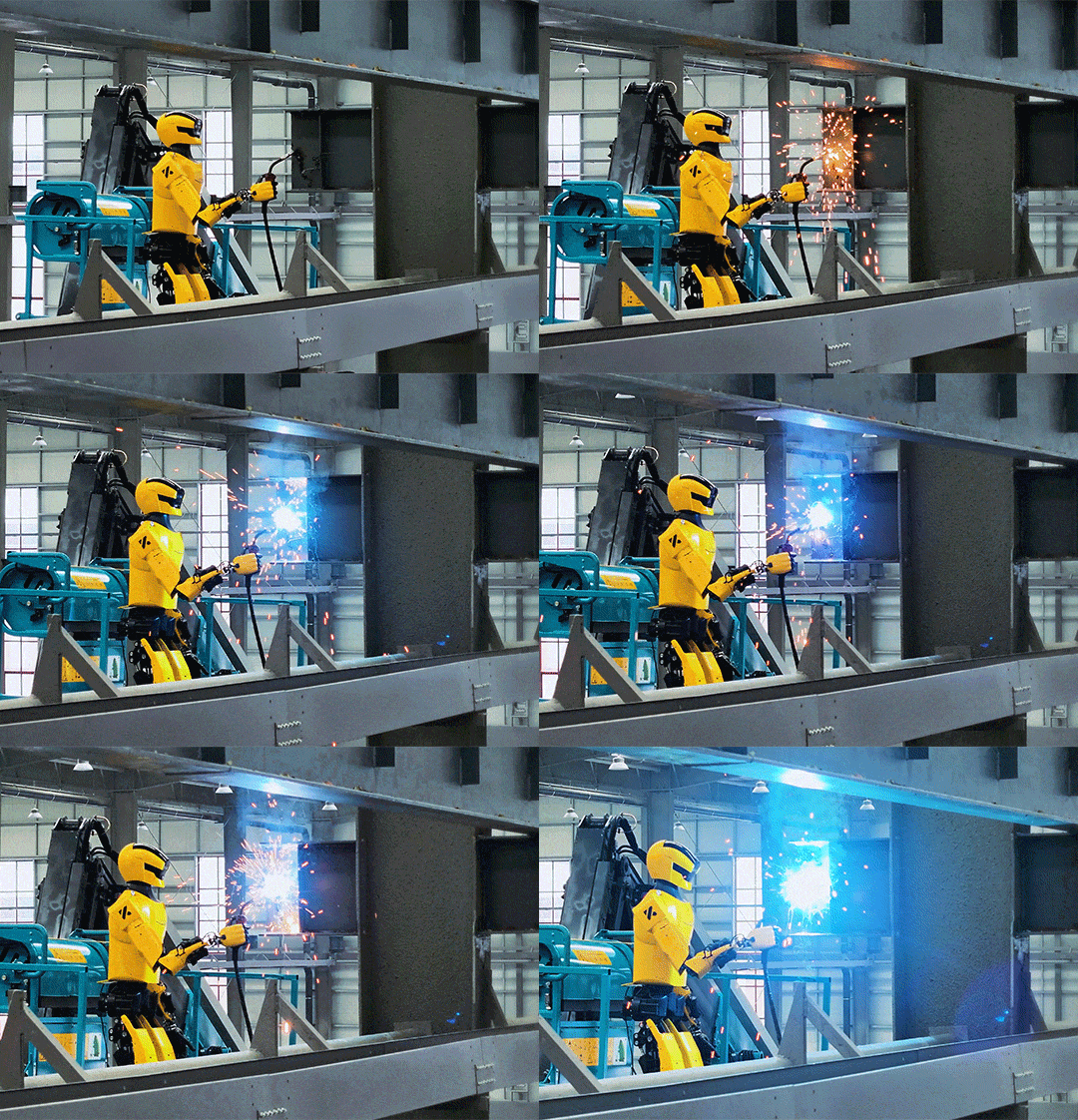
The target company in this acquisition, Kepler Robot, is a leading Chinese enterprise specializing in industrial-grade heavy-duty humanoid robots. Unlike the homogenized models in the industry that primarily focus on demonstration and exhibition purposes, Kepler precisely targets core industrial operation scenarios, pursuing a practical and engineering-oriented approach.
Technologically, Kepler Robot possesses a full stack of independent core technologies, including self-developed high-power-density actuators, multi-sensor fusion perception algorithms, and an embodied intelligent decision-making control system, building a complete technological barrier for humanoid robots. In terms of products, the company focuses on essential industrial scenarios such as high-risk operations, precision manufacturing, and high-altitude maintenance, forming a differentiated competitive advantage in overall load capacity, continuous battery life, and adaptability to complex on-site operations. It avoids the fierce competition in the consumer and exhibition robot market, deeply cultivating the high-value industrial application sector and possessing mature on-site deployment and engineering adaptation capabilities.
The acquiring company, Kelin Electric, is a specialized and innovative enterprise in the field of intelligent power operation and maintenance. It has long been deeply involved in core businesses such as power equipment condition monitoring and intelligent power grid operation and maintenance, accumulating mature digital operation and maintenance technologies, a comprehensive customer channel in the power industry, and extensive experience in engineering implementation. With its traditional power business stabilizing, the company is targeting the emerging intelligent industry, leveraging its vertical industry resources to enter the industrial robot sector, seeking a second growth curve, and laying a solid industrial foundation for this cross-industry acquisition.
- Deep Integration of Power and Robotics: Solving Industry Operation and Maintenance Pain Points
From the perspective of industrial synergy, this acquisition is a typical example of high-quality scenarios and core technologies mutually empowering each other. The power industry has become an excellent vertical testing ground and commercialization site for industrial humanoid robots.
The power industry has long faced numerous essential operational scenarios such as high-altitude inspections, live-line work, equipment monitoring, and high-risk operation and maintenance. The industry’s pain points are prominent: high safety risks associated with manual high-risk operations, rising labor costs for frontline workers year by year, difficulty in unmanned operation and management, and insufficient all-weather operation capabilities in extreme environments. Industrial humanoid robots, with their anthropomorphic working posture, strong environmental adaptability, and high-intensity continuous operation capability, can accurately replace human labor in dangerous, repetitive, and high-intensity maintenance work, perfectly meeting the needs of intelligent power grid upgrades.
The collaboration path between the two parties is clear: On the product side, they will jointly develop power grid-specific inspection humanoid robots and high-altitude special operation robots, customizing them to adapt to the special operating environment of the power grid; on the technology side, they will integrate power sensing and monitoring technologies with embodied intelligent motion control and visual force control algorithms to complete the entire intelligent equipment technology chain; on the market side, they will share mature channels in the power industry to accelerate the penetration and application of robot products in real economy scenarios such as power, new energy, and high-end manufacturing. This integration will significantly reduce safety hazards in power grid operation and maintenance, and promote the comprehensive transformation of power operation and maintenance towards digitalization, unmanned operation, and intelligence.
- Restructuring of the Track Logic: From Technology Demonstration to Commercial Implementation, Industrial Capital Leads the Integration
From the perspective of industry development trends, this merger and acquisition is a typical microcosm of the shift in the logic of the humanoid robot track in 2026. Previously, the humanoid robot industry in China largely focused on laboratory technology research and development and exhibition prototype demonstrations, emphasizing concepts over practical application. Now, the focus has shifted entirely, with industrial vertical scenarios becoming the main battleground for commercial breakthroughs.
Compared to consumer scenarios, industrial scenarios offer advantages such as clear demand, strong willingness to pay, clear implementation standards, and rapid iteration feedback, providing a stable commercial revenue channel for humanoid robots. Simultaneously, the industry’s capital structure has undergone significant changes, with industrial capital gradually replacing purely financial capital as the core investment entity. Listed companies and leading companies in the real economy are accelerating their entry into the robotics sector.
The dimensions of industry competition have also upgraded. Simple technical parameters and prototype demonstrations are no longer sufficient to build competitive barriers. Mass production capabilities, supply chain integration levels, depth of cultivation in vertical scenarios, and commercialization efficiency have become the core competitiveness of enterprises. Collaborative empowerment, industry integration, and pragmatic implementation have become the main themes of the industry. Inferior demonstration models are being rapidly eliminated, and industrial-grade humanoid robots with real operational capabilities are entering a development window.
- Deep Cultivation of Vertical Scenarios: Defining the Long-Term Development Logic of the Industry
A senior industry analyst stated that the humanoid robot and embodied AI industries have moved beyond extensive growth, and single technological advantages no longer provide long-term competitiveness. Future competition will be a comprehensive contest of strength in scenarios, technology, manufacturing, supply chain, and market resources. Leveraging high-quality vertical industry scenarios to achieve technological iteration and commercialization is the core path for the industry’s long-term development.
Kelin Electric’s acquisition of Kepler Robot is a typical example of the real economy embracing the wave of embodied AI. As artificial intelligence continues to empower traditional industries, industrial humanoid robots that integrate customized needs from vertical industries will accelerate their large-scale adoption. In the future, cross-industry integrated enterprises with scenario resources, core technologies, and industrial operation capabilities will continue to seize opportunities in the intelligent equipment industry and continuously explore incremental space for the intelligent upgrading of traditional industries.
From the perspective of industry development, this cross-industry deployment of power companies in industrial humanoid robots not only builds new growth advantages for both companies but also provides a model for industrial integration in the China’s embodied AI industry. With the entry and support of more real-economy industries, humanoid robots will break free from the predicament of technological stagnation and take root in various industrial vertical scenarios, propelling the robot industry in China towards a new stage of high-quality, large-scale, and commercial development.
Conclusion:
The ultimate track for humanoid robots has never been stage performances, but rather practical industrial application. Large-scale deployment in high-risk power maintenance scenarios will become a crucial breakthrough for the commercialization of industrial humanoid robots. The combination of industrial capital, vertical scenarios, and core technologies will also become the mainstream development paradigm in the future.
From May 21 to 22, 2026, the Second Global Unmanned Forklift Application Scenario Competition & the Material Handling and Sorting Challenge for Embodied Wheeled Humanoid Robots 2026 will be held in Hangzhou by China Mobile Robot Industry Alliance (CMRA) and Humanoid Robot Scene Application Alliance (HRAA) Building upon the existing unmanned forklift category, this event introduces a dedicated wheeled humanoid robot track for the first time, addressing the industry’s practical needs for embodied intelligence applications and further bridging technological innovation with industrial implementation.